TRENDEFRARAtlas of the Sultans · Ottoman monuments
Tomb of Mahmud II
Monument · Mausoleum, Istanbul, 1839–1840
- Type
- Mausoleum (türbe)
- Built
- 1839–1840
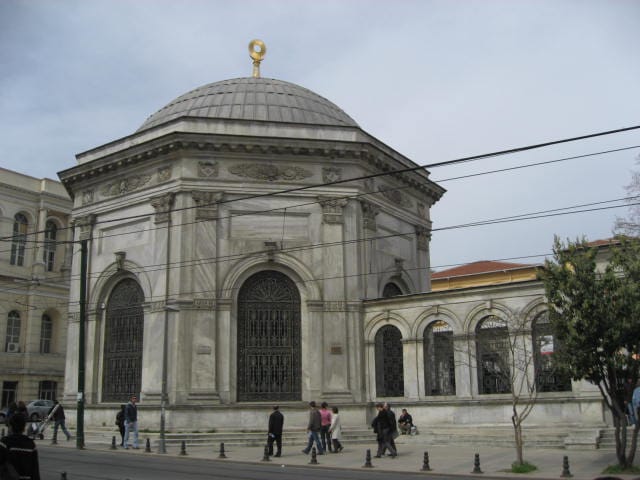

An Empire-style tomb on the Divanyolu
Mahmud II died on 28 June 1839 and was buried on 1 July in the garden of the Esma Sultan Palace on the Divanyolu. Under Sultan Abdulmejid, Abdülhalim Efendi, director of the imperial building office (Ebniye-i Hassa), was charged with building the tomb; work began after 5 July 1839 and was completed on 12 October 1840. The master builders Ohannes and Bogos worked on it, and its inscriptions were written by the calligrapher Mehmed Haşim Efendi. The tomb stands within a group of buildings comprising a sebil, rooms, a fountain and a graveyard.
The octagonal tomb, built in the Empire style, has marble-clad façades and is covered by a large dome; its interior is decorated with stucco reliefs. Among its eighteen cenotaphs are those of Mahmud II, Sultan Abdulaziz, Sultan Abdulhamid II and Bezmialem Valide Sultan. The adjoining graveyard holds some 140 graves, including that of Ziya Gökalp. The round sebil with Tuscan columns is the first and only example of its type in Istanbul. The globe that crowned the corner fountain was torn off and destroyed in early 2003.
Construction and rewards
So that he could finish the tomb quickly, Abdülhalim Efendi was relieved of his post as director of imperial buildings (Ebniye-i Hassa) and replaced by Seyyid Abdülhalim Efendi; after completing the building he was reappointed to the same post for this success. The master builders, the Superintendent of Imperial Foundations Mahir Efendi and the calligrapher Mehmed Haşim Efendi were also rewarded. The inscription over the gate leading from the street into the courtyard was written by Yesarizade Mustafa Izzet.
Façades and interior decoration
The north façade holds the door; the other faces have wide, tall round-arched windows, flanked by pilasters with stylised Corinthian capitals that animate the façades. At the top are two coats of arms in the form of shields with crossed swords and a projecting cornice on consoles; the finial of the dome, with its radiating design, recalls the sun.
Inside, the lunettes of the drum bear the names of God, Muhammad, the four caliphs, and Hasan and Hüseyin. The dome, divided into coffers, is decorated with reliefs of coats of arms, wreaths and flower baskets. The large crystal chandelier hanging from its centre and the gold-embroidered covers on the cenotaphs reflect a search for synthesis between Empire decoration and traditional ornament.
Those buried in the tomb and cemetery
Among those buried in the tomb are also Esma Sultan, Mahmud II's daughters Atiye and Hatice Sultan, Abdulaziz's son Yusuf Izzeddin Efendi, and consorts of Abdulhamid II and Abdulaziz. The adjoining cemetery holds the graves of Abdülhak Molla, Ishak Sükuti, a founder of the Committee of Union and Progress, the calligrapher Abdülfettah Efendi, the ambassador to Vienna Sadullah Pasha and the historian Ata Bey; Ziya Gökalp's grave was designed by Arif Hikmet Koyunoğlu.
Beneath the metal grilles of the sebil are four water-dispensing openings on each side. The corner fountain, about 2.5 m high, consists of a square base, a square prismatic body and a sphere on top; the sphere motif is an interesting experiment reflecting the cultural developments of the first half of the 19th century.
Related sultans
Cite as: Atlas of the Sultans, “Tomb of Mahmud II · Ottoman monuments”, https://padisahlaratlasi.com/en/monuments/tomb-of-mahmud-ii/ (last updated 21 November 2026). Corrections · Image credits