TRENDEFRARAtlas of the Sultans · Grand viziers
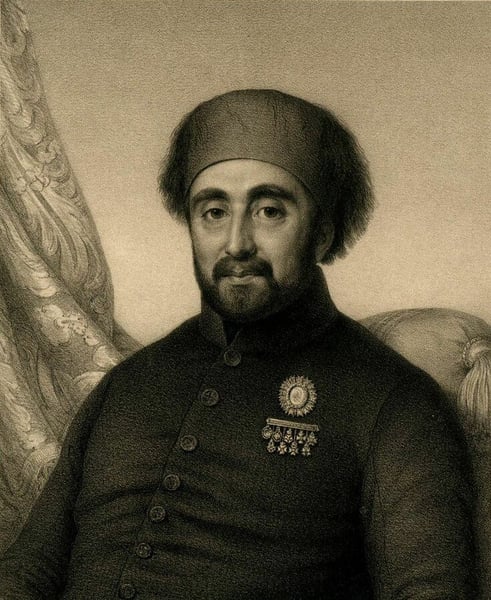
Mustafa Reşid Pasha
Grand vizier six times, 1846–1858
 AI

A self-taught scribe
He was born on 13 March 1800 in the Davutpaşa quarter of Istanbul; he is also known by the nicknames “Koca” and “Büyük” (the Great). He received no regular education and was self-taught. Having lost his father at a young age, he came under the protection of his brother-in-law, Ispartalı Seyyid Ali Pasha, and began his official career as seal-keeper (mühürdar) during the latter's grand vizierate. During the Ottoman-Russian war of 1828–1829 the plain and effective reports he wrote from the army caught Mahmud II's attention; he took part in the peace negotiations at Edirne in 1829 as chief secretary. Under the patronage of Pertev Efendi he took part in the negotiations on the Egyptian question, and in 1832 he became amedi (head of the Amedi office).
From embassy to the Tanzimat
In 1834 he was sent as envoy to Paris to discuss the Algerian question, and then to London; he came to know European diplomacy at first hand and improved his French. He tried to win the support of Europe, above all of Britain, against the governor of Egypt, Muhammad Ali Pasha. In 1837 he became minister of foreign affairs, and he played an important role in the commercial treaty signed with Britain in 1838. When Abdulmejid came to the throne he returned to Istanbul and on 3 November 1839 brought about the proclamation of the Tanzimat Edict (the Edict of Gülhane).
The author of the article, Kemal Beydilli, recalls that Reşid Pasha shared this responsibility with the thirty-eight statesmen whose signatures stand beneath the text on which the edict was based, and that the road to the Tanzimat had been entered upon in the last years of Mahmud II's reign; he stresses, nevertheless, that this does not diminish his active role in the proclamation and implementation of the edict.
Six grand vizierates
On 28 September 1846 he became grand vizier for the first time; the founding of a mixed commercial court, the banning of torture and the opening of the Ministry of Public Schools (Mekatib-i Umumiyye Nezareti) fall in this period. Because of his struggle with his opponents and outside pressures he was dismissed and reappointed many times; in all he came to the grand vizierate six times. He was influential in the opening of the Encümen-i Daniş (Academy of Learning). By opposing the extradition of Hungarian and Polish refugees he helped create a climate in Europe favourable to the Ottomans. Apart from the proclamation of the Tanzimat, this stance and the winning of Britain and France as allies in the Crimean War are counted among his main achievements. As minister of foreign affairs during the Menshikov crisis he played the chief role in the rejection of Russia's demand for a protectorate over the Orthodox; when his opposition to the Suez Canal project provoked France's reaction, he was removed from office in 1855. He criticized the mention of the Reform Edict of 1856 in the Treaty of Paris; he warned that the rights granted to non-Muslims would upset the balance all at once.
Death and assessment
During his sixth grand vizierate he died of a heart attack on 7 January 1858; his tomb is next to the Beyazıt Mosque. Beydilli sees him as one of the few statesmen of the Tanzimat period who had a mission; but he considers it an exaggeration that in later periods he was presented as superior to Mahmud II with epithets such as “prophet of civilization”. The article also states that the path opened by Reşid Pasha, who saw the survival of the state in the balance among the great powers and leaned on Britain, was the beginning of a factionalism among statesmen based on foreign powers. He pioneered the simplification of official correspondence so that everyone could understand it; Ali Pasha and Fuad Pasha, as well as Cevdet Pasha, rose under his patronage.
Source: TDV Encyclopedia of Islam, “MUSTAFA REŞİD PAŞA” (Kemal Beydilli)
Related sultans
Cite as: Atlas of the Sultans, “Mustafa Reşid Pasha · Grand viziers”, https://padisahlaratlasi.com/en/grand-viziers/mustafa-resid-pasha/ (last updated 21 November 2026). Corrections · Image credits