TRENDEFRARAtlas of the Sultans · Ottoman monuments
Hagia Sophia
Monument · Church (537), mosque from 1453, Istanbul
- Type
- Mosque
- Built
- 1453
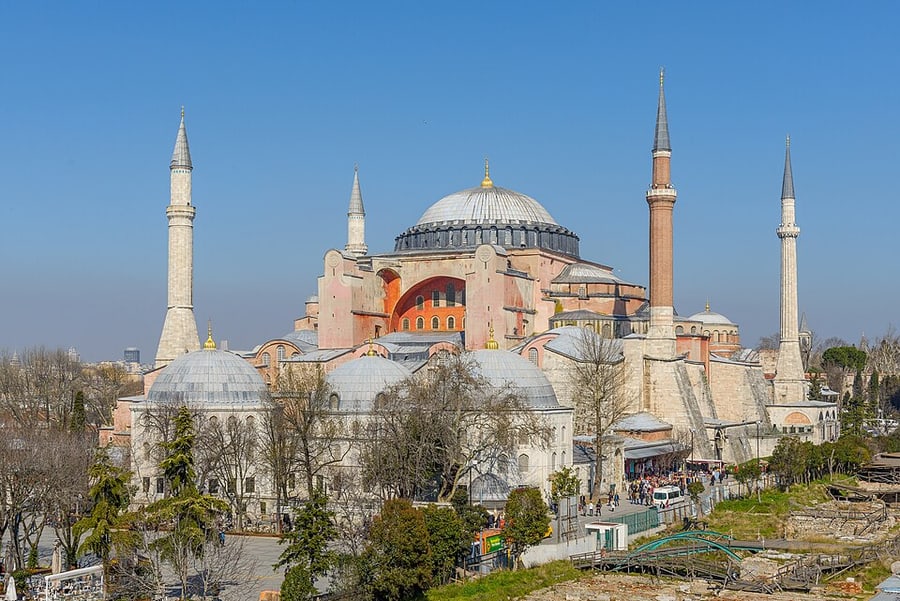

The Great Church of Byzantium
The first building of Hagia Sophia was built in the 4th century as a timber-roofed basilica and opened in 360. When the second church burned in the Nika revolt of 532, Justinian I had the present building constructed by Anthemios of Tralles and Isidoros of Miletus; the church opened on 27 December 537. The central space is covered by a great shallow dome reaching about 31-33 m in diameter. The building carried this load only with difficulty from a structural point of view; part of the dome collapsed in 558, and it was damaged again in the earthquake of 986 and in 1346. The Spanish envoy Clavijo, who came to Constantinople in 1402, found the church dilapidated and neglected.
The symbol of the conquest
When Istanbul was taken, Hagia Sophia, the largest sanctuary of the city, was converted into a mosque by Mehmed the Conqueror as the symbol of the conquest, and the first Friday prayer was performed there. According to Tursun Bey, the Conqueror climbed up to the dome and, faced with the ruinous state of the building and its surroundings, recited the famous Persian couplet. The Conqueror prevented the destruction of the building, endowed the mosque as the first of his charitable works, and had a madrasa built beside it. The first minaret was set up in wood on top of one of the buttress turrets on the west. From 1453 to 1934 Hagia Sophia was the city's chief mosque; it became almost a tradition to give the name Ayasofya to the largest church converted into a mosque in other conquered cities.
Ottoman additions
Under Suleiman the Magnificent, bronze candlesticks brought from Buda were placed on either side of the mihrab in 1526. Under Selim II the houses hemming in the building were cleared away, the collapse of the building was prevented by buttresses built by Mimar Sinan, and the first sultan's tomb beside Hagia Sophia was built for Selim II, again by Sinan. Under Murad III the two northern minarets, a minbar, a preacher's chair and a gallery were added, and two monolithic marble jars brought from Bergama were placed inside; the tombs of Murad III and Mehmed III followed. In 1739 Mahmud I built a library with bronze grilles, and in 1740 an ablution fountain, a primary school and a kitchen-imaret in the courtyard.
The building's most extensive Ottoman restoration was carried out in 1847–1849 by the Swiss architect Gaspare Fossati on the orders of Abdulmejid. At that time a new royal lodge and a timekeeper's house were built, the mosaics were uncovered and drawings made of them, and the large roundels of Kazasker Mustafa Izzet were hung. The building was damaged again in the earthquake of 1894.
From museum back to mosque
By a Council of Ministers decision dated 24 November 1934, Hagia Sophia ceased to be a mosque and was placed under the General Directorate of Museums. The furnishings and panels belonging to the mosque were removed, the large panels later being hung back in their places; the madrasa built by the Conqueror was demolished in 1936. From 1932 the mosaics were uncovered again through the work carried out by Thomas Whittemore on behalf of the Byzantine Institute of America. The royal lodge section was opened for worship briefly in 1980 and permanently from 1991. On 2 July 2020 the Council of State annulled the 1934 decision, and Hagia Sophia was reopened for worship under the name Ayasofya-i Kebir Cami-i Şerifi with the Friday prayer held on 24 July 2020. Reconstruction of the madrasa in its original form began in 2017.
Source: TDV Encyclopedia of Islam (TDV İslâm Ansiklopedisi), “AYASOFYA” (Semavi Eyice)
Related sultans
Cite as: Atlas of the Sultans, “Hagia Sophia · Ottoman monuments”, https://padisahlaratlasi.com/en/monuments/hagia-sophia/ (last updated 21 November 2026). Corrections · Image credits