TRENDEFRARAtlas of the Sultans · 14 / 39 · sultan
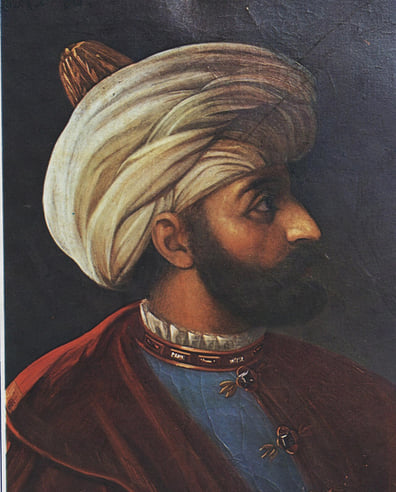
Imaginary portrait (made later) — artist and date unknown
Murad III
The borders reached their widest extent in his reign, but in the same years the cost of long wars, the debasement of the coinage and factional struggles at court began. That the peak and the unravelling fit into the same reign is its central paradox.
Open the reign of Murad III on the map▶ Watch the 1-minute video: YouTube · Instagram · TikTok
Interesting fact
When he died in 1595, forty-nine of his children were alive and seven of his concubines were pregnant.
Source: TDV İslâm Ansiklopedisi (Turkish), article “MURAD III”
Life
A prince raised in Manisa
Murad was born on 4 July 1546 at the Bozdağ summer pasture (yayla) near Manisa, in the years when his father Selim II was sanjak governor of Saruhan. According to the TDV article, his mother was Nurbanu Sultan, of Venetian origin, whose original name was Cecilia Baffo. He received his early education at the palace in Manisa; his circumcision festivities were held there in April 1557. At a young age he became governor of the sanjak of Aydın; when his father moved to Karaman in 1558 he went with him and received the governorship of the sanjak of Akşehir.
When his father came to the throne, he was sent to Manisa as sanjak governor. There he met Safiye Sultan, his haseki (favourite consort) of Albanian origin, to whom he would remain devoted all his life; their son, the later Mehmed III, was born in Manisa in 1566. The reports of the Venetian ambassadors present him as a talented, well-educated and devout prince who was much loved by those around him.
Accession and Sokullu
Murad received the news of his father's death from the grand vizier Sokullu Mehmed Pasha and from men sent by his mother, and set out in haste; after a difficult journey he met Sokullu at Sarayburnu and entered the palace at midnight. His accession was proclaimed on 22 December 1574. That same night, as the order of succession required, his five brothers were strangled; the funerals of his father and his brothers fell on the same day. His first acts were to distribute the accession bonus to the troops and to order the walls of the Kaaba to be repaired.
Murad kept Sokullu in office and drew on his experience, but over time he weakened his power and rendered him ineffective. The palace circle, people such as his mother Nurbanu Sultan, his haseki Safiye Sultan and his favourite, the Halveti sheikh Şüca', grew more and more influential in affairs of state. Sokullu was assassinated in 1579.
The long war with Iran
Wishing to take advantage of the internal turmoil of Safavid Iran, Murad decided on a new war in 1578, probably despite Sokullu's opposition. Lala Mustafa Pasha was charged with conquering Shirvan (Şirvan) by way of Georgia and defeated the Safavids twice. Özdemiroğlu Osman Pasha held Shirvan; on becoming grand vizier he took Tabriz in 1585, and the Friday sermon was read in the city in the sultan's name, but shortly afterwards he fell ill there and died.
The war, which lasted twelve years, came to an end with the arrival in Istanbul of Haydar Mirza, the envoy of Shah Abbas: under the peace made in 1590, the conquered lands remained in Ottoman hands. According to the atlas, the Ottoman state reached its widest borders with this peace. But the financial burden of the war was heavy: in 1589, over wages paid in debased akçe, the household troops (kapıkulu) rose in revolt in Istanbul, demanded the killing of the beylerbeyi of Rumelia, Mehmed Pasha, and the chief treasurer (başdefterdar) Mahmud Efendi, and in the end obtained it.
Relations with Europe and the Long War
Relations with England developed considerably in Murad's reign. In 1579 English merchants were granted permission to trade, and this permission later became a charter of privileges (ahidname); official letters passed between Murad and Queen Elizabeth I, and even a joint operation against Spain was planned. In North Africa there was a struggle for influence over Morocco with Spain and Portugal; the kings who ascended the throne of Poland-Lithuania were recognized with Ottoman approval.
In 1593, after the Bosnian forces were routed at Kulpa, war was declared on the Habsburgs at the insistence of Koca Sinan Pasha. This Long War, which was to last thirteen years, shook the basic structure of the state to its foundations. Sinan Pasha took Yanıkkale (Győr) in 1594, but that same winter the voivodes of Transylvania, Wallachia and Moldavia joined the anti-Ottoman alliance, and in January 1595 the Wallachian army burned the fortress of Ibrail (Brăila).
Character and death
Murad was a sultan who did not go to war in person and rarely left the palace; according to the Venetian ambassadors, one reason for this was his unease at the affection the people showed his son Mehmed. The circumcision festival he organized for his son Mehmed in 1582 was a long and magnificent celebration that displayed all the splendour of the court.
He wrote religious and mystical (Sufi) poetry under the pen name “Muradi”. Schweigger writes that he loved reading books, especially works of history, that he was interested in astronomy and that he gave permission for an observatory to be built. Many works of history and geography were presented to him in his time; the TDV article describes this period as an age in which Ottoman culture reached the peak of its classical form. His most important work is the Muradiye Complex in Manisa, built to plans by Mimar Sinan on the site of the small mosque (mescid) he had built there as a prince: its mosque was completed in 1586, and its madrasa, soup kitchen (imaret), inn (han) and hospice (tabhane) in 1592–93. He built a madrasa, a soup kitchen and a school (mektep) in each of Mecca and Medina; the two northern minarets, together with a minbar, a preacher's chair (kürsü) and a gallery (mahfil), were added to Hagia Sophia, and mosques were built in his name at Modon and Navarino (Navarin) in the Morea.
Murad died in Istanbul on 17 January 1595, in the most difficult days of the Long War, and was buried in the burial ground (hazire) of Hagia Sophia.
Source: TDV Encyclopedia of Islam (TDV İslâm Ansiklopedisi), “Murad III” (Bekir Kütükoğlu); the main sources of this article are Selaniki, Gelibolulu Ali, Hoca Sadeddin, the reports of Venetian ambassadors and the travel account of Salomon Schweigger.
Meanwhile in the world
Contemporary rulers
- Rudolf IIHoly Roman Emperor · 1576–1612Religious strife under his rule paved the way to the Thirty Years' War
- Philip IIKing of Spain and Portugal · 1556–1598Habsburg king who sent the Armada against England
- Elizabeth IQueen of England · 1558–1603Last Tudor monarch; her reign is called England's Golden Age
- Henry IVKing of France · 1589–1610First Bourbon king of France
- Abbas I (the Great)Safavid Shah · 1588–1629Reorganized the army and moved the capital to Isfahan
- AkbarMughal Emperor · 1556–1605Regarded as the greatest of the Mughal emperors
- Wanli EmperorEmperor of Ming China · 1572–1620During his reign Matteo Ricci established Jesuit missions in China
What was happening in the world?
- 1580Francis Drake sailed back into Plymouth, completing his three-year voyage around the world.
- 1581The northern provinces of the Low Countries renounced Philip II's sovereignty in the Act of Abjuration.
- 1582Pope Gregory XIII introduced the Gregorian calendar, correcting the drift of the Julian calendar.
- 1588The Spanish Armada, sent by Philip II to invade England, was repelled by the English fleet.
- 1590Toyotomi Hideyoshi brought all of Japan, from Kyushu to Tohoku, under his control.
- 1592Hideyoshi's army landed at Busan and invaded Korea; Japanese forces withdrew in 1598.
Sources: britannica.com [1] [2] [3] [4] [5] [6] [7] [8] [9] [10] [11] [12] [13]
Family
| Father | Selim II |
|---|---|
| Mother | Nurbanu Sultan |
| Consorts | Safiye Sultan |
| Children | Mehmed III and more than twenty princes and princesses (records are incomplete) |
Major achievements
- Twelve-year war with Persia and the Treaty of Ferhad Pasha (1590), bringing the empire to its widest borders
- First trade capitulation with England (1580)
- Taqi al-Din's Istanbul Observatory founded (later demolished)
- Golden age of the palace painting studio: miniatures of the Şehname and Surname
- Ottoman influence established in Morocco
- Debasement of the akçe and the spread of bribery — the beginning of financial decay
Treaties
- Treaty of Ferhad Pasha (Constantinople) (1590, Persia)
Grand viziers
| Name | From | To | Length |
|---|---|---|---|
| Sokullu Mehmed Pasha | June 29, 1565 | October 12, 1579 | 14 years, 105 days |
| Semiz Ahmed Pasha | October 13, 1579 | April 27, 1580 | 197 days |
| Koca Sinan Pasha | July 31, 1580 | December 6, 1582 | 2 years, 128 days |
| Kanijeli Siyavuş Pasha | December 24, 1582 | July 25, 1584 | 1 year, 214 days |
| Özdemiroğlu Osman Pasha | July 28, 1584 | October 29, 1585 | 1 year, 93 days |
| Hadım Mesih Pasha | December 1, 1585 | April 15, 1586 | 135 days |
| Kanijeli Siyavuş Pasha (term 2) | April 15, 1586 | April 2, 1589 | 2 years, 352 days |
| Koca Sinan Pasha (term 2) | April 2, 1589 | August 1, 1591 | 2 years, 121 days |
| Ferhad Pasha | August 1, 1591 | April 4, 1592 | 247 days |
| Kanijeli Siyavuş Pasha (term 3) | April 4, 1592 | January 28, 1593 | 299 days |
| Koca Sinan Pasha (term 3) | January 28, 1593 | February 16, 1595 | 2 years, 19 days |
Battles and treaties
| Year | Event | Result / parties |
|---|---|---|
| 1578 | Battle: Çıldır | Ottoman victory; the way to Tiflis and Shirvan lay open |
| 1585 | Campaign: Capture of Tabriz | Tabriz passed to the Ottomans and was held until 1603 |
| 1589 | Revolt: Beylerbeyi Incident | Mehmed Pasha, governor of Rumelia, and the chief treasurer Mahmud Efendi, whose heads the troops demanded, were killed; the grand vizier, the şeyhülislam and … |
| 1590 | Treaty: Treaty of Ferhad Pasha (Constantinople) | |
| 1593 | Battle: Battle of Sisak and outbreak of the Long War (1593) | The Bosnian forces were routed; the Ottoman state declared war on Austria (Long War, 1593–1606) |
Full infoboxes are in the site’s “Battles and Treaties” tab; source: TDV Encyclopedia of Islam.
Death
He died of illness in Topkapı Palace in 1595.
Territorial change
| Year | Region | Event | Source |
|---|---|---|---|
| 1576 | + Kars–Ardahan–Artvin | Kars rejoined the Ottoman lands shortly before 1576; after the Battle of Çıldır (1578) its fortress was rebuilt | TDV İA, “KARS” (one-year difference: TDV: shortly before 1576) |
| 1578 | + Dagestan–Derbent | Campaigns in Shirvan and Dagestan (1578–1583), Özdemiroğlu Osman Pasha | TDV İA, “MURAD III” |
| 1578 | + Batumi (Adjara) | Sanjaks of Akhaltsikhe and Batumi after the Battle of Çıldır (1578) | TDV İA, “MURAD III” (one-year difference) |
| 1578 | + Eastern Georgia (Kartli and Kakheti, Tbilisi) | Capture of Tbilisi (1578); ceded to the Ottomans by the Treaty of Ferhad Pasha (1590) | TDV İA, “MURAD III” |
| 1578 | + Akhaltsikhe (Childir) | Sanjaks of Akhaltsikhe and Batumi after the Battle of Çıldır (1578) | TDV İA, “AHISKA” |
| 1585 | + Azerbaijan–Shirvan–Yerevan | Twelve-year war with Persia: Yerevan (1583) and Tabriz (1585) taken; the Treaty of Ferhad Pasha (1590) recognised it | TDV İA, “MURAD III” (disputed date: The region was taken piece by piece: Yerevan 1583, Tabriz 1585, Ganja 1588; treaty 1590) |
| 1590 | + Luristan–Nahavand | Treaty of Ferhad Pasha (1590): Luristan and Nahavand were among the lands left under Ottoman rule | TDV İA, “İRAN” |
The lands that changed hands in this period, and the battles or treaties that brought the changes, can be seen on the map: map of the reign of Murad III.
Cite as: Atlas of the Sultans, “Murad III: Reign Map, Wars and Conquests (1574–1595)”, https://padisahlaratlasi.com/en/sultans/iii-murad/ (last updated 21 November 2026). Corrections · Image credits
Terms on this page: Sanjak · Celali revolts
Grand viziers of this reign: Sokullu Mehmed Pasha · Koca Sinan Pasha
Monuments of this reign: Stone Bridge (Skopje) · Hagia Sophia · Selimiye Mosque and Complex (Edirne) · Atik Valide Mosque · Tomb of Selim II · Kılıç Ali Pasha Mosque · Zal Mahmud Pasha Mosque · Pertev Pasha Mosque · Çemberlitaş Hamam · Sokullu Mehmed Pasha Mosque (Havsa) · Sokullu Mehmed Pasha Bridge (Bridge on the Drina) · Azapkapı Sokullu Mehmed Pasha Mosque · all (16) →
Women of the dynasty in this reign: Mihrimah Sultan · Safiye Sultan · Nurbanu Sultan
State organisation: The waqf system in the Ottoman Empire
Myths and misconceptions: Did the Ottomans reach their greatest extent under Suleiman the Magnificent? · Did women really rule the state during the “Sultanate of Women”? · Did the sultan preside over meetings of the Imperial Council (Divan-ı Hümayun)? · Was the Ottoman army made up mostly of Janissaries?