TRENDEFRARAtlas of the Sultans · 15 / 39 · sultan
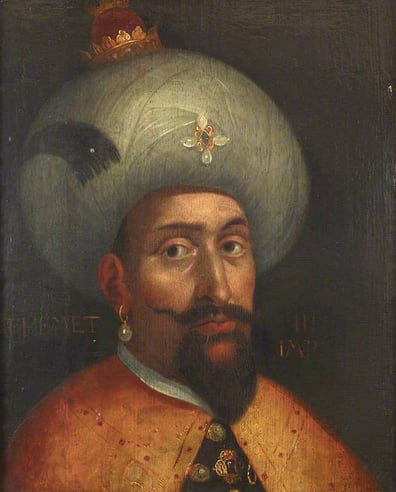
Imaginary portrait (made later) — attributed to Cristofano dell'Altissimo
Mehmed III
The victory at Keresztes is the one bright moment of his reign. The Celali revolts in Anatolia, financial collapse and violence within the palace make his reign the beginning of the state's internal crisis.
Open the reign of Mehmed III on the map▶ Watch the 1-minute video: YouTube · Instagram · TikTok
Interesting fact
He led the army on campaign in person and witnessed the capture of the fortress of Eger (Eğri), which the Ottomans had failed to take before (12 October 1596).
Source: TDV İslâm Ansiklopedisi (Turkish), article “MEHMED III”
Life
The years in Manisa
Mehmed was born on 26 May 1566 on the plain of Sart near Manisa. His father was Murad III and his mother Safiye Sultan, of Albanian origin, from the village of Rezi in Dukakin; the TDV article states that the claim that Safiye was the Venetian-born Cecilia Baffo is mistaken, and that Baffo was Nurbanu Sultan, the mother of Murad III. Tradition holds that he was named by his great-grandfather Suleiman the Magnificent, who received the news of his birth on the Szigetvár campaign.
About a year after the magnificent circumcision festival of 1582, on 17 December 1583, he crossed to Üsküdar with more than 1,500 attendants and went on to Manisa, which had become the sanjak of the heir to the throne. He stayed in Manisa for about twelve years. According to the Venetian ambassadors, his father was uneasy about the affection the people showed his son.
Accession and the nineteen brothers
The death of Murad III was skilfully concealed until Mehmed arrived. The prince, who received the news from a man sent by his mother and by the chief black eunuch (Darüssaade ağası), came to Mudanya in harsh winter conditions and reached Istanbul by galley on 27 January 1595. After his accession, the rule of fratricide that formed part of the order of succession was applied: nineteen princes, four of them adults (Mustafa, Bayezid, Osman and Abdullah) and the rest very young, were strangled. The event has remained in memory as one of the grimmest scenes in Ottoman history.
The Eğri campaign
In the Long War bad news was coming from the front; the fall of the fortress of Esztergom on 2 September 1595 in particular caused a great stir. According to Selaniki, the sultan was pressed to go on campaign in person; one Friday, while the sermon was being read at the Süleymaniye, one of the ulema spoke openly on the matter. Mehmed became the first sultan since Suleiman the Magnificent to go on campaign at the head of the army. The target chosen was Eğri (Eger), a great fortress the Ottomans had failed to take before.
Eğri was taken in 1596. The pitched battle then fought at Haçova (Mezőkeresztes) ended in victory, although the Ottoman army had at first been in serious difficulty. Immediately after the victory the sultan dismissed the grand vizier Damad Ibrahim Pasha and appointed Cigalazade Sinan Pasha in his place; but the circle around his mother Safiye Sultan soon had this appointment overturned. In the west the war went on: the battle won before Kanizsa (Kanije) during Damad Ibrahim Pasha's campaign of 1600 and the surrender of the fortress on 22 October 1600 were greeted with joy in Istanbul. The foundations of the Yeni Cami (New Mosque), built by his mother Safiye Sultan at Eminönü, were also laid in this period, in 1598.
The Celalis, revolts and the palace
In the second half of his reign the great Celali revolts broke out in Anatolia. The revolt of Karayazıcı Abdülhalim caused the sultan a great deal of trouble; after Karayazıcı died in the Canik mountains, his brother Deli Hasan, who took his place, had Sokolluzade Hasan Pasha, the commander (serdar) sent against the Celalis, killed before the fortress of Tokat in 1602. Deli Hasan was pacified only by being pardoned and sent to Bosnia as its beylerbeyi. The news of disasters coming from Anatolia caused great anxiety in Istanbul.
Unrest grew in Istanbul too. In 1600 the sipahis rose in revolt, claiming that the coins coming from the customs tax farm (iltizam) run by Kira Kadın, Safiye Sultan's closest servant, were debased, and brought about her death. In 1603, this time under pressure from the sipahis, the grand vizier Yemişçi Hasan Pasha was dismissed and executed.
Last year and death
Mehmed's last year was a grim one within the family as well. Suspicious of his eldest son, Prince Mahmud, whom he knew the troops supported, the sultan ordered Mahmud strangled on 7 June 1603, and Mahmud's mother and some thirty servants were thrown into the sea. In the same months news came from the east that Shah Abbas had taken Tabriz (21 October 1603) and that Nakhchivan had been evacuated.
Mehmed III died in December 1603 at the age of thirty-seven and was buried beside his father in the burial ground (hazire) of Hagia Sophia. He was succeeded by his fourteen-year-old son Ahmed I. The TDV article describes him as a sultan who welcomed the literary works presented to him and wrote good poetry under the pen name “Adli”, but notes that his reign, which bore the stamp of his mother Safiye Sultan and her circle, is remembered with general discontent because of the long war, the Celali revolts, the losses in the east and the ailing economy.
Source: TDV Encyclopedia of Islam (TDV İslâm Ansiklopedisi), “Mehmed III” (Feridun M. Emecen); the main sources of this article are Selaniki, Hasanbeyzade Ahmed, Peçevi and the reports of the English ambassador Henry Lello.
Meanwhile in the world
Contemporary rulers
- Rudolf IIHoly Roman Emperor · 1576–1612Religious strife under his rule paved the way to the Thirty Years' War
- Philip IIIKing of Spain and Portugal · 1598–1621Expelled the Moriscos from Spain and governed through royal favourites
- Elizabeth IQueen of England · 1558–1603Last Tudor monarch; her reign is called England's Golden Age
- Henry IVKing of France · 1589–1610Ended France's Wars of Religion with the Edict of Nantes
- Abbas I (the Great)Safavid Shah · 1588–1629Reorganized the army and moved the capital to Isfahan
- AkbarMughal Emperor · 1556–1605Regarded as the greatest of the Mughal emperors
- Tokugawa IeyasuShogun of Japan · 1603–1605Founder of the Tokugawa shogunate, which lasted until 1868
What was happening in the world?
- 1598Henry IV's Edict of Nantes granted French Protestants broad religious liberty and ended the Wars of Religion.
- 1600The philosopher Giordano Bruno was burned at the stake in Rome by order of the Roman Inquisition.
- 1600The English East India Company was founded by a royal charter of Elizabeth I.
- 1600Victory at the Battle of Sekigahara made Tokugawa Ieyasu the undisputed master of Japan.
- 1602The Dutch East India Company (VOC) was founded as a joint-stock company with a monopoly on Asian trade.
Sources: britannica.com [1] [2] [3] [4] [5] [6] [7] [8] [9] [10] [11] · kids.britannica.com [1]
Family
| Father | Murad III |
|---|---|
| Mother | Safiye Sultan |
| Consorts | Handan Sultan, Halime Sultan |
| Children | Ahmed I, Mustafa I, Şehzade Mahmud, Şehzade Selim |
Major achievements
- Conquest of Eger fortress (1596) and victory at Keresztes — one of the last sultans to lead a campaign in person
- Continuation of the Long War with Austria
- Outbreak of the Celali revolts and the breakdown of order in Anatolia
- The most extensive use of fratricide (nineteen brothers)
Treaties
None recorded.
Grand viziers
| Name | From | To | Length |
|---|---|---|---|
| Koca Sinan Pasha (term 3) | January 28, 1593 | February 16, 1595 | 2 years, 19 days |
| Ferhad Pasha (term 2) | February 16, 1595 | July 7, 1595 | 141 days |
| Koca Sinan Pasha (term 4) | July 7, 1595 | November 19, 1595 | 135 days |
| Tekeli Lala Mehmed Pasha | November 19, 1595 | November 28, 1595 | 9 days |
| Koca Sinan Pasha (term 5) | December 1, 1595 | April 4, 1596 | 125 days |
| Damad Ibrahim Pasha | April 1596 | October 27, 1596 | |
| Cigalazade Sinan Pasha | October 27, 1596 | December 5, 1596 | 39 days |
| Damad Ibrahim Pasha (term 2) | December 5, 1596 | November 3, 1597 | 333 days |
| Hadım Hasan Pasha | November 3, 1597 | April 9, 1598 | 157 days |
| Cerrah Mehmed Pasha | April 9, 1598 | January 6, 1599 | 272 days |
| Damad Ibrahim Pasha (term 3) | January 6, 1599 | July 10, 1601 | 2 years, 185 days |
| Yemişçi Hasan Pasha | July 22, 1601 | October 4, 1603 | 2 years, 74 days |
| Yavuz Ali Pasha | October 4, 1603 | July 26, 1604 | 296 days |
Battles and treaties
| Year | Event | Result / parties |
|---|---|---|
| 1596 | Siege: Conquest of Eger | The fortress surrendered; Eger became the seat of an Ottoman province |
| 1596 | Battle: Keresztes | Ottoman victory; the Habsburg army was routed |
| 1599 | Revolt: Revolt of Karayazıcı | Defeated by Sokolluzade Hasan Pasha at Sepetli (12 August 1601), he died in 1602; his brother Deli Hasan carried on the revolt until he was appeased with a … |
| 1600 | Siege: Capture (1600) and defence (1601) of Kanizsa | The fortress was taken and made a provincial centre; the Habsburg siege of 1601 was repulsed |
Full infoboxes are in the site’s “Battles and Treaties” tab; source: TDV Encyclopedia of Islam.
Death
He died of a sudden illness in Topkapı Palace in 1603, shortly after having his son Şehzade Mahmud executed.
Territorial change
| Year | Region | Event | Source |
|---|---|---|---|
| 1596 | + Eger | Capture of Eger (12 October 1596) — the province of Eger was created | TDV İA, “EĞRİ” |
| 1597 | − Luristan–Nahavand | The Lesser Luristan atabegate ended in 1597 and the region passed under Safavid rule; the exact date Nahavand was lost is unknown | TDV İA, “İRAN” (disputed date: The TDV article on Iran says the Lesser Luristan atabegate ended in 1597; the exact year Nahavand was lost is unknown (forces were sent against it again in 1616)) |
| 1600 | + Kanizsa | Capture of Kanizsa (20 October 1600) — the province of Kanizsa was created | TDV İA, “KANİJE” |
The lands that changed hands in this period, and the battles or treaties that brought the changes, can be seen on the map: map of the reign of Mehmed III.
Cite as: Atlas of the Sultans, “Mehmed III: Reign Map, Wars and Conquests (1595–1603)”, https://padisahlaratlasi.com/en/sultans/iii-mehmed/ (last updated 21 November 2026). Corrections · Image credits
Terms on this page: Şehzade · Celali revolts
Grand viziers of this reign: Koca Sinan Pasha
Monuments of this reign: Gazi Ali Pasha Mosque · New Mosque and Complex (Eminönü) · Tomb of Mehmed III
Women of the dynasty in this reign: Safiye Sultan
Myths and misconceptions: Did the Ottomans reach their greatest extent under Suleiman the Magnificent?