TRENDEFRARAtlas of the Sultans · Ottoman monuments
Sokullu Mehmed Pasha Bridge (Bridge on the Drina)
Monument · Bridge, Višegrad; inscription date 1577–78
- Type
- Bridge
- Location
- Bosnia and Herzegovina
- Built
- 1577
A work of Mimar Sinan

Founder, architect and date
The bridge over the Drina river at Višegrad in Bosnia and Herzegovina was built by Mimar Sinan as a charitable work of the Grand Vizier Sokullu Mehmed Pasha. This bridge is also mentioned in the Tezkiretü'l-ebniye, which lists Sinan's works. For a long time the bridge was known by the name of Višegrad or of its founder Sokullu; after 1960, however, it became famous under the name of the river that flows beneath it, thanks to Ivo Andrić's novel.
As is also mentioned in Sokullu's endowment deed, at the two ends of the bridge there were two inscriptions in verse giving the name of the founder and the date of construction. These two inscriptions, now in the inscription kiosk, give the date 985 (1577–78). Some researchers read the first inscription as 979 (1571–72) and think this may be the beginning of construction. Ekrem Hakkı Ayverdi, however, comparing the damaged parts of the inscriptions with the texts of Evliya Çelebi, concluded that both give the same date. According to the author of the article, the second inscription in the kiosk dated 979 is very recent in its lettering and does not fit the building.
A stone bridge with eleven arches
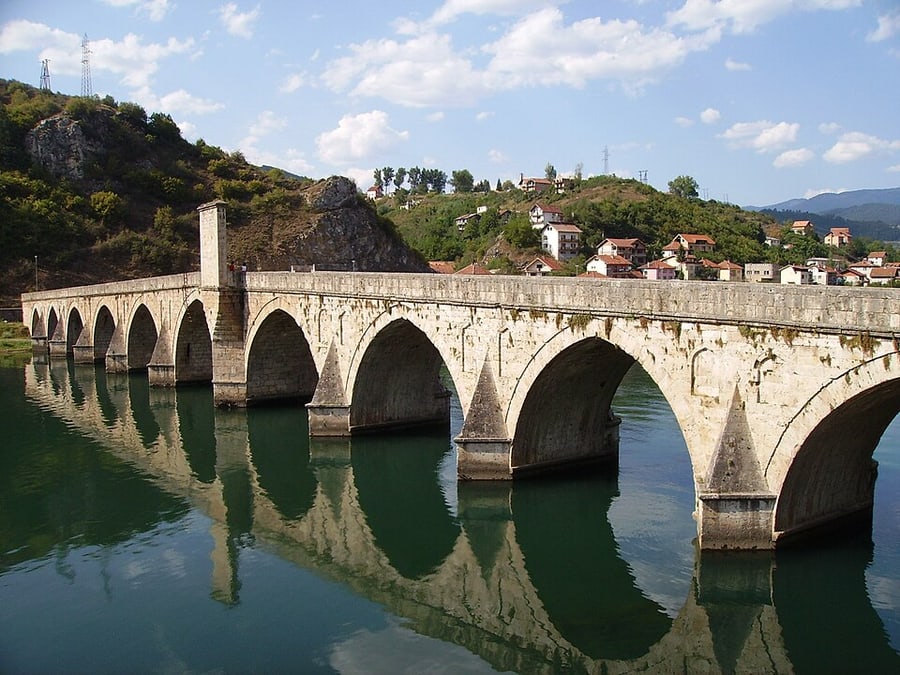
Built of very finely dressed cut stone, the bridge turns at one end at an angle of 90 degrees. In the middle is the inscription kiosk with an arch of interlocking marble in two colours, and directly opposite it a resting platform with stone benches. The main section over the river, according to the measurements given, is 179 metres long and has eleven arches. The spans of the large central arches are 14.79 and 14.20 metres, and those of the others between 11.50 and 13.50 metres. The piers are on average 4 metres thick, and the curved section connecting to the road is 120 metres long. The parapets are made of solid stone slabs. Whether the two blind arches between each pair of piers were made as flood openings or to add movement to the façade is disputed.
Restorations and wartime destruction
The bridge, whose sturdiness found its way into the proverbs of the local people, was repaired in 1664 and 1875 according to Ayverdi; in the flood of 1896 only its parapets were damaged. After the Austrian repair of 1911, three of its arches were destroyed in 1914–1915 during the First World War. For a time people crossed by a wooden extension placed on it; in 1939 the destroyed parts were rebuilt, but in 1943 four piers and five arches were destroyed again. The restoration begun in 1949 was completed in 1952; the inscriptions too, after being smashed in these wars, were carved in stone again following their old texts.
Fame through a novel
The bridge entered world literature with Ivo Andrić's novel The Bridge on the Drina (Na Drini Ćuprija), published in 1945. The novel, which won its author the Nobel Prize in Literature in 1961, was also translated into Turkish. The author of the article stresses that the novel's presentation of the bridge's architect as a Bosnian named Rade is contrary to the scholarly facts.
According to the author, thanks to the novel written about it and to Sokullu's Bosniak origin, the bridge was saved from disappearing and has survived as a monument of art displaying the nobility and beauty of Turkish architecture in this part of Europe.
Source: TDV Encyclopedia of Islam (TDV İslâm Ansiklopedisi), “DRİNA KÖPRÜSÜ” (Semavi Eyice)
Related sultans
Cite as: Atlas of the Sultans, “Sokullu Mehmed Pasha Bridge (Bridge on the Drina) · Ottoman monuments”, https://padisahlaratlasi.com/en/monuments/sokollu-mehmed-pasha-bridge-bridge-on-the-drina/ (last updated 21 November 2026). Corrections · Image credits