TRENDEFRARAtlas of the Sultans · Grand viziers
Koca Sinan Pasha
Grand vizier five times between 1580 and 1596
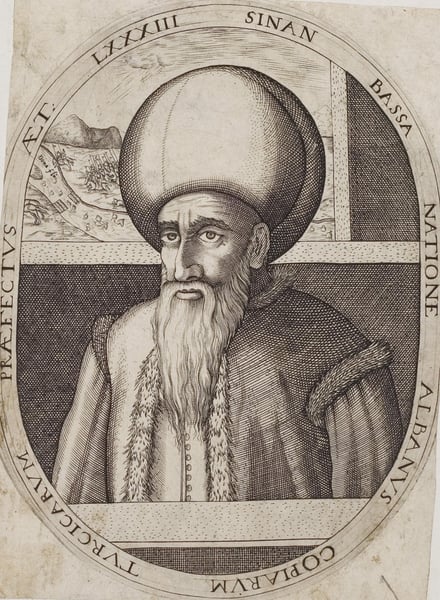 AI

Conqueror of Yemen and Tunis
He was the son of a villager of Albanian origin named Ali; he was born in Luma or, according to another account, in Delvinë (Delvine). His date of birth is not certain; it is suggested that he was born around 1520. Taken as a devşirme recruit, he entered the Enderun with the help of his elder brother Ayas Pasha and became Suleiman I's chief taster (çaşnigirbaşı). After sanjak governorships he became governor-general of Erzurum, Aleppo and, at the end of 1567, Egypt.
During the revolt of Imam Mutahhar in Yemen, at a council in Cairo he clashed with Lala Mustafa Pasha, whom he held responsible for his elder brother's execution, and had the command in Yemen transferred to himself. By taking Aden, Sanaa and Kawkaban he brought the region back under Ottoman rule and earned the title “conqueror of Yemen”. In 1574, when La Goulette (Halkulvadi) was taken after a thirty-three-day siege and Tunis was brought under control again, he also came to be called “conqueror of Tunis”.
His first two grand vizierates
His rivalry with Lala Mustafa Pasha continued in the Iranian campaign as well. After Sokullu's death, his partisans had Lala Mustafa removed from the command; when Semiz Ahmed Pasha died, the seal of the grand vizierate was sent on 31 July 1580 to Sinan Pasha at the front. When the expected peace could not be achieved, he was dismissed in 1582 and sent to Malkara. After four years out of office he regained favour with the gifts he presented, and on 2 April 1589, during the “Beylerbeyi Incident”, he became grand vizier for the second time.
In this period the Iranian wars, which had continued since 1578, ended in peace, efforts were made to reform the coinage, and new mints were established. The project of a canal via the Sakarya linking the Black Sea and the Gulf of Izmit was taken up again, but came to nothing because of his opponents' resistance. He was dismissed in 1591, and some of his endowments were abolished and added to the sultan's crown estates (has).
The Long War and his last grand vizierates
On 28 January 1593 he became grand vizier for the third time. Despite the objections of some statesmen and scholars he persuaded the sultan to go to war against Austria, and a long period of war began that would last until 1606. Although he took Győr (Yanıkkale), after Murad III's death his rival Ferhad Pasha had him dismissed in 1595. Five months later he came to the grand vizierate for the fourth time; the Wallachian campaign failed and Esztergom (Estergon) was lost. He was dismissed again, but twelve days later, on the death of his successor, he was appointed for the fifth time.
He encouraged Mehmed III to go on campaign in person; while the preparations were under way he fell ill and died on 4 April 1596, and was buried in his tomb on the Divanyolu.
Character and legacy
Selaniki, who was in his service, writes that at his death he was over eighty, that he believed all virtues were united in himself, and that he was convinced every matter could be settled with money. The sources of the period describe him as brave, quick-witted, stubborn, harsh and proud. He built up a following among the harem, the ulema and the soldiery with gifts and positions; his struggle with Lala Mustafa Pasha and Ferhad Pasha left its mark on the last quarter of the 16th century. At his death it was found that he owed a large debt to the treasury, and his fortune was confiscated. His külliye, sebil (public fountain) and tomb on the Divanyolu are open to visitors today.
Source: TDV Encyclopedia of Islam, “KOCA SİNAN PAŞA” (Mehmet Ipşirli)
Related sultans
Cite as: Atlas of the Sultans, “Koca Sinan Pasha · Grand viziers”, https://padisahlaratlasi.com/en/grand-viziers/koca-sinan-pasha/ (last updated 21 November 2026). Corrections · Image credits