TRENDEFRARAtlas of the Sultans · Ottoman monuments
Tomb of Selim II
Monument · Tomb, Istanbul, 1573–1577
- Type
- Mausoleum (türbe)
- Built
- 1573–1577
A work of Mimar Sinan
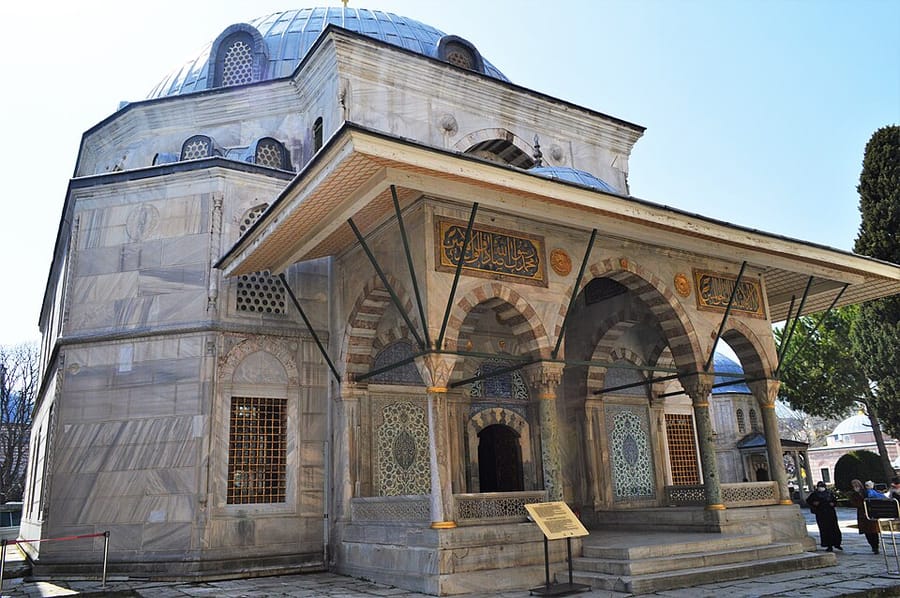

Sinan's tomb beside Hagia Sophia
The tomb stands in the burial ground of the Hagia Sophia Mosque. According to the chronicler Peçuylu Ibrahim Efendi, work began in 1573–74, on the orders of Sultan Selim II, while additions were being made to Hagia Sophia. The sultan died before it was finished and was first buried in a tent set up on the same site; when the building was completed in 1576–77 his body was moved into it. Built by Mimar Sinan, the tomb is square with broadly chamfered corners on the outside and forms an octagonal gallery inside; it is covered by a double dome.
The marble-faced building is fronted by a three-arched portico. Of the 16th-century underglaze tile panels flanking the entrance, the left one was removed by a Frenchman named Dorigny, replaced with a copy, and the original taken to the Louvre. Inside, the walls are tiled up to the level of the upper windows, and the dome and pendentives are richly decorated. Besides Selim II, the tomb holds his consort (haseki) Nurbanu Sultan, his daughters and sons, and children of Murad III. It was repaired in the 1950s, between 1982 and 1987 and in 1996, and a restoration began in 2006.
Exterior and portico
The outer dome rests on the walls by means of a tall drum, while the inner dome is carried on pointed arches above columns; additional windows were opened to light the space between the two domes. On the façades a roll moulding with a leaf-decorated crest gives the building a two-storey appearance. Rosettes fill the spandrels of the window arches of two-coloured stone, and twisted colonnettes with hourglass capitals mark the corners of the building.
The centre of the portico is covered by an eight-segmented dome on muqarnas corbels and its sides by mirror vaults; of the front columns, the middle ones are of breccia with muqarnas capitals and the outer ones of marble with lozenge capitals. The inscription above the entrance is itself of 16th-century underglaze tiles. The entrance panels show white Chinese clouds and spring branches on a red ground, and the lunettes above them a geometric pattern developed from a ten-pointed star. Fossati is thought to have carried out some work on the tomb while restoring Hagia Sophia.
Interior decoration and burials
Inside, the columns forming the octagon have muqarnas capitals; there are quarter domes at the corners, cupboards between the lower windows, a plain mihrab niche in the south wall and a gallery on brackets above the entrance. The tiles, in red, navy blue, blue, turquoise, green and black on a white ground, show hatayi, leaf and flower motifs as well as arrangements of flowers springing from vases. The medallion at the crown of the dome bears verse 16 of Surat al-Ra'd, and tile medallions on the pendentives carry the names of God, Muhammad, the four caliphs, Hasan and Husayn. The door is inlaid with mother-of-pearl and made in the kündekari technique.
Besides Selim II and Nurbanu Sultan, the tomb holds his daughters Gevherhan, Ismihan and Fatma Sultan, his sons Süleyman, Osman, Cihangir, Mustafa and Abdullah, and the sons and daughters of Murad III.
Source: TDV Encyclopedia of Islam (TDV İslâm Ansiklopedisi), “SELİM II TÜRBESİ” (Zeynep Hatice Kurtbil)
Related sultans
Cite as: Atlas of the Sultans, “Tomb of Selim II · Ottoman monuments”, https://padisahlaratlasi.com/en/monuments/tomb-of-selim-ii/ (last updated 21 November 2026). Corrections · Image credits