TRENDEFRARAtlas of the Sultans · Ottoman monuments
Azapkapı Sokullu Mehmed Pasha Mosque
Monument · Mosque, Istanbul, 1577–1578
- Type
- Mosque
- Built
- 1577–1578
A work of Mimar Sinan
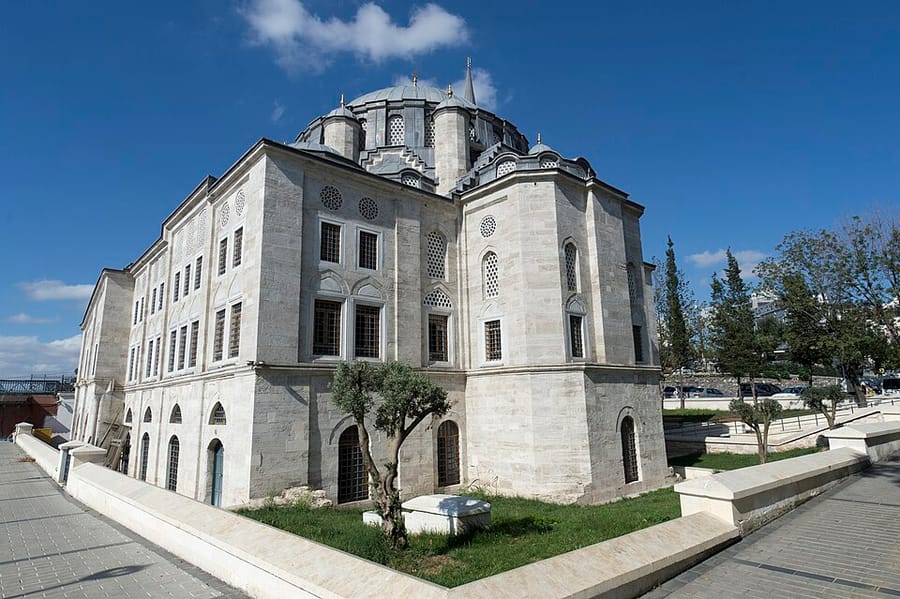

A Sinan mosque on the Golden Horn
According to its inscription, the mosque was built in 1577–78 by Grand Vizier Sokullu Mehmed Pasha; its architect was Mimar Sinan. It stood at the end of the Galata walls near the Arsenal, on the narrow shore between the walls and the sea, and takes its name from the Azapkapı gate, named after the barracks of the Arsenal's marines (azap). Because it stood by a crowded landing stage, it was raised on vaulted cellars. Here Sinan applied the system of the Selimiye Mosque in Edirne on a smaller scale, setting the central dome on eight piers. Its pierced marble minbar is among the finest of its kind, and the minaret is unusually reached by a covered passage carried on a bridge.
The mosque was damaged in the fire of 1807, when its minaret partly collapsed; the minaret shaft was renewed in the 19th century. A restoration begun shortly before the Balkan Wars and the First World War was abandoned, and the building stood in ruins for more than thirty years; at one point even its demolition was considered. A major restoration begun around 1938 revived it, and it reopened for worship in 1941 with new Kütahya tiles, renewed painted decoration and its broken inscription rewritten after the original pattern. The minaret shaft was rebuilt in 1955.
Gate, inscription and foundations
The verse inscription, which had broken and was rewritten from its old mould in 1941, is the work of the chief calligrapher Kamil Akdik. The city gate that gave the mosque its name was called Porta di San Antonio in Genoese times; it was later known as Yenikapı and, after the bridge was built in the 19th century, as Köprükapısı, and it stood until the Galata walls were demolished. While the building lay in ruins, it was even proposed to pull it down and use its foundations to support the new Unkapanı Atatürk Bridge. That it has shown no significant movement despite the weak ground on the Golden Horn shore suggests its foundations were secured with long piles.
Plan and decoration
The thrust of the dome resting on eight piers is taken up by four squinches and four semi-domes. Two stairways lead up to the portico, today an enclosed space under a single-pitched roof; in Sinan's design it may have been an open colonnaded gallery. The marble door jambs use interlocking coloured stones, and the door and window shutters are fine pieces of woodwork. The galleries and the marble mihrab show the same careful craftsmanship as the minbar. The dome inscription is by the late Ottoman calligrapher Halim Efendi, and in 1936 the coloured plaster windows, some of which still survived, were replaced with new ones.
Minaret and endowment buildings
Access to the minaret through a passage over a bridge cannot be a later solution: Evliya Çelebi saw the minaret this way, and the building elements under the bridge belong to the classical period. The shaft renewed after 1826 was made very slender, with a bulbous balcony; in 1955 the balcony was given muqarnas corbelling to suit the mosque's architecture, but the shaft remained too thin for Sinan's era. An old fountain stands beneath the minaret. Two rows of masonry shops behind the mosque, perhaps part of its endowment, were demolished in 1985, while the Yeşildirek Bath, which belonged to the mosque's endowment, still stands despite many alterations.
Source: TDV Encyclopedia of Islam (TDV İslâm Ansiklopedisi), “AZAPKAPI CAMİİ” (Semavi Eyice)
Related sultans
Cite as: Atlas of the Sultans, “Azapkapı Sokullu Mehmed Pasha Mosque · Ottoman monuments”, https://padisahlaratlasi.com/en/monuments/azapkapi-sokollu-mehmed-pasha-mosque/ (last updated 21 November 2026). Corrections · Image credits