TRENDEFRARAtlas of the Sultans · Ottoman monuments
Çemberlitaş Hamam
Monument · Hamam, Istanbul, 1584
- Type
- Bathhouse (hammam)
- Built
- 1584
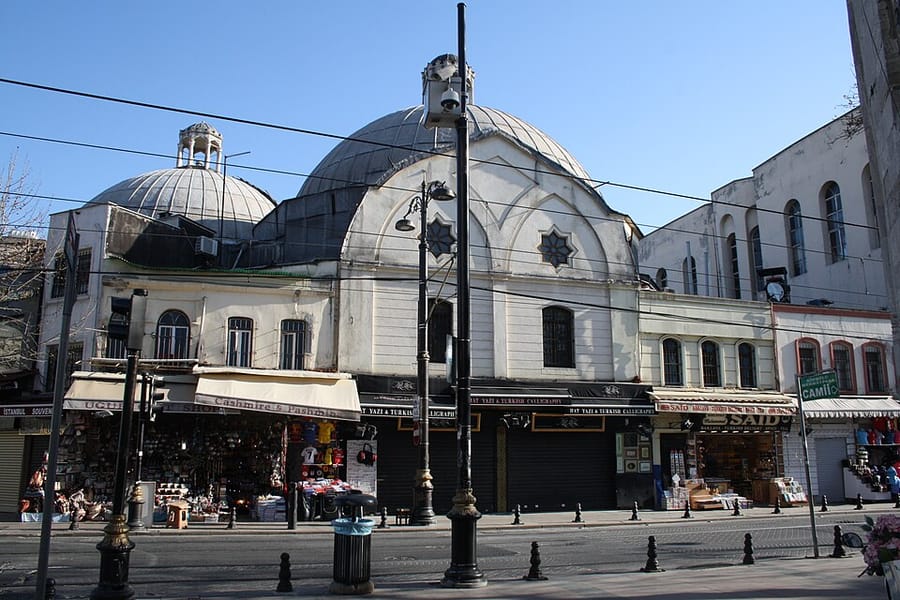

Nurbanu Sultan's double bath
Standing on the Divanyolu beside the Column of Constantine (Çemberlitaş), the bath has an inscription over its door that became legible during the last restoration and gives the date 1584. It shows that the building, also called the Valide Hamam, was commissioned by Nurbanu Sultan, wife of Selim II and mother of Murad III, to provide income for her foundations, above all the Atik Valide Complex in Üsküdar. It would be expected to be a work of Mimar Sinan, but as it is not named in the sources listing his works, its architect remains uncertain.
It is a double bath made up of two identical sections. What makes it unique among Ottoman baths are its hot rooms: square outside, inside they become twelve-sided spaces ringed by twelve columns, with domed private cubicles in the corners, and the floor is decorated with geometric inlay of coloured stone. In 1868 part of the women's changing hall was cut away to widen the Divanyolu. The women's section later became a restaurant and then a carpet shop; the men's section, still working as a bath, was extensively restored in 1972–1973.
The inscription and the Köprülüs
The bath stands on the Vezir Hanı side of the monument that Emperor Constantine I erected in the middle of the forum bearing his name, that is, on the site of the old square. Its door inscription long remained unread; the Austrian scholar H. Glück could make out only the words Sultan Murad and Sultan Valide and guessed that the bath belonged to the endowment of Murad III's mother. The eight-line chronogram revealed when the inscription was cleaned was written by the poet Sai Mustafa Çelebi. Sinan had also built Nurbanu Sultan's Yeşildirek Bath in Üsküdar and her bath at Ayakapı; since Nurbanu died in 1583 and Sinan in 1588, the building falls within Sinan's years as chief architect.
It has been claimed that the Köprülü family, whose mansions stood right next door, had the bath repaired; the family also built a library opposite it and the Vezir Hanı behind it. On the pediments of the cell doors in the hot room are Persian and Turkish texts attributed to Köprülü Mehmed Pasha, one of which says the bath has no equal on earth. Whether these were added later and whether they really have anything to do with the Köprülüs has not yet been investigated.
Domes and inlaid stone floor
The changing rooms of both sections are covered by large domes carried on corner squinches; those of the women's section are fluted. Of the lanterns that once crowned these domes, only the women's survives: an elegantly decorated lantern capped by a small dome on arches resting on slender columns. Each section has a warm room with three domes, flanked by latrines projecting from the mass of the building. In the hot room, columns with lozenge capitals carry the dome on pointed arches, and the triangular pediments of the cell doors are decorated with buds.
The coloured stone inlay of the hot-room floor is of unmatched richness: white and red buds line the tips of a twelve-sided frame of green stone, a row of black and white buds encloses the central field, and in the middle interlocking six-pointed stars are set within an intricate black network.
Later centuries
Glück reports that in 1916–1917 the bath had suffered a fire which destroyed the interior of the changing room and the wooden shops outside the door; at that time it served as a military disinfection station, doors had been opened between the two sections and a boiler heating system installed in the women's section. Sold at an unknown date by the Pious Foundations Administration, the bath has changed hands several times. The entrance of the men's section now lies in a hollow because the street level has risen, and shops built against the facade hide the exterior. The corner cut off in 1868 was closed with a wall pierced by rectangular windows below and star-shaped ones above. The names of the owner who commissioned the last restoration and of its architect are recorded in an inscription in the corridor leading down to the entrance.
Source: TDV Encyclopedia of Islam (TDV İslâm Ansiklopedisi), “ÇEMBERLİTAŞ HAMAMI” (Semavi Eyice)
Related sultans
Cite as: Atlas of the Sultans, “Çemberlitaş Hamam · Ottoman monuments”, https://padisahlaratlasi.com/en/monuments/cemberlitas-hamam/ (last updated 21 November 2026). Corrections · Image credits