TRENDEFRARAtlas of the Sultans · Ottoman monuments
Selimiye Mosque and Complex (Edirne)
Monument · Mosque and complex, 1568–1574
- Type
- Complex (külliye)
- Built
- 1568–1574
A work of Mimar Sinan


Selim II's work in Edirne
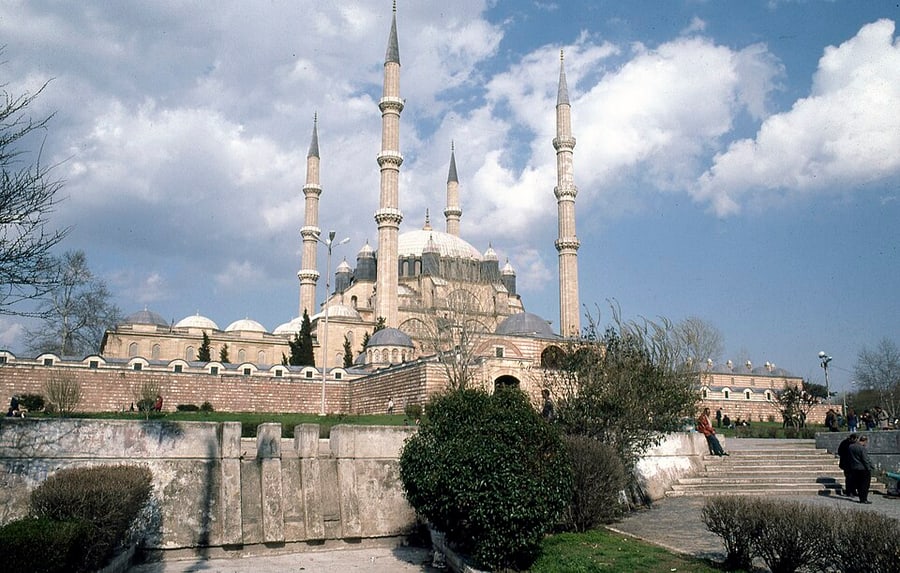
Sultan Selim II had the complex built in the centre of Edirne, on the site of the old palace, at the place called Kavak Meydanı. The mosque, the madrasas and the shops on the eastern side of the arasta (market street) were built by Mimar Sinan between 1568 and 1574. The western shops of the arasta, its vaulted roof, the prayer dome and the primary school are accepted to have been completed after the death of Selim II, under Murad III, by the architect Davud Ağa.
The complex consists of the mosque in the middle of a large rectangular courtyard, two madrasas to the southeast and southwest, and the arasta and the primary school to the west. Built on a rise of about 70 metres in Edirne, a city of the plain, the Selimiye can be seen on the flat land from every direction and from very far away; those approaching the city first see its minarets from 10-15 kilometres away, and then its dome. The authors of the article note that here Sinan once again showed his mastery in choosing the right site.
The summit of Ottoman architecture
According to the authors, the mosque, which represents the highest level reached by Ottoman architecture, stands on a raised base in the middle of a courtyard measuring 130 × 190 metres. In this building with a central plan on eight supports, the main dome, resting on eight twelve-sided piers, is 31.30 metres in diameter and 42.25 metres high. Because the piers were moved close to the walls, an undivided, wide and spacious space was obtained beneath the dome. The Selimiye, regarded as the summit of the efforts to achieve unity of space, entered the history of world art, in the authors' words, by surpassing all the sultans' mosques, including the Süleymaniye, and Hagia Sophia.
For the first time the four minarets rise from the corners of the domed main space; the minarets, with fluted shafts and three balconies each, are 70.89 metres high. In the minarets on the courtyard side, three separate staircases independent of one another lead to the balconies; three people can reach the different balconies without seeing each other. Underglaze tiles decorate the mihrab area, the royal lodge and the minbar kiosk. The upside-down tulip motif on one of the columns of the muezzins' gallery has become the subject of folk legends.
Madrasas, arasta and other buildings
The Darülhadis (school of hadith) Madrasa was completed in 1570–71 and its first professor was appointed in 1572–73. The Darülkurra (school of Qur'an recitation) Madrasa, placed symmetrically to it, is the only one of Sinan's darülkurras to survive with its arrangement of cells. The arasta, built to provide income for the mosque, is 255 metres long and has 124 shops; at the point where its two arms meet rises an impressive prayer dome. On the mihrab side of the mosque is an open tomb built in the name of Prince Selim, son of Ahmed III. The galleries on the western side of the mosque have been arranged as a library.
The present state
The Darülhadis Madrasa is used as the Museum of Turkish and Islamic Art, founded in 1971. The Darülkurra Madrasa has been turned into the Foundations Museum, where metalwork, tiles and calligraphy brought from endowed buildings in and around Edirne are displayed. The primary school is used by an association, and its ground floor serves as a coffeehouse. The site of the two-storey han with a large courtyard that once stood west of the arasta, and of some other buildings, has today been laid out as a park.
Related sultans
Cite as: Atlas of the Sultans, “Selimiye Mosque and Complex (Edirne) · Ottoman monuments”, https://padisahlaratlasi.com/en/monuments/selimiye-mosque-and-complex-edirne/ (last updated 21 November 2026). Corrections · Image credits