TRENDEFRARAtlas of the Sultans · Grand viziers
Keçecizade Fuad Pasha
Grand vizier twice, 1861–1866
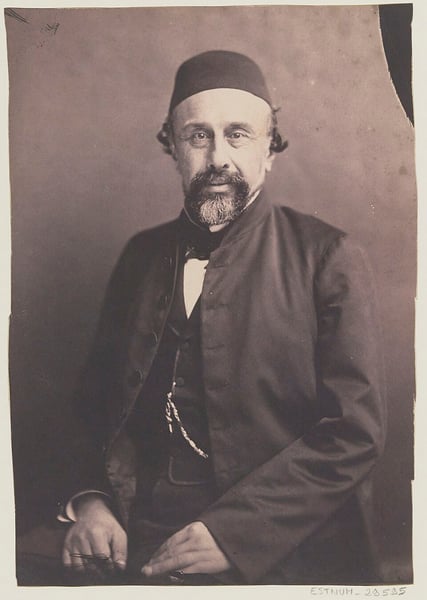

From the medical school to foreign affairs
He was born in Istanbul on 17 January 1815; his father was the poet Keçecizade Izzet Molla. He first learned Arabic and Persian on the scholarly (ilmiye) path; when his father was exiled he entered the Medical School (Mekteb-i Tıbbiyye), and since teaching there was in French he learned that language too. After graduating as a doctor with the rank of captain, he moved in 1837, at the encouragement of Mustafa Reşid Pasha, to the translation office of the Sublime Porte. He served as first secretary of the London embassy and went on a special mission to Spain and Portugal.
In 1849, in the crisis that broke out over the Hungarian and Polish refugees, he was sent to St Petersburg as envoy extraordinary; by talking with the tsar he settled the matter peacefully. In Bursa he wrote the Kavaid-i Osmaniyye (an Ottoman grammar) together with Cevdet Efendi (later Pasha). When he was sent to Egypt in 1852, he reached an agreement with the governor Abbas Pasha and succeeded in raising Egypt's annual tribute from sixty thousand to eighty thousand purses (kese).
Foreign minister and the Damascus affair
In 1852 he became minister of foreign affairs. His pro-French stance in the question of the Holy Places provoked a reaction in Russia; after the arrival of Prince Menshikov he resigned. During the Crimean War, by suppressing a Greek violation of the border, he also showed that he was a good commander; in the following years he served several times as minister of foreign affairs and as president of the Supreme Council of the Tanzimat (Meclis-i Ali-i Tanzimat).
In 1860, after the events that began in Lebanon and spread to Damascus, he was sent to the region with wide powers. To leave no opening for French intervention he had 167 people whom he considered connected with the Damascus events executed, and had the governor of Damascus shot; this severity caused a reaction both in Damascus and in Istanbul. He rejected the offer of the khedivate of Syria, believing that it would pave the way for the separation of Mount Lebanon (Cebelilübnan). According to the author of the article, at the end of this process Syria remained under Ottoman rule for another half-century.
Two grand vizierates
Abdulaziz made him grand vizier on 22 November 1861. He took measures to put the finances in order and had paper money withdrawn from circulation; but when the budget could not be balanced, he resigned at the beginning of 1863. He did not leave the sultan's side during his journey to Egypt, received for the first time in Ottoman history the title “yaver-i ekrem” (chief aide-de-camp), and on 1 June 1863 became grand vizier for the second time. This grand vizierate, which lasted more than three years, ended in 1866 when a note in which he opposed Abdulaziz's marriage to the daughter of the Khedive of Egypt, Ismail Pasha, reached the sultan by mistake.
Last years and assessment
On the European journey of 1867 he was at Abdulaziz's side as minister of foreign affairs. When his heart disease worsened he died on 12 February 1869 in Nice, where he had gone to spend the winter, and was buried next to the mosque he had built in Sultanahmet. The author of the article, Orhan F. Köprülü, counts him among the three important figures of the Tanzimat era; he states that he trusted Britain most but, without tying himself to any side, put the interest of the state first. He feared that nationalist currents would tear the state apart and argued that this could be prevented by treating non-Muslims equally. The establishment of the provincial (vilayet) system, the Galatasaray Lycée and the Darülfünun (university) are counted among his services. Who actually wrote the political testament attributed to him, however, is disputed. Fuad Pasha, regarded as a powerful prose writer, is remembered for witty anecdotes that are still told today. The mansion he had built in Beyazıt, in which he never lived, today houses the Faculty of Pharmacy of Istanbul University.
Source: TDV Encyclopedia of Islam, “FUAD PAŞA, Keçecizâde” (Orhan F. Köprülü)
Related sultans
Cite as: Atlas of the Sultans, “Keçecizade Fuad Pasha · Grand viziers”, https://padisahlaratlasi.com/en/grand-viziers/kececizade-fuad-pasha/ (last updated 21 November 2026). Corrections · Image credits