TRENDEFRARAtlas of the Sultans · Grand viziers
Mahmud Nedim Pasha
Grand vizier, 1871–1872, 1875–1876
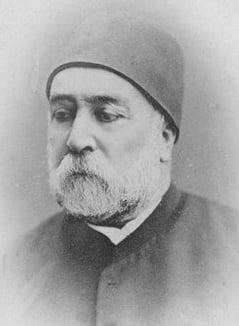

Under Reşid Pasha's patronage
He was born in Istanbul in 1818; his father was the governor of Baghdad, Gürcü Mehmed Necib Pasha. In 1831 he entered the correspondence office of the grand vizierate (Sadaret Mektubi Kalemi), attracted the attention of Mustafa Reşid Pasha and in 1847 became head of correspondence of the grand vizierate. After serving as undersecretary for foreign affairs, he became governor of Sidon with the rank of vizier in 1855; he served as governor of Damascus and Izmir, as minister of commerce and, for seven years, as governor of Tripoli in Libya (Trablusgarp). When his links with the Young Ottomans, who opposed Ali Pasha, came to light, he came to Istanbul and asked for pardon. In 1868 he became minister of the navy, and when he fell out with Ali Pasha he strengthened his ties with the palace.
First grand vizierate: purges and Russian influence
After Ali Pasha's death he became grand vizier on 8 September 1871. He acted in accordance with the wishes of the sultan and of Valide Sultan Pertevniyal; he removed the statesmen of the Tanzimat from office and sent them off to the four corners of the country, and moved governors around frequently. He reduced the number of departments of the Council of State (Şura-yı Devlet), where the reformers were concentrated, to three, and made some provinces smaller while creating new ones. In the name of economy he put a large number of officials on the inactive list and cut salaries; while a balanced budget was being announced, officials' salaries went unpaid for months. The berat of the Bulgarian Exarchate was issued in this period. The article notes that there were serious allegations that he took bribes in the new railway agreement made with Baron Hirsch.
In foreign policy he departed from the Europe-oriented line of the Tanzimat statesmen and came under the influence of the Russian ambassador Ignatiev; among the people he came to be called “Nedimov”. When the reactions grew, Abdulaziz dismissed him on 31 July 1872 and appointed Midhat Pasha in his place. The fact that during a grand vizierate of about eleven months he worked with five seraskers (war ministers) and five finance ministers shows how much he tampered with the position of officials.
Second grand vizierate and the financial crisis
After he said he could resolve the Herzegovina revolt in a short time, he became grand vizier again on 26 August 1875. The decision of 6 October 1875, which provided for half of the debt payments to be made in cash and half in bonds in order to close the budget deficit, brought down bond prices and turned European public opinion against the Ottomans. The revolt spread to Bosnia, and then an uprising broke out among the Bulgarians as well; the Salonica incident made the situation even more difficult. He was dismissed on 11 May 1876 after demonstrations by medrese students who had risen up, partly under the influence of Midhat Pasha and Hüseyin Avni Pasha. In this second grand vizierate, again under Ignatiev's influence, the organization of the nahiyes (sub-districts) was changed so that their directors would be appointed according to the majority of the population; as a result many nahiye directorships in Rumelia passed to Christians. Serious pressure was also put on the press.
Last years
In the reign of Abdulhamid II he asked for pardon; in Said Pasha's first grand vizierate, in 1879, he became minister of the interior, and he left office in 1883 because of illness. He died on 14 May 1883; his tomb is in Cağaloğlu. He was intelligent, a poet and well versed in the correspondence procedures of the Sublime Porte; the article reports that those who knew him described him as suspicious, fickle, inconstant and corrupt. His Ayine-i Devlet, containing his views on the administration of the state and the Tanzimat, has been published together with his autobiographical poem Hasbihal.
Source: TDV Encyclopedia of Islam, “MAHMUD NEDİM PAŞA” (Ali Akyıldız)
Related sultans
Cite as: Atlas of the Sultans, “Mahmud Nedim Pasha · Grand viziers”, https://padisahlaratlasi.com/en/grand-viziers/mahmud-nedim-pasha/ (last updated 21 November 2026). Corrections · Image credits