TRENDEFRARAtlas of the Sultans · Ottoman monuments
Tomb of Osman Gazi
Monument · Tomb, Bursa, 1863
- Type
- Mausoleum (türbe)
- Built
- 1863

From the Silver Dome to the present tomb
According to the sources, while Bursa was under siege Osman Gazi saw the chapel of a monastery in the city shining like silver and asked in his will to be buried beneath this silver dome. When Orhan Bey took the city, he buried his father in this round Byzantine building known as the Gümüşlü Kümbet (Silver Dome), and other parts of the monastery were converted into a madrasa and a mosque. Also popularly called the Davullu Manastır, the tomb burned in 1801 and was repaired, and it was very badly damaged in the earthquake of 1855.
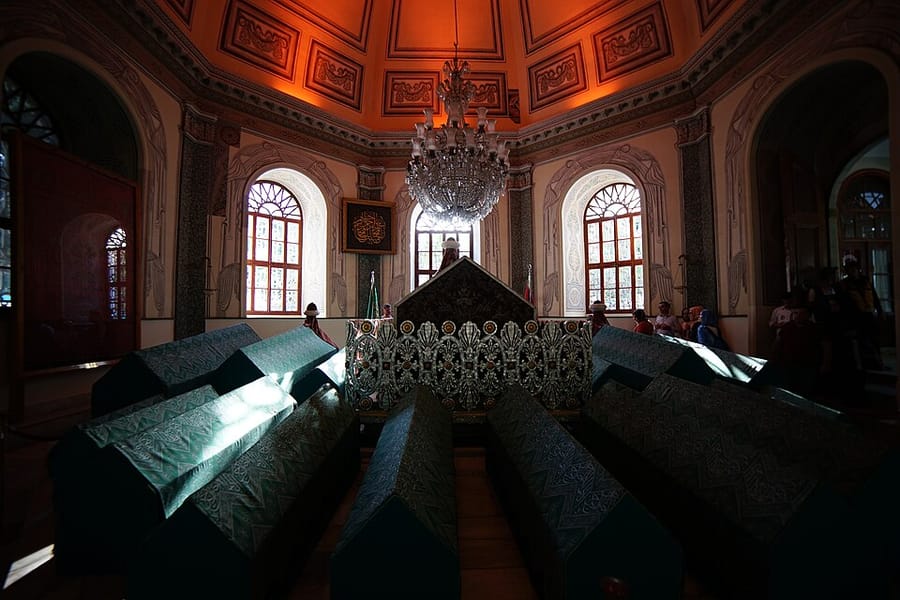
The present tomb was built in 1863 by Sultan Abdulaziz, slightly larger than its predecessor; the date comes from a ten-line inscription composed by Osman Nevres. The building consists of a porch bearing Abdulaziz's monogram (tuğra), an entrance hall, a room for the tomb keeper and the burial chamber, whose walls, drum and dome are all octagonal. The cenotaph, with its mother-of-pearl inlaid grille, was last repaired in 2004. Of the seventeen cenotaphs in the tomb, five are identified: those of Osman Gazi, his son Alaeddin Bey, Orhan Bey's wife Asporça Hatun, Orhan's son Ibrahim and Murad I's son Savcı Bey.
The long siege and the name Davullu Manastır
The conquest of Bursa was not easy: small forts called havale were built to the east and west of the city, which was kept under siege for twenty to twenty-five years. After the Orhan Mosque, converted from part of the monastery, collapsed in an earthquake, its inscription was set into the east wall of the Şehadet Mosque.
Because the drum, rosary, horsetail standard and banner sent to Osman Bey by the Seljuk Sultan Alaeddin as tokens of independence were kept in this tomb, the building was popularly called Davullu Manastır (the Monastery with the Drum). Foreign writers in particular misunderstood this as the Monastery of David, and the belief that all round buildings were dedicated to Saint Elijah also led to its being called the Monastery of Aya Eliya. Recent research, however, has found round buildings dedicated to other saints as well.
Decoration and gifts
The inscription was written in ta'liq script by the Mevlevi Zeki Dede. The tomb, reached by going down a few steps, is lit by round-arched windows with voluted keystones, marble frames and cast-iron grilles. Each segment of the dome is decorated with two garlands; the simple painted decoration has been renewed in restorations, and the corner pilasters have the appearance of green marble. The cenotaph's velvet cover with baroque floral decoration and its mother-of-pearl inlaid screen are works of art in their own right; the screen was repaired in 2004 by the inlay master Zafer Karazeybek. At the head of the cover is a thuluth inscription by Abdülfettah Efendi embroidered in silver thread, and a crystal chandelier with white lamps hangs above the cenotaph.
Over the centuries Ottoman statesmen and notables of other Islamic countries presented gifts to the tomb, but only two survive. One is the Victory verse composed in thuluth by the calligrapher Hakkı in gilt on a black ground; beneath it can be read the name of the Society of Primary School Teachers and dates corresponding to 1922. The other is a panel presented by Bursa Yurdu, with five lines embroidered in gold thread on red satin.
Source: TDV Encyclopedia of Islam (TDV İslâm Ansiklopedisi), “OSMAN GAZİ TÜRBESİ” (Doğan Yavaş)
Related sultans
Cite as: Atlas of the Sultans, “Tomb of Osman Gazi · Ottoman monuments”, https://padisahlaratlasi.com/en/monuments/tomb-of-osman-gazi/ (last updated 21 November 2026). Corrections · Image credits