TRENDEFRARAtlas of the Sultans · 31 / 39 · sultan
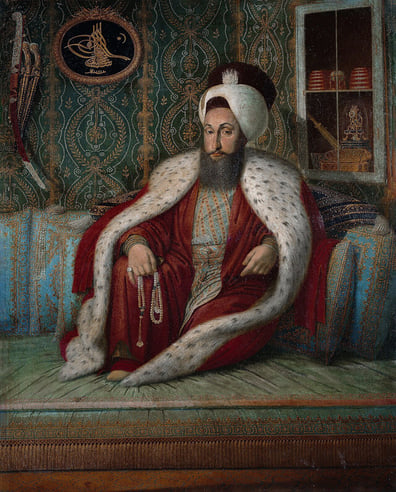
Portrait made in his lifetime — Konstantin Kapıdağlı · 1803
Selim III
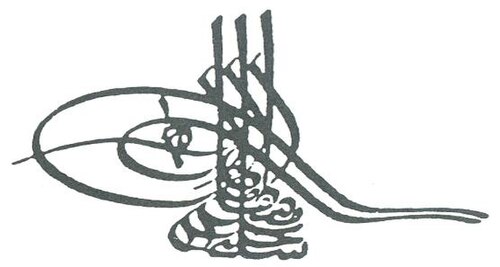
He launched a thorough programme of reform: a new army, permanent embassies, engineering schools. The programme was overthrown by a Janissary revolt and he himself was killed; yet the Nizam-ı Cedid became the blueprint for Mahmud II's reforms.
Open the reign of Selim III on the map▶ Watch the 1-minute video: YouTube · Instagram · TikTok
Interesting fact
As a prince he wrote poetry as “Ilhami” and took music lessons from Kırimi Ahmed Kamil Efendi. As a performer and above all as a composer he is one of the leading figures of Turkish music; his era is regarded as a musical school bearing his name.
Source: TDV İslâm Ansiklopedisi (Turkish), article “SELİM III”
Life
A prince raised on hopes of reform
Selim was born on 24 December 1761. His father was Mustafa III and his mother Mihrişah Sultan. His father used to take him to firing trials of new cannon and encouraged his interest in artillery. Although Mustafa III, at his death, willed that Selim be enthroned, the throne passed to his uncle Abdulhamid I. Throughout his uncle's reign Selim lived confined in the palace, yet he corresponded secretly with King Louis XVI of France, and a group seeking reform formed around him. In this period, under the pen name “Ilhami,” he wrote poems expressing his determination to fight the enemy and his belief that the bad course of affairs would end with his own accession.
Enthroned in wartime
When Abdulhamid I died on 7 April 1789, Selim came to the throne at the age of twenty-eight. The ongoing war with Russia and Austria was going badly. Wishing to begin his new reign with a victory, he rejected peace proposals. Through Prussia's intervention, Austria made peace at Ziştovi (Sistova) in 1791; the war with Russia, however, continued with heavy losses and ended in 1792 with the Treaty of Jassy (Yaş). This treaty recognized Russia's annexation of Crimea.
The bitter results of the war convinced Selim that a thorough renewal was unavoidable. While the army was still on its way home, he asked the statesmen for memoranda on what needed to be done.
The Nizam-ı Cedid
The reforms that began in 1792 became known as the Nizam-ı Cedid (“New Order”). A new infantry army trained in the European manner was established; in Üsküdar, in the district known today as Selimiye, a large barracks was built together with a mosque and surrounding buildings. The Naval Engineering School (Mühendishane-i Bahri) was developed; in Hasköy an engineering school was founded to train military engineers for the bombardier and sapper corps (1795, Mühendishane-i Berri-i Hümayun), and a printing press was opened there (1797); a large barracks was also built at Levent, and the navy was renewed. A separate treasury called the “Irad-ı Cedid” was created to meet the expenses of the new army. Selim also took a close interest in printing and personally supervised the books to be printed.
Relations with Europe were renewed as well: the first permanent embassies were opened in London (1792) and in Paris, Berlin and Vienna (1797). They were used both for diplomacy and for bringing experts from Europe. Selim also had the Eyüp Sultan Mosque and Tomb rebuilt. But the old army system remained in place, and the two armies had to exist side by side.
Crises
Napoleon Bonaparte's capture of Italy, the fall of Venice and finally his attack on Egypt in July 1798 drew the Ottoman state into an alliance with Russia and Britain. At home, the revolt of Pazvandoğlu in Vidin could not be put down; the raids of the bandit groups in Rumelia known as the “Dağlılar” (mountaineers) brought Selim to the point of saying, “They have made us a laughingstock before the world.” The Serbian uprisings also took on the character of a national movement for the first time in this period (1804). In Arabia, the Wahhabis' seizure of Mecca and Medina and their cutting of the pilgrimage route (1806) shook the legitimacy of his reign.
An attempt to extend the Nizam-ı Cedid to Rumelia led to clashes at Edirne in 1806 and was withdrawn. In the same year a new war with Russia began. In February 1807 the British fleet passed through the Dardanelles and appeared before Istanbul; famine and high prices broke out in the city.
The Kabakçı revolt and his death
After the army had set out on the Russian campaign, the Kabakçı Mustafa revolt broke out in May 1807. It was started by the Bosphorus fortress auxiliaries (yamaks) and supported by the deputy grand vizier (kaymakam) Köse Musa Pasha and the şeyhülislam (chief mufti) Topal Ataullah Efendi. Hoping to keep his throne, Selim abolished the Nizam-ı Cedid and sacrificed the reformers whom the rebels demanded; he was nevertheless deposed and replaced by his cousin Mustafa IV.
Selim's supporters gathered around Alemdar Mustafa Pasha, the ayan (provincial notable) of Rusçuk. Alemdar marched on the palace on 28 July 1808 to restore him to the throne; but before he could enter the palace, Selim was killed on the orders of Mustafa IV. The next day, amid the grief of a great crowd, he was buried in the tomb of the mosque his father had built at Laleli.
Selim was also one of the important composers of classical Turkish music; his works are still performed today. Although the Nizam-ı Cedid he founded collapsed, the path he opened was continued through the reforms of his cousin Mahmud II.
Source: TDV Encyclopedia of Islam (TDV İslâm Ansiklopedisi), “Selim III” (Kemal Beydilli); Ahmed Cavid, Vasıf, Cevdet Pasha, Cabi Ömer Efendi and the reports of European envoys of the period are the main sources of this article.
Meanwhile in the world
Contemporary rulers
- Catherine II (the Great)Empress of Russia · 1762–1796Enlightened ruler who reorganized the Russian Empire and expanded its borders
- George IIIKing of Great Britain and Ireland · 1760–1820King during the loss of the American colonies and the Napoleonic Wars
- Francis IIHoly Roman Emperor · 1792–1806Last Holy Roman emperor; took the title Emperor of Austria in 1804
- Napoleon IEmperor of the French · 1804–1815Rose from the revolutionary army to dominate much of Europe
- Alexander IEmperor of Russia · 1801–1825Tsar who first fought Napoleon, then led the coalition that defeated him
- Fath-Ali ShahShah of Iran (Qajar dynasty) · 1797–1834Qajar shah who lost Caucasian territories in two wars with Russia
- Jiaqing EmperorEmperor of China (Qing dynasty) · 1796–1820Qing emperor beset by the White Lotus Rebellion and treasury deficits
What was happening in the world?
- 1789Parisians storm the Bastille prison; the event becomes the symbol of the French Revolution and accelerates it.
- 1789George Washington takes the oath in New York as the first president of the United States.
- 1796Edward Jenner uses cowpox material to give the first vaccination against smallpox.
- 1800Alessandro Volta builds the voltaic pile, the first battery to provide a continuous electric current.
- 1804After a revolution that began as a slave uprising, Haiti declares its independence from France.
- 1806The Holy Roman Empire comes to an end when Francis II gives up the imperial title.
Sources: britannica.com [1] [2] [3] [4] [5] [6] [7] [8] [9] [10] [11] [12] [13]
Family
| Father | Mustafa III |
|---|---|
| Mother | Mihrişah Sultan |
| Consorts | Refet Kadın, Nefizar Kadın, Afitab Kadın |
| Children | Two daughters died young; he had no child to continue the line |
Major achievements
- Founding of the Nizam-ı Cedid army and its treasury
- First permanent embassies in European capitals (London 1793, Paris, Vienna, Berlin)
- Imperial School of Military Engineering (1795)
- Egypt recovered from French occupation (1801)
- As a composer: creator of the Suzidilara mode, the most productive musician among the sultans
- Support for printing and translation
Treaties
- Treaty of Jassy (1792, Russia)
- Alliance with Britain and Russia (1799)
- Treaty of Paris with France (1802)
Grand viziers
| Name | From | To | Length |
|---|---|---|---|
| Koca Yusuf Pasha | January 24, 1786 | June 7, 1789 | 3 years, 134 days |
| Kethüda Hasan Pasha | June 7, 1789 | November 23, 1789 | 169 days |
| Cezayirli Gazi Hasan Pasha | December 3, 1789 | March 30, 1790 | 117 days |
| Şerif Hasan Pasha | April 16, 1790 | February 13, 1791 | 303 days |
| Koca Yusuf Pasha (term 2) | February 1791 | May 3, 1792 | 1-2 years |
| Melek Mehmed Pasha | May 4, 1792 | October 19, 1794 | 2 years, 168 days |
| Safranbolulu Izzet Mehmed Pasha | October 20, 1794 | August 30, 1798 | 3 years, 314 days |
| Yusuf Ziya Pasha | September 1798 | April 24, 1805 | 6-7 years |
| Hafız Ismail Pasha | April 24, 1805 | September 14, 1806 | 1 year, 143 days |
| Ibrahim Hilmi Pasha | September 14, 1806 | June 3, 1807 | 262 days |
Battles and treaties
| Year | Event | Result / parties |
|---|---|---|
| 1789 | Battle: Battles of Focșani and Rymnik (1789) | The Ottoman army suffered two heavy routs; its commander was dismissed |
| 1790 | Naval battle: Tendra | Ottoman fleet defeated: one battleship blew up, one captured |
| 1791 | Naval battle: Kaliakra | The Ottoman fleet withdrew towards the Bosphorus; neither side lost a ship |
| 1791 | Treaty: Treaty of Sistova | Ottoman Empire, Habsburg Monarchy |
| 1792 | Treaty: Treaty of Jassy | Russian Empire, Ottoman Empire |
| 1798 | Battle: French invasion of Egypt | The French forces evacuated Egypt, which returned to Ottoman rule |
| 1799 | Treaty: Alliance with Britain and Russia | |
| 1799 | Siege: Siege of Acre (1799) | The French siege was repulsed; Bonaparte withdrew |
| 1802 | Treaty: Treaty of Paris with France | First French Republic, Ottoman Empire |
| 1804 | Revolt: First Serbian Uprising | Partial autonomy was conceded in the Treaty of Bucharest (1812); the uprising, which demanded more, was crushed in 1813, Belgrade was retaken and Karađorđe … |
| 1807 | Naval battle: British passage of the Dardanelles | The British fleet passed the Straits and reached Istanbul; afterwards the Straits were refortified, notably at Nağaraburnu |
| 1807 | Naval battle: Battle of the Dardanelles (1807) | Indecisive |
| 1807 | Revolt: Kabakçı Mustafa Revolt | Selim III was deposed and Mustafa IV enthroned (29 May 1807); the Nizam-ı Cedid came to an end |
Full infoboxes are in the site’s “Battles and Treaties” tab; source: TDV Encyclopedia of Islam.
Death
Deposed in the Kabakçı Mustafa revolt of 1807, he was murdered in Topkapı Palace in 1808 by those who wanted to keep Mustafa IV on the throne.
Territorial change
| Year | Region | Event | Source |
|---|---|---|---|
| 1791 | − Anapa–Novorossiysk coast | Occupied on 26 July 1791 at the end of the third Russian siege; returned when the Treaty of Jassy (10 January 1792) accepted the old borders in the Caucasus (TDV, Anapa) | TDV İA, “ANAPA” |
| 1792 | + Anapa–Novorossiysk coast | Occupied on 26 July 1791 at the end of the third Russian siege; returned when the Treaty of Jassy (10 January 1792) accepted the old borders in the Caucasus (TDV, Anapa) | TDV İA, “ANAPA” |
| 1806 | − Budjak–Bessarabia | Russo-Turkish War of 1806–1812 — Bender and Akkerman fell to Russia in 1806, Izmail in 1809; the Treaty of Bucharest (1812) left Bessarabia to Russia | TDV İA, “SELİM III” |
The lands that changed hands in this period, and the battles or treaties that brought the changes, can be seen on the map: map of the reign of Selim III.
Cite as: Atlas of the Sultans, “Selim III: Reign Map, Wars and Conquests (1789–1807)”, https://padisahlaratlasi.com/en/sultans/iii-selim/ (last updated 21 November 2026). Corrections · Image credits
Terms on this page: Janissaries · Nizam-ı Cedid
Grand viziers of this reign: Koca Yusuf Pasha · Alemdar Mustafa Pasha
Monuments of this reign: Emir Sultan Mosque · Eyüp Sultan Mosque · Galata Mevlevi Lodge · Aynalıkavak Pavilion · Hala Sultan Tekke · Çapanoğlu Mosque · Yıldız Palace · Et'hem Bey Mosque · Teşvikiye Mosque · Selimiye Barracks · Üsküdar Selimiye Mosque
State organisation: The Treasury (Defterdarlık) and Ottoman Finance