TRENDEFRARAtlas of the Sultans · Grand viziers
Koca Yusuf Pasha
Grand vizier, 1786–1789, 1791–1792
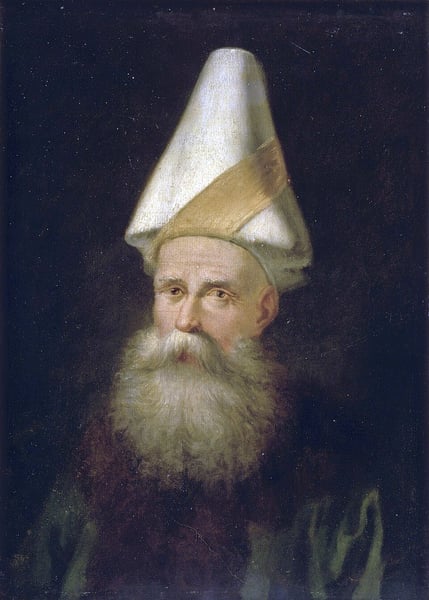 AI

From the coffeehouse to agent at the Porte
He was probably born in the 1730s. A slave of Georgian origin, he was bought and brought up in 1748 by the harbour master Hasan Kaptan; even after being freed he did not leave his master's side until the latter's death. He then ran a coffeehouse in Kasımpaşa, went to sea with the fleet in the summers and used the capital he saved in trade. He met Cezayirli Hasan Pasha, also of Georgian origin, probably through some business; when Cezayirli became grand admiral (kaptan-ı derya), Yusuf became first his treasurer and then his agent at the Porte (kapı kethüdası) with the rank of chief gatekeeper. The records in the sources that he was Cezayirli's slave are thought to stem from confusion with the harbour master Hasan.
Cezayirli's grand vizier
Cezayirli Hasan Pasha, the most powerful figure of Abdulhamid I's reign, preferred to put his own man in the grand vizierate and run affairs from behind the scenes rather than take the office himself. He had Yusuf, who had no experience of government at all, first appointed governor of the Morea with the rank of vizier. The governor's procession of unparalleled splendour organized when he was seen off to the Morea was also intended to prepare public opinion for an imminent grand vizierate. Indeed, on 24 January 1786 Şahin Ali Pasha was dismissed and Yusuf Pasha appointed in his place. The author of the article, Kemal Beydilli, likens this appointment to Suleiman the Magnificent's raising of Ibrahim Pasha directly from head of the privy chamber to the grand vizierate, and states that it was hardly possible for the new grand vizier to do anything without Cezayirli's approval.
War and defeats
Yusuf Pasha, who considered war inevitable under the pressure of a public enraged by the loss of the Crimea, brought the sultan, who favoured peace, closer to a decision for war, and on 16 August 1787 war was declared on Russia. The failure to take into account that Austria would also enter the war on Russia's side was, according to the author of the article, a false step taken from the very start. The successes in the battles of Mehadia and Caransebeş (Şebeş) did not last long; the fall of the fortress of Özü (Ochakiv) on 17 December 1788 and the killing of more than ten thousand of its inhabitants discredited both Yusuf Pasha and Cezayirli. Selim III dismissed him on 7 June 1789 after the defeat at Galați (Kalas).
While he was commander-in-chief at Vidin, after the execution of Şerif Hasan Pasha, the grand vizierate was given to him again, and on 27 February 1791 he took up his post at the camp in Shumen. After the defeat at Măcin (Maçin), the leaders of the army decided unanimously that peace was unavoidable; Yusuf Pasha arranged for this decision to be sent to Istanbul in the form of a petition (mahzar) signed by all. He returned having closed the war with heavy losses and was dismissed on 3 May 1792.
Last years and assessment
Without suffering confiscation, he was appointed governor of Trabzon and guardian of Anapa. When papers were left at Hocapaşa demanding that he be reappointed grand vizier and announcing that otherwise the city would be set on fire, he was asked to leave Istanbul within a few days. He was then sent to the governorship of Jeddah, which he had sought. He struggled in the face of the activities of the Wahhabis and died suddenly in 1800. The reform memorandum (layiha) he submitted to Selim III shows, according to the author of the article, that he was unaware of military developments in Europe. Beydilli describes Yusuf Pasha, called “koca” (the elder) because of his advanced age, amid the “kaht-ı rical” — the lack of capable men — that marked the period, as the “ehven-i mevcud” (the best of a bad lot).
Source: TDV Encyclopedia of Islam, “YÛSUF PAŞA, Koca” (Kemal Beydilli)
Related sultans
Cite as: Atlas of the Sultans, “Koca Yusuf Pasha · Grand viziers”, https://padisahlaratlasi.com/en/grand-viziers/koca-yusuf-pasha/ (last updated 21 November 2026). Corrections · Image credits