TRENDEFRARAtlas of the Sultans · 30 / 39 · sultan
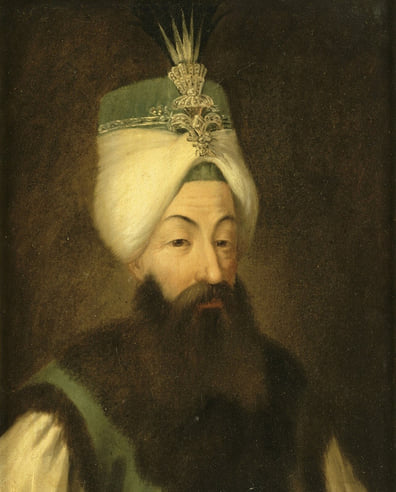
Portrait made in his lifetime — attributed to Ferdinando Tonioli · 1788
Abdulhamid I
The sultan of Küçük Kaynarca and the loss of Crimea. The first surrender of a Muslim people to a Christian state was a heavy blow to the claim to the caliphate; the naval engineering school is his lasting legacy.
Open the reign of Abdulhamid I on the map▶ Watch the 1-minute video: YouTube · Instagram · TikTok
Interesting fact
He spent his years as a prince under watch in the palace and came to the throne in 1774 at forty-nine. The Imperial Naval Engineering School (Mühendishane-i Bahri-i Hümayun) opened in his reign, on 29 April 1775.
Source: TDV İslâm Ansiklopedisi (Turkish), article “MUSTAFA III”
Life
Forty-four years under watch
Abdulhamid was born in Istanbul on 20 March 1725. He was the second son of Ahmed III to come to the throne, after his elder brother Mustafa III; his mother was Rabia Şermi Sultan. He was five years old when his father was deposed in the Patrona Halil revolt of 1730. His childhood and youth were spent under close watch, together with his brothers, in the palace quarters reserved for deposed sultans, and this situation continued throughout the reign of his elder brother Mustafa III.
Küçük Kaynarca
When his elder brother died, he came to the throne on 21 January 1774, at the age of forty-nine, during one of the most critical periods in the state's history. The Ottoman-Russian war, under way since 1768, was going badly; the rout and dispersal of the Ottoman army at Shumen (Şumnu) forced the sultan to accept a peace offer. With the Treaty of Küçük Kaynarca, signed on 21 July 1774, the Ottoman state lost important territories in the north, above all Azov, and was forced to recognize the independence of the Crimea. Russia also obtained certain rights concerning the Orthodox subjects of the Ottoman state, as well as the commercial privileges previously granted to France.
The treaty is one of the turning points of the Ottoman retreat: the separation from the Ottoman state of the Crimea, with its Muslim population, caused a great shock. Over the Muslims of the Crimea the sultan was recognized as having only a religious tie, in his capacity as caliph.
The loss of the Crimea
After the war Abdulhamid turned to internal order. Internal revolts were suppressed by the grand admiral (kaptanıderya) Cezayirli Gazi Hasan Pasha: the disturbances in Syria were calmed, the Mamluk (Kölemen) beys in Egypt were brought into line, and the disturbances in the Morea were ended (1779). Reform efforts were undertaken with the grand viziers Karavezir Seyyid Mehmed Pasha and Halil Hamid Pasha.
The Crimean question, however, remained unresolved. When the Russians sought to make Şahin Giray khan of the Crimea, the Aynalıkavak Convention (Aynalıkavak Tenkihnamesi) was signed through French mediation in 1779, and the Ottomans recognized Şahin Giray as khan. In 1783 Potemkin entered the Crimea and killed thousands of Muslims; the caliph's name was no longer read in the Friday sermons (hutbe) in the mosques of the Crimea. On 9 January 1784, with the Crimean Deed (Kırım Senedi), the Crimea was fully annexed to Russia. Knowing that the army was not ready, the sultan could not bring himself to decide on a new war.
Reforms and buildings
Abdulhamid took a close interest in military training. The navy was renewed through Gazi Hasan Pasha; the sultan attached importance to the training of naval officers at the Imperial Naval Engineering School (Mühendishane-i Bahri-i Hümayun), opened in 1775. The construction of light vessels on the model of French and English ships began, and French experts were also employed.
In 1777, at Sirkeci, on the site of today's Fourth Vakıf Han (IV. Vakıf Hanı), he built a charitable complex (imaret) consisting of a fountain, a primary school (sıbyan mektebi), a madrasa and a library; the library's books are today in the Süleymaniye Library. In 1778, in his mother's name, he had a mosque built on the Beylerbeyi shore together with a timekeeper's house (muvakkithane), a bath and a primary school. In 1783 he built a mosque, a fountain, a bath and shops in Emirgan; many fountains in Beylerbeyi, Çamlıca and Istinye are his work.
The last war and death
Russia's push beyond the Crimea into Georgia and its incitement of the Mamluks in Egypt made a new war inevitable. With Koca Yusuf Pasha's appointment as grand vizier, war was declared on Russia in 1787; Austria also entered the war on Russia's side. The sultan, who in 1785 had escaped the danger of being deposed through a plot by Grand Vizier Halil Hamid Pasha, saw his health deteriorate badly in these years.
According to the TDV article, Abdulhamid suffered a sudden stroke while reading the grand vizier's letter reporting that the fortress of Ochakov (Özi) had fallen to the Russians, and he died on 7 April 1789. He was buried in the tomb he had built at Bahçekapı. He is remembered as a good-natured, compassionate and diligent sultan. He had twelve daughters and seven sons, most of whom died young; of his sons, Mustafa IV and Mahmud II became sultans. He was succeeded by his nephew Selim III.
Source: TDV Encyclopedia of Islam (TDV İslâm Ansiklopedisi), “Abdülhamid I” (M. Münir Aktepe); the main sources of this article are Vasıf, Cevdet Pasha's Tarih, Enveri Sadullah Efendi and Ottoman archival documents.
Meanwhile in the world
Contemporary rulers
- Louis XVIKing of France · 1774–1792His reign, beset by financial crisis, ended in the French Revolution
- Joseph IIHoly Roman Emperor · 1765–1790'Enlightened despot'; co-ruled with his mother Maria Theresa until 1780
- Catherine II (the Great)Empress of Russia · 1762–1796Brought Russia fully into European political and cultural life
- Frederick II (the Great)King of Prussia · 1740–1786Seized Silesia and made Prussia a major European power
- George IIIKing of Great Britain and Ireland · 1760–1820British king during the American War of Independence
- Karim Khan ZandRuler of Iran (Zand dynasty) · 1750–1779Ruled as vakil (regent), never claiming the title of shah
- QianlongEmperor of China (Qing dynasty) · 1735–1796Fourth Qing emperor, who ruled for six decades
What was happening in the world?
- 1776The Continental Congress adopted the Declaration of Independence, separating thirteen American colonies from Britain.
- 1776Adam Smith published The Wealth of Nations, naming the division of labour the chief driver of growth.
- 1781Immanuel Kant published the Critique of Pure Reason, examining the limits of human reason.
- 1783The first free flight with people aboard took place over Paris in a Montgolfier hot-air balloon.
- 1783In the Peace of Paris, Britain recognized the independence of the United States.
- 1787The United States Constitution was signed at the Constitutional Convention in Philadelphia.
Sources: britannica.com [1] [2] [3] [4] [5] [6] [7] [8] [9] [10] [11] [12] [13]
Family
| Father | Ahmed III |
|---|---|
| Mother | Rabia Şermi Sultan |
| Consorts | Ayşe Sineperver Sultan, Nakşidil Sultan, Hümaşah Kadın, Ruhşah Kadın |
| Children | Mustafa IV, Mahmud II, Şehzade Abdullah, Esma Sultan |
Major achievements
- Enthroned after forty-nine years in the ‘cage’
- Founding of the Imperial Naval Engineering School (1775) — the first naval engineering school
- Fortification and artillery reforms with Cezayirli Hasan Pasha and Koca Yusuf Pasha
- Efforts to prevent the loss of Crimea after Küçük Kaynarca
Treaties
- Treaty of Küçük Kaynarca (1774, Russia)
- Convention of Aynalıkavak (1779, Russia)
Grand viziers
| Name | From | To | Length |
|---|---|---|---|
| Muhsinzade Mehmed Pasha (term 2) | November 28, 1771 | August 4, 1774 | 2 years, 249 days |
| Izzet Mehmed Pasha | August 10, 1774 | July 7, 1775 | 331 days |
| Derviş Mehmed Pasha | July 7, 1775 | January 5, 1777 | 1 year, 182 days |
| Darendeli Mehmed Pasha | January 5, 1777 | September 1, 1778 | 1 year, 239 days |
| Kalafat Mehmed Pasha | September 1, 1778 | August 21, 1779 | 354 days |
| Karavezir Mehmed Pasha | August 22, 1779 | February 20, 1781 | 1 year, 182 days |
| Izzet Mehmed Pasha (term 2) | March 18, 1781 | August 25, 1782 | 1 year, 160 days |
| Yeğen Hacı Mehmed Pasha | August 25, 1782 | December 31, 1782 | 128 days |
| Halil Hamid Pasha | December 31, 1782 | March 31, 1785 | 2 years, 90 days |
| Şahin Ali Pasha | March 31, 1785 | January 24, 1786 | 299 days |
| Koca Yusuf Pasha | January 24, 1786 | June 7, 1789 | 3 years, 134 days |
Battles and treaties
| Year | Event | Result / parties |
|---|---|---|
| 1774 | Treaty: Treaty of Küçük Kaynarca | Russian Empire, Ottoman Empire |
| 1779 | Treaty: Convention of Aynalıkavak | Russian Empire, Ottoman Empire |
| 1783 | Event: Annexation of Crimea | The Crimean Khanate was annexed by Russia |
| 1787 | Naval battle: Ochakiv (1787) | The relief of Ochakiv failed; the Ottoman fleet suffered serious losses |
| 1787 | Siege: Kinburn and the fall of Ochakov (1787–1788) | The attack on Kinburn was repulsed; Ochakov fell to the Russians after a siege |
| 1788 | Naval battle: Fidonisi (Snake Island) | Outcome disputed: the TDV presents it as an Ottoman success, Russian sources as a Russian one |
Full infoboxes are in the site’s “Battles and Treaties” tab; source: TDV Encyclopedia of Islam.
Death
He died of a brain haemorrhage in 1789 after hearing of the fall of Ochakiv fortress.
Territorial change
| Year | Region | Event | Source |
|---|---|---|---|
| 1783 | + Anapa–Novorossiysk coast | Anapa fortress: building began with materials sent from Soğucak; though financial trouble stalled it at times, it was largely completed in 1783–1786 (TDV, Anapa) | TDV İA, “ANAPA” (disputed date: Maddede inşaatın başlangıç yılı verilmez; kale 1783–1786'da büyük ölçüde tamamlandı) |
| 1788 | − Ochakiv (Yedisan) | Fall of the fortress of Ochakiv (December 1788) — Yedisan passed under Russian control; Treaty of Jassy (1792) | TDV İA, “ÖZÜ” |
The lands that changed hands in this period, and the battles or treaties that brought the changes, can be seen on the map: map of the reign of Abdulhamid I.
Cite as: Atlas of the Sultans, “Abdulhamid I: Reign Map, Wars and Conquests (1774–1789)”, https://padisahlaratlasi.com/en/sultans/i-abdulhamid/ (last updated 21 November 2026). Corrections · Image credits
Terms on this page: Caliphate · Şehzade
Grand viziers of this reign: Muhsinzade Mehmed Pasha · Halil Hamid Pasha · Koca Yusuf Pasha
Monuments of this reign: Molla Çelebi Mosque · Hekimoğlu Ali Pasha Mosque · Mosque of Muhammad Bey Abu al-Dhahab · Beylerbeyi Mosque (Istanbul) · Çapanoğlu Mosque · Jezzar Pasha Mosque · Ishak Pasha Palace · Hırka-i Şerif Mosque
Women of the dynasty in this reign: Nakşidil Sultan
Myths and misconceptions: Were Crimea, Wallachia and Moldavia Ottoman territory?