TRENDEFRARAtlas of the Sultans · Ottoman monuments
Aynalıkavak Pavilion
Monument · Pavilion, Istanbul, 1613–1614
- Type
- Palace and pavilion
- Built
- 1613–1614
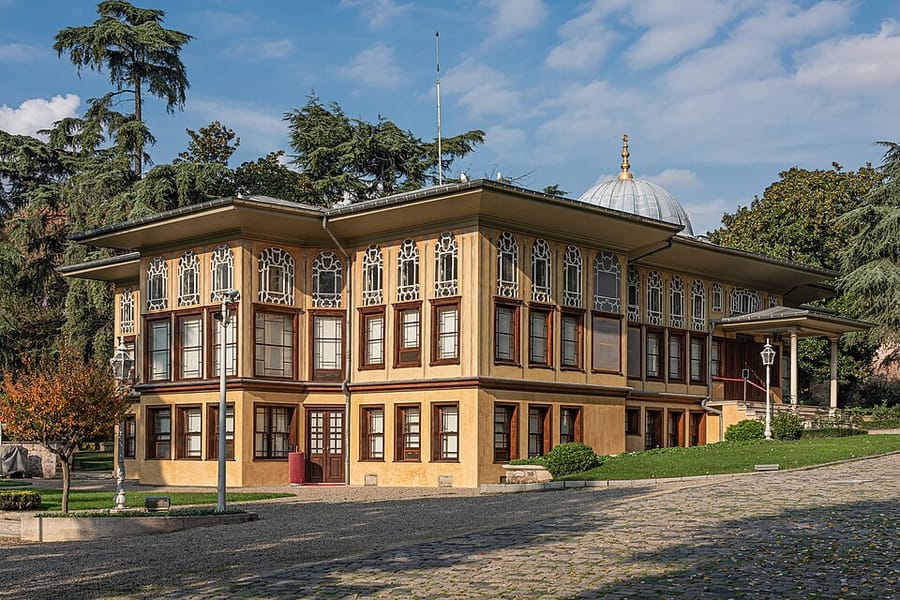

The surviving pavilion of the Tersane Palace
The oldest documented pavilion in the Tersane (Arsenal) garden on the Golden Horn, between Kasımpaşa and Hasköy, was built on the order of Sultan Ahmed I in 1613; in February 1614 the sultan stayed in the newly completed building. The Tersane Palace grew with additions by Sultan Ibrahim and later sultans and was repaired on the order of Mehmed IV after a fire in 1678. Known since the 17th century also as the “Mirror Palace”, its name has been explained in several ways. In 1779 talks with Russia held here ended in the signing of the Aynalıkavak Convention.
Selim III had most of the palace demolished to enlarge the Arsenal, leaving only the building thought to be the Has Oda pavilion, whose interior was remodelled in the new taste. Poems by Enderunlu Fazıl and Şeyh Galib above the inner doors give the date 1791–92. Although Krikor Balyan is named as its architect, he was then too young to have built it from the ground up; he probably supervised its interior decoration. Arranged around a pair of reception halls on a long axis, the pavilion long remained under the control of the Navy and was later handed over to the National Palaces Administration and opened to visitors.
From royal garden to palace
According to Evliya Çelebi, the imperial tent was pitched here and the spoils distributed immediately after the conquest, and Mehmed the Conqueror ordered a pavilion, a pool and a bath to be built and 12,000 cypresses to be planted; it is not certain, however, whether a pavilion was built in his reign. When the Arsenal settled in Kasımpaşa in the early 16th century, the land between the shore and the slopes of Okmeydanı became the Arsenal garden, called Hasbahçe because it was reserved for the sultan; it held vegetable gardens supplying the palace and the Has Ahır, the stable for the sultan's horses.
In 1647 Sultan Ibrahim had the high wall that blocked the harem's view of the sea pulled down. During the fifteen-day circumcision festival of Ahmed III's princes at Okmeydanı in June 1720, the sultan stayed in this palace with the whole harem; the festival is described and illustrated in miniatures in Seyyid Vehbi's Surname. Repaired in 1787 on the orders of Grand Vizier Koca Yusuf Pasha, the palace became, in the late 18th century, a kind of foreign affairs residence used for talks with foreign envoys.
Origin of the name
A common view holds that large mirrors sent as gifts after the 1718 peace with Venice were used on the palace's interior walls, and that the phrase “mirrors as tall as a poplar (kavak)” turned into the name Aynalıkavak. Yet Du Loir, who was in Istanbul in 1639–1641, calls the place the “Mirror Palace”, and the Swedish engineer Loos, who drew the palace in 1710, uses the name “Spiegel Serail”; the name is thus older than the Venetian mirrors. Melling writes that it comes from a kind of poplar whose leaves glitter like mirrors in the sun, while Ibrahim Hakkı Konyalı argues that, since archery targets were called mirrors and their stands poplars, the name derives from neighbouring Okmeydanı.
The present pavilion
When the palace was demolished under Selim III, its stones were used to build the madrasa and tomb of Mihrişah Valide Sultan in Eyüp, and the surviving pavilion became an excursion pavilion from which the sultan watched ships being launched. Of the Hasköy, Tersane and Okmeydanı gates in the courtyard wall, the Okmeydanı gate bears Şeyh Galib's poem dated 1791–92 and Mahmud II's tughra dated 1817–18. The pavilion, on sloping ground, has a basement storey; the divanhane on the Okmeydanı side has a ribbed timber dome above and a porch from the time of Selim III in front. A large chandelier, a valuable brazier and a gilded sofa survive from the palace's old furnishings.
During the First World War, Navy Minister Cemal Pasha had the pavilion repaired and removed its outbuildings and the ruined bath.
Source: TDV Encyclopedia of Islam (TDV İslâm Ansiklopedisi), “AYNALIKAVAK SARAYI” (Semavi Eyice)
Related sultans
Cite as: Atlas of the Sultans, “Aynalıkavak Pavilion · Ottoman monuments”, https://padisahlaratlasi.com/en/monuments/aynalikavak-pavilion/ (last updated 21 November 2026). Corrections · Image credits