TRENDEFRARAtlas of the Sultans · Ottoman monuments
Üsküdar Selimiye Mosque
Monument · Mosque, Istanbul, 1802–1805
- Type
- Mosque
- Built
- 1802–1805

A Nizam-ı Cedid-era mosque
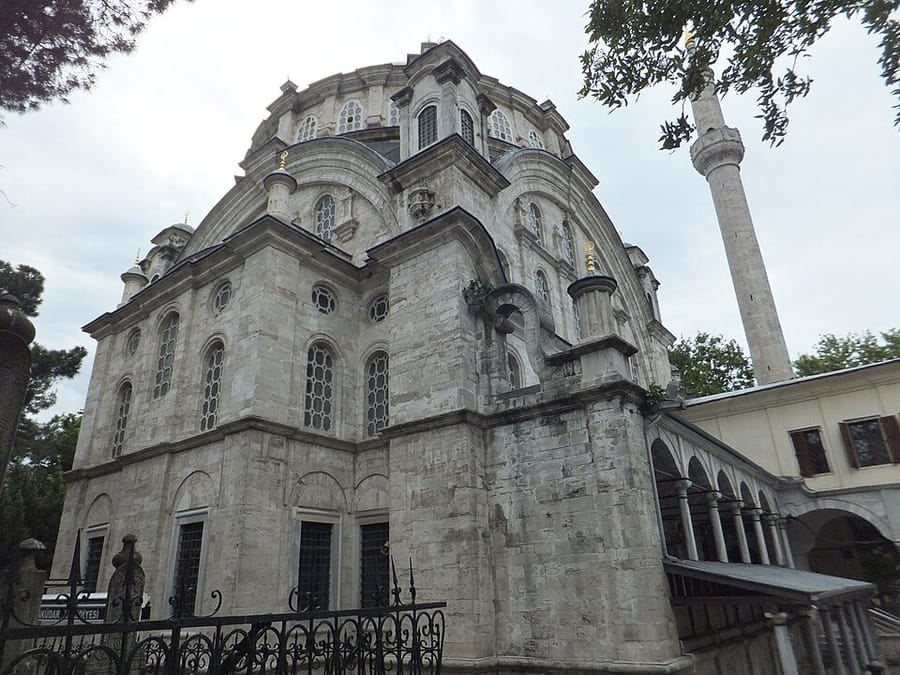
The mosque is the centrepiece of the complex (külliye) that Selim III founded with his personal fortune on the grounds of the Kavak Palace in Üsküdar. With its bathhouse, school, dervish lodge, fountains, shops and weaving hans, the complex formed part of a settlement laid out on a grid of intersecting streets, symbolising the Nizam-ı Cedid (New Order). The mosque's foundation stone was laid on 26 April 1802, and it opened for worship on 5 April 1805. Work began under the chief court architect Mehmed Arif Agha and was completed under Ahmed Nureddin Agha, with Foti Kalfa as the builder.
Built in the Ottoman Baroque style, the mosque has a square prayer hall of 15 × 15 m covered by a single dome. A novelty here is the integration of the portico with a kiosk-like royal lodge (hünkar mahfili). The inscription band containing the Sura al-Fath (Victory), which runs around three sides of the hall, reflects Selim III's resolve to renew the age of conquests. Both minarets collapsed in a southerly gale on 3 February 1823 and were soon rebuilt. The mosque was partly repaired in 1967 and fully restored in 1999–2002; today it hosts the military funerals of army officers who die in Istanbul.
A large complex and its courtyard
Besides the mosque and school, the complex comprised a Naqshbandi lodge containing a small mosque known as the Little Selimiye, a printing house, a bathhouse, ninety-seven shops, four fountains, places for dyers and yarn bleachers, and seven separate inns for silk weavers; the Harem landing stage was also turned into a commercial pier. Of these, the mosque, the bathhouse, the timekeeper's house, the primary school and one fountain survive. The mosque's inscription describes it as 'light made solid'; the building supervisor is said to have been either Uzun Hasan Efendi or Hüseyin Efendi.
The mosque stands within a rectangular courtyard-garden and has no arcaded courtyard; its walls are not parallel to the courtyard walls. The building, set on a high base, is reached by broad stairs on three sides. Along the north-east courtyard wall are the school, water tanks, the ablution fountain and the timekeeper's house. The imperial mounting stone in the courtyard and a 'newly invented' public fountain known to have stood there in 1806 have not survived.
Interior and inscriptions
With marble in its lower parts and küfeki limestone above, the mosque has five rows of windows including those of the drum; the pilasters between the third and fourth rows are notable. On the façades, S- and C-scrolls and shell motifs reflect the Baroque style, while some details reflect the Empire style. The upper walls are decorated with painted ornament, and the mihrab and minbar are of finely worked marble. The monumental thuluth inscriptions in the dome are by Ismail Hakkı Altunbezer, and some inscriptions are by Çarşambalı Arif Bey. The west wing of the royal loge now houses the Ibrahim Hakkı Konyalı Library, and the mihrab façade has two symmetrical birdhouses.
School, timekeeper's house and bathhouse
The two-storey primary school at the north-east corner of the courtyard has a stone lower floor and a timber upper floor; once used as a police post, it now houses a public library below and staff lodging above. The lead-covered timekeeper's house adjoining the courtyard wall now stores equipment for military funerals. The bathhouse north of the mosque was completed in 1802 on the foundations of the Kavak Palace bath; its large domed hot room, with four private cubicles and three iwans, follows the classical scheme. The inscription of the nearby Fountain of Selim III in Çiçekçi, dated 1802, was composed by Seyyid Ihya Efendi and written by Yesarizade Mustafa Izzet.
Related sultans
Cite as: Atlas of the Sultans, “Üsküdar Selimiye Mosque · Ottoman monuments”, https://padisahlaratlasi.com/en/monuments/uskudar-selimiye-mosque/ (last updated 21 November 2026). Corrections · Image credits