TRENDEFRARAtlas of the Sultans · Ottoman monuments
Sulaymaniyya Takiyya (Damascus)
Monument · Complex, Damascus, 1554–1559
- Type
- Complex (külliye)
- Built
- 1554–1559
A work of Mimar Sinan

A way-station complex on the Barada
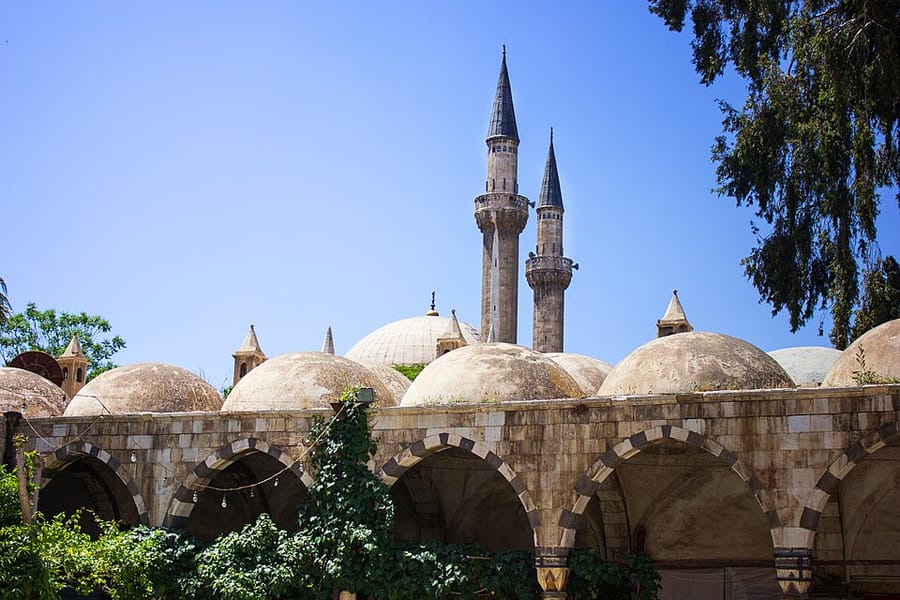
The mosque and its dependencies in the Süleymaniye complex (külliye) of Damascus were built for Suleiman the Magnificent (Kanuni Sultan Suleiman) in 1554–1559; a madrasa and an arasta (market street) were added under Selim II in 1566–67, and a hankah (dervish lodge) was completed after 1576. The mosque, guest rooms (tabhane), public kitchen and double caravanserai are listed in the inventories of Mimar Sinan's works. A court architect was sent to Damascus through Sinan's agency, while construction was directed by a Christian architect from Damascus named Todoros. The madrasa, arasta and hankah cannot be attributed to Sinan.
The complex stands on the bank of the Barada River, on the site of a Mamluk-era riding ground known as the Green Field (Gök Meydanı). With a strict symmetry recalling the Fatih complex in Istanbul, the mosque and the public kitchen face each other on the qibla axis. The walls of the square, single-domed mosque are built of alternating courses of black basalt and white limestone, as was common in Syria before the Ottomans; the portal, mihrab and minbar combine local and imperial styles. Mehmed VI (Vahdeddin) and several members of the dynasty who died in exile are buried in its graveyard. The hankah no longer survives.
Who carried out the construction
The text of the verse inscription above the portal is by Şemsi Ahmed Pasha; it states that construction began in 962 and was completed in 966 of the Hijra. The building accounts of the Süleymaniye Complex in Istanbul record that lead sheeting was sent to the mosque in Damascus, finished in 1559. Şemsi Ahmed Pasha, then governor of Damascus and later founder of the complex in Üsküdar, is thought to have supervised the work. According to the same accounts, a court architect named Muslihuddin Halife was sent to Damascus through Sinan in November-December 1553.
According to al-Almawi, the first building superintendent was the endowment's trustee Mawlana Molla Agha al-Ajami; the post was later given to a certain Mustafa. On the site of the complex had stood al-Qasr al-Ablaq, the palace built in 1266–1269 by the Mamluk Sultan Baybars I overlooking the jousting ground.
The mosque, hospices and soup kitchen
The south-west and south-east corners of the mosque are reinforced externally with buttresses, and the entrance front has a double portico, as in mosques of Sinan's period. Two single-balcony minarets with conical caps rise at the northern corners of the prayer hall. The portal is framed by a band of black-and-white geometric interlace; its muqarnas hood ends in a shell-shaped semi-dome. The tympana of the relieving arches over the lower windows are faced with local underglaze tiles.
A large ablution pool lies between the mosque and the soup kitchen. The hospice rooms are grouped in two wings of five units each; the units, each with a fireplace, are covered by domes on octagonal drums. From the roofs of the four units of the kitchen at the centre of the T-shaped soup kitchen rise chimneys, and a twelve-bay domed portico runs along its courtyard front. The wings of the double caravanserai each consist of fourteen units covered by domes without drums.
Madrasa, arasta and khanqah
In the madrasa twenty-two domed cells line the arcaded courtyard; the onion dome of the mosque-classroom recalls the Ayyubid and Mamluk domes of the region. The arasta consists of two rows of shops with pointed barrel vaults and runs east to west. The khanqah, which has disappeared entirely, was created by converting an unfinished Janissary barracks on the Green Square and contained twenty dervish cells.
Source: TDV Encyclopedia of Islam (TDV İslâm Ansiklopedisi), “SÜLEYMANİYE KÜLLİYESİ” (M. Baha Tanman)
Related sultans
Cite as: Atlas of the Sultans, “Sulaymaniyya Takiyya (Damascus) · Ottoman monuments”, https://padisahlaratlasi.com/en/monuments/sulaymaniyya-takiyya-damascus/ (last updated 21 November 2026). Corrections · Image credits