TRENDEFRARAtlas of the Sultans · Ottoman monuments
Behram Pasha Mosque
Monument · Mosque, Diyarbakır, 1564–1572
- Type
- Mosque
- Location
- Diyarbakır, Turkey
- Built
- 1564–1572
A work of Mimar Sinan

Sinan's work in Diyarbakır
Standing in the south of Diyarbakır near the Mardin Gate, the mosque was built by Behram Pasha, the thirteenth Ottoman governor and beylerbeyi of the city and son of Kara Şahin Mustafa Pasha of the Sokullu family. According to the inscription over the main portal, construction began in 1564 and was completed in 1572. It is regarded as an important experimental work by Mimar Sinan outside Istanbul, although among the sources listing Sinan's works it appears only in the Tuhfetü'l-mimarin. The building was evidently conceived as a complex (külliye), and its bathhouse also survives.
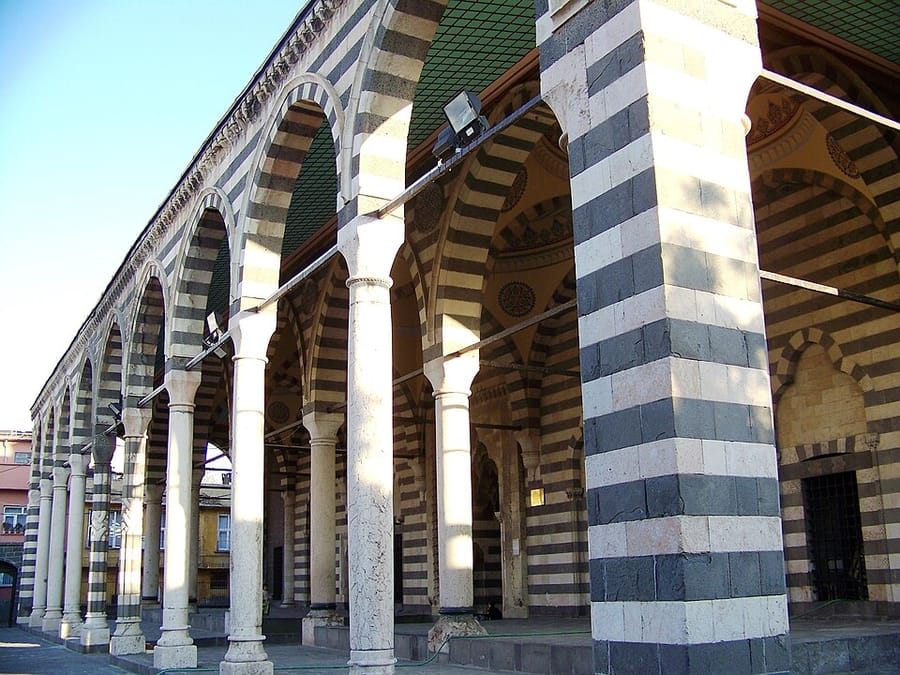
In this single-domed, single-minaret mosque of cut stone, rectangular recesses were opened in the thick walls and fitted with small mihrab niches and upper-floor galleries, so that the dome rests in effect on an octagonal system of supports. The portico, surrounded by columns and set under a sloping roof, forms a broad canopy suited to the regional custom of praying outdoors in summer. The walls use stone of two colours, and the interior is lined with 16th-century Iznik tiles. The minaret, partly destroyed in 1928, was repaired in the same style the following year.
Spaces within the thick walls
The roofing system of the mosque was created by modifying the scheme of a squinch dome resting on four walls. Openings left in the thick walls produced four square spaces at the four corners; the two on the mihrab side are small cells covered by little domes and are entered from inside. Inside, the muqarnas fillings at the springing of the squinches are the main elements of architectural decoration.
The portico, originally of five domes, gained a second arcade when it was surrounded by columns on the outside, so that the mosque has a double portico. The knotted columns of the ablution fountain in the courtyard are also noteworthy.
Among Sinan's experimental buildings
The plan of the main space of the Behram Pasha Mosque is closely related to that of the Bali Pasha and Silivrikapı Ibrahim Pasha mosques in Istanbul. Although it is named in only one of the sources listing Sinan's works, the building is counted among Mimar Sinan's important experimental works because of this similarity and its original solution of setting the dome on an octagonal system of supports.
Source: TDV Encyclopedia of Islam (TDV İslâm Ansiklopedisi), “BEHRAM PAŞA CAMİİ” (Ara Altun)
Related sultans
Cite as: Atlas of the Sultans, “Behram Pasha Mosque · Ottoman monuments”, https://padisahlaratlasi.com/en/monuments/behram-pasha-mosque/ (last updated 21 November 2026). Corrections · Image credits