TRENDEFRARAtlas of the Sultans · Ottoman monuments
Banya Bashi Mosque
Monument · Mosque, Sofia, 1566–1567
- Type
- Mosque
- Built
- 1566–1567

Sofia's surviving mosque
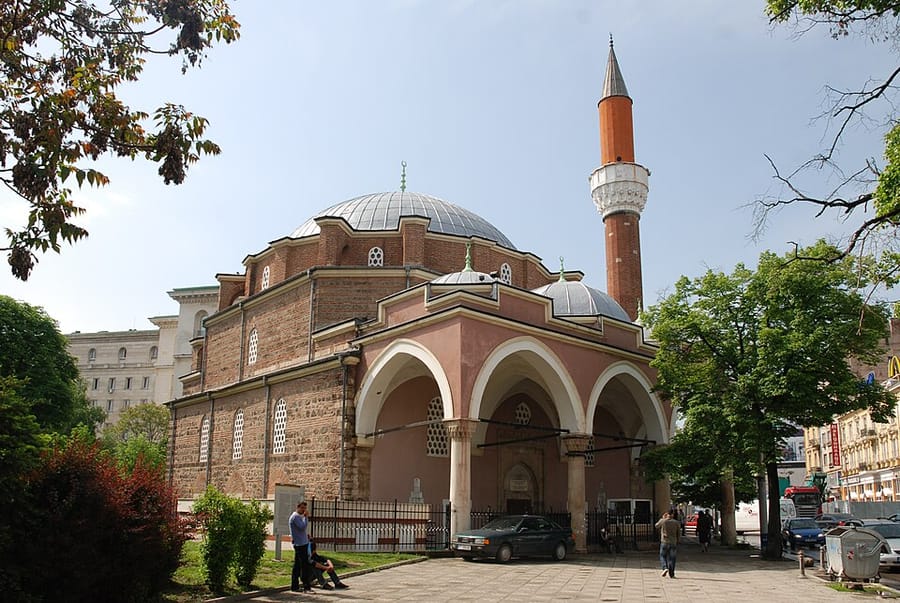
Standing on Maria Luiza Boulevard in central Sofia, the mosque is also known as the Kadı Seyfullah Efendi or Molla Efendi Mosque; the name Banya Bashi comes from the bathhouse that adjoined it. Nothing is known of its founder, Kadı Seyfullah Efendi, except that his nearby tomb was demolished after the Russo-Ottoman War. An old painted inscription on the door arch bore the date 1566–67; a later stone plaque ascribing the mosque to Mimar Sinan rests on no solid evidence. The square building, with walls of alternating stone and brick courses, is covered by a dome 15 m in diameter and has a single-balcony minaret whose beauty Evliya Çelebi praised.
According to a register of 1902, it is the only survivor of the forty-one mosques and three masjids that stood in Sofia before the war of 1877–1878. It escaped demolition plans in 1890 and 1906, and its major repair was carried out in 1915–1917 with funds from the Ottoman Ministry of Pious Foundations, when the minaret was shortened. In 2007 its interior walls were faced with Kütahya tiles, and after cracks caused by metro construction and the 2012 earthquake, TİKA began an extensive restoration. The mosque is still in use for worship.
Endowments and threats of demolition
The mosque's endowments, consisting of eleven shops, a bakery, a han and a market garden, were destroyed after the war of 1877–1878. The building had been damaged either in the severe earthquake of 1858 or during the fighting, and the finial of its minaret had fallen. It was partly repaired with 15,000 francs allocated by Prince Alexander in 1882 and 100 liras given by Sultan Abdulhamid in 1904. During the 1915–1917 restoration the marble minbar, cracked in the earthquake, was replaced with a wooden one, and in 1917 the Ottoman government sent 36 tonnes of lead to renew the domes.
In 1890 Mayor Dimitar Petkov decided to demolish the mosque and the adjoining bath to build a new bathhouse, but this was prevented by the Ottoman government's intervention. In 1906 the bath that gave the mosque its name was pulled down and replaced by a mineral bath, while the mosque was saved once again by the Sublime Porte's strong reaction. In 1983 it underwent an extensive exterior restoration based on a project by the architect Hristo Ganchev.
Architecture
The walls of the square mosque are 15 m high and 1.8 m thick. Above, the alternating stone-and-brick walls are chamfered at the corners and pass to an octagon inside by means of squinches; the brick drum of the dome, supported by buttress arches, has sixteen segments. The building is lit by four tiers of windows. The portico opens through pointed arches on four columns with muqarnas capitals and is covered by three domes. To the right of the mosque is a three-vaulted annex called the “tetimme”, built in the name of Kadı Seyfullah Efendi's late wife and probably used for teaching children.
The brick minaret has a cut-stone balcony with muqarnas, and a lead-covered wooden cone above. With the tile revetment of 2007, the wooden minbar and preaching chair were replaced with new tiled ones, and the painted decoration of the squinches, pendentives, window surrounds and dome was renewed.
Source: TDV Encyclopedia of Islam (TDV İslâm Ansiklopedisi), “KADI SEYFULLAH EFENDİ CAMİİ” (Sefer Hasanov)
Related sultans
Cite as: Atlas of the Sultans, “Banya Bashi Mosque · Ottoman monuments”, https://padisahlaratlasi.com/en/monuments/banya-bashi-mosque/ (last updated 21 November 2026). Corrections · Image credits