TRENDEFRARAtlas of the Sultans · Ottoman monuments
Emperor's Mosque
Monument · Mosque, Sarajevo, 1566–1567
- Type
- Mosque
- Location
- Sarajevo, Bosnia and Herzegovina
- Built
- 1566–1567
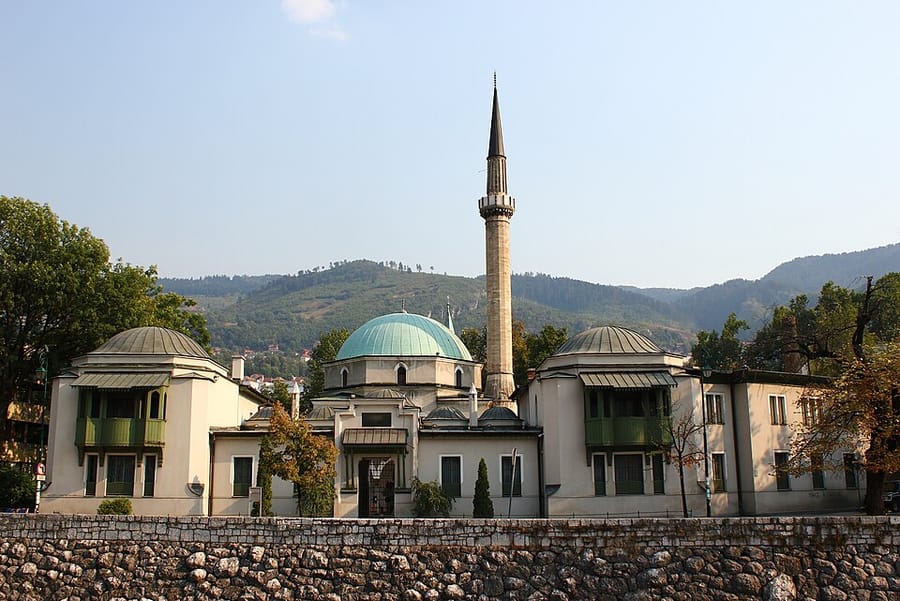

A mosque named after the Conqueror
Also known as the Cami-i Atik and the Mosque of Ebülfeth Sultan Mehmed Han, this mosque is believed to have been built by Ishak Bey, the sancakbey (district governor) of Bosnia, or by his son Isa Bey. According to local tradition, Mehmed the Conqueror (Fatih Sultan Mehmed) admired it while touring the city, and so it was given the sultan's name. Ishak Bey's endowment deed of February 1462 suggests that it was built in those years; the quarter around it was the city's first Muslim settlement. The first building was of timber (according to Ayverdi, perhaps only its roof); it burned during a bandit raid between 1555 and 1561 and was rebuilt in stone in 1566–67.
In style, the present building is a 16th-century Ottoman work. Its square prayer hall, measuring 15.42 × 15.32 metres externally, is covered by a dome about 13 metres across on an octagonal drum. The mihrab and minbar are simple and elegant, and the faceted minaret is notably tall for the building. In 1848 Mehmed Fazıl Pasha added wings on both sides. A library added in 1759–60 was demolished in 1912 and its books were moved to the Gazi Husrev Bey Library. Nothing remains of the complex's madrasa, school or bathhouse.
The question of date and the inscriptions
Until 1516 the quarter around the mosque was called the Hatip quarter; it was then known as the Old quarter or the Sultan Mehmed Old Mosque quarter, and later as the Hünkar quarter (Careva Mahala). On his journey of 1659–60, Evliya Çelebi mentions an Isa Pasha Mosque in Sarajevo and gives a copy of its Arabic inscription dated 1520. Semavi Eyice asks whether this building is the Hünkar Mosque; if so, what is known about the mosque's date would have to be reconsidered.
The mosque's library had been founded by Şehdi Osman Efendi, divan secretary of Hekimoğlu Ali Pasha. A Turkish poem of eight couplets by the poet Ziver Bey, describing the repairs and additions of Mehmed Fazıl Pasha, was written by the calligrapher Mehmed Rifat Efendi and placed on the pediment of the portal. The Hünkar Bridge, built by the same benefactor in the name of Mehmed the Conqueror, disappeared entirely when it was rebuilt in the 20th century.
Details of the prayer hall
The pointed-arched portico resting on marble columns is thought to have once been domed; the portal lacks a deep niche and hood. The transition to the dome is made by squinches with fluted interiors, with five rows of muqarnas beneath them. The three lower windows on each side facade were blocked when the 5-metre-wide wings were added. Above the mihrab niche are six rows of muqarnas decorated with 19th-century painted ornament.
On either side of the door are 19th-century wooden galleries with lathe-turned balustrades and a semicircular bay in the middle. The minaret is entered through a door cut into the thickness of the wall at the corner; its balcony rests on three rows of muqarnas. Near the minaret stands the tomb of Sheikh Ibrahim; most of the graves in the burial ground have survived, and their inscriptions were published by Mehmed Mujezinović.
Courtyard and entrance block
According to Ekrem Hakkı Ayverdi's plan, the courtyard is flanked by porticoes of four domes each, open both to the courtyard and to the outside. The entrance to the courtyard is occupied by a block made up of a large domed room at each end and, on either side of a central passage, four domed rooms. Of the end rooms, the right one served as the centre of the Islamic Community and the mufti's office, and the left one housed the Gazi Husrev Bey Library until 1994. Ayverdi holds that this section was built in 1849 by Mehmed Fazıl Pasha together with the other additions.
Source: TDV Encyclopedia of Islam (TDV İslâm Ansiklopedisi), “HÜNKÂR CAMİİ” (Semavi Eyice)
Related sultans
Cite as: Atlas of the Sultans, “Emperor's Mosque · Ottoman monuments”, https://padisahlaratlasi.com/en/monuments/emperor-s-mosque/ (last updated 21 November 2026). Corrections · Image credits