TRENDEFRARAtlas of the Sultans · Ottoman monuments
Uzunköprü Bridge (Silivri)
Monument · Bridge, Silivri, 1568
- Type
- Bridge
- Location
- Turkey
- Built
- 1568
A work of Mimar Sinan
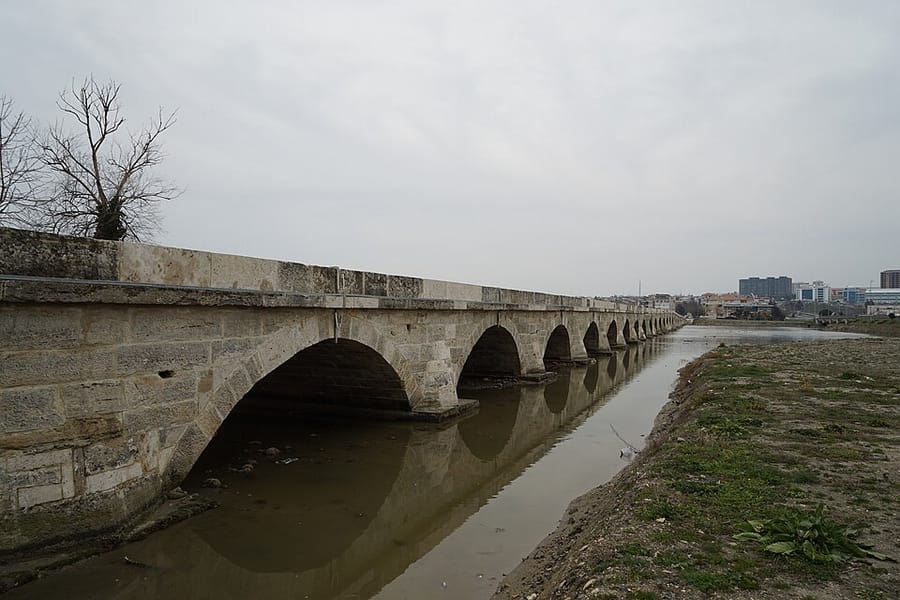

Sinan's thirty-two-arch bridge
This bridge over the Silivri stream, about 1 km west of Silivri, is a work of Mimar Sinan. As it has no inscription, its construction date is established as 1568 from two archival documents; the bridge is named in the Tuhfetü'l-mi'marin and the Tezkiretü'l-ebniye. Crossing the stream and a wide marshy area prone to flooding, it is 333 m long and has thirty-two arches. Because the bridge is very long and low, depressed arches were used instead of pointed ones; the spans are about 7 m and the piers about 3 m wide. Since the piers do not project much, all the arches can be seen at once. It is built of limestone from nearby quarries.
The bridge was repaired in 1606 by the architect Dalgıç Ahmed Ağa. Besides Evliya Çelebi, the English traveller John Covel, who came to Silivri in 1675, and P. Lucas, who passed through in 1714, also mention it. Long left in ruins, it was repaired in 1984 by the regional highways directorate, which rebuilt its parapets in cement and damaged the arches at its ends. On the seaward side, the land in front of the bridge has been divided into plots and built over with houses.
Masonry and piers
The voussoirs are 50-60 cm long, and long stones are used on the soffits of the arches. The material is a partly silicified coarse limestone, and the quality of the stonework is notable. Apart from the parapet posts, the bridge is built with rather plain workmanship, the emphasis being on meeting practical needs.
Because the bridge crosses a low valley rather than a stream with a defined bed and is not exposed to strong currents, the fronts and backs of its piers begin with a slight point and merge with the body of the wall within a short distance. Stones with inclined faces were used at the springing to take the thrust of the depressed arches; in other words, no traditional pier pattern was followed, and the detail was adapted to need. The parapet stones reach 2.60 m in length. Between the highest point and the two ends there is an average gradient of 1% and a difference in level of 1.40-1.50 m.
Its place among the bridges of Thrace
The 1606 repair is known from a document on the first page of an account book in the Topkapı Palace Museum Archives. Historical and topographical conditions led to the building of many bridges in Thrace; bridge architecture, developing since the first half of the 15th century, reached its peak with Sinan's monumental works, and the Silivri bridge holds an important place in this development.
Just west of Silivri, on the old campaign road and 325 m from the government house, there is another small bridge over the Karılar stream (Boğlucadere), but it has not preserved its original form.
Source: TDV Encyclopedia of Islam (TDV İslâm Ansiklopedisi), “UZUNKÖPRÜ” (Tayfun Akkaya)
Related sultans
Cite as: Atlas of the Sultans, “Uzunköprü Bridge (Silivri) · Ottoman monuments”, https://padisahlaratlasi.com/en/monuments/uzunkopru-bridge-silivri/ (last updated 21 November 2026). Corrections · Image credits