TRENDEFRARAtlas of the Sultans · Ottoman monuments
Bayezid II Complex, Amasya
Monument · Complex, Amasya, 1481–1486
- Type
- Complex (külliye)
- Built
- 1481–1486

A sultan's complex on the Yeşilırmak
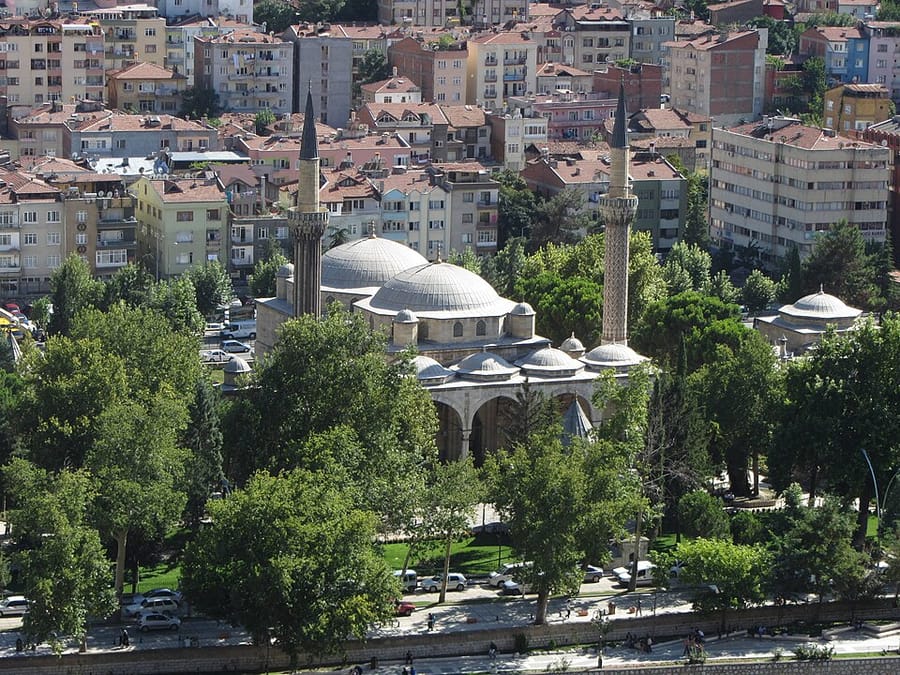
In the complex (külliye) that Bayezid II built on the bank of the Yeşilırmak river in Amasya, the mosque stands at the centre, with the madrasa on its right and the soup kitchen (imaret) and guesthouse on its left. According to Hüseyin Hüsameddin Bey, work began in September 1481, just after the sultan's accession, and was entrusted to Prince Ahmed. The inscription above the door records that the mosque was completed in July 1486; the endowment deed was drawn up in 1496. The prayer hall is covered by two successive domes; the article's author, Semavi Eyice, holds that the side wings, each with three domes, were originally guest rooms. The right-hand minaret is decorated with red inlay, the left-hand one with red and white bands.
The mosque was badly damaged in the earthquakes of 1590 and 1668–69 and repaired; over the following centuries fountains, a sebil, a timekeeper's house and libraries were added in the courtyard. In the 1939 earthquake some domes and arches of the portico collapsed, and the repairs of the 1960s are not considered successful. The complex still suffers from the river's floods. The madrasa, also known as the Sultaniye, is used as the provincial public library, the imaret and guesthouse have been restored as a dormitory, and the primary school has disappeared.
Inscription and interior
The three-part foundation inscription in thuluth, above the main portal and on the two side walls, was written by the calligrapher Ali b. Mezid. Hüseyin Hüsameddin Bey, citing Idris-i Bitlisi, reports that the building was begun in thanksgiving for the sultan's accession. There is no evidence for the claim that the complex stands on the site of a Church of the Virgin Mary. The mosque lies in the middle of an outer courtyard of about 160 × 120 metres and has no separate inner courtyard. The first dome of the prayer hall is about 13 metres in diameter and the second, on the qibla side, about 15 metres; a 2.37-metre-wide arch separates them.
The lunettes of the four windows opening onto the portico bear white thuluth inscriptions in tile on a dark blue ground. The muqarnas mihrab is modest and the white marble minbar plain; by contrast, the wooden door and window shutters, with their geometric interlace, brass bands and carved inscription panels, are of outstanding workmanship. The red inlay of the right-hand minaret is dominated by zigzag lines ending in lily motifs, a decoration seen on no other minaret.
Madrasa, imaret and tomb
In the madrasa, porticoes surround a courtyard with a central fountain on three sides, and behind them lie eighteen domed cells with fireplaces. The professorship of the madrasa was reserved for the muftis of Amasya, and its first teacher was the Şeyhülislam Zenbilli Ali Efendi. The L-shaped kitchen and soup kitchen (aşhane-imaret) was long used as a military depot; the space of 10.87 × 17.25 metres with two large hearths is the kitchen. The square domed tomb south-east of the mosque is believed to be that of Prince Osman, killed on the orders of Selim I in 1513; today it contains no cenotaph.
Later additions
The damage of the 1668–69 earthquake was repaired within a year by the administrator Merzifoni Ibrahim Ağa. In 1782–83 Hacı Ali Ağa had taps installed so that ablutions could be made with hot water in winter, and ablution fountains and a sebil were added in later years. The timekeeper's house (muvakkithane) in the Tanzimat style, built in 1840 by Hacı Hüseyin Zeki Efendi, has walls richly painted with landscapes and buildings, including a picture of the Bayezid Mosque itself. During the 1980 flood a deposit 70 centimetres high formed inside the mosque.
Source: TDV Encyclopedia of Islam (TDV İslâm Ansiklopedisi), “BEYAZIT II CAMİİ ve KÜLLİYESİ” (Semavi Eyice)
Related sultans
Cite as: Atlas of the Sultans, “Bayezid II Complex, Amasya · Ottoman monuments”, https://padisahlaratlasi.com/en/monuments/bayezid-ii-complex-amasya/ (last updated 21 November 2026). Corrections · Image credits