TRENDEFRARAtlas of the Sultans · Ottoman monuments
Bayezid II Complex (Edirne)
Monument · Mosque complex, Edirne, 1484–1487/88
- Type
- Complex (külliye)
- Built
- 1484–1488
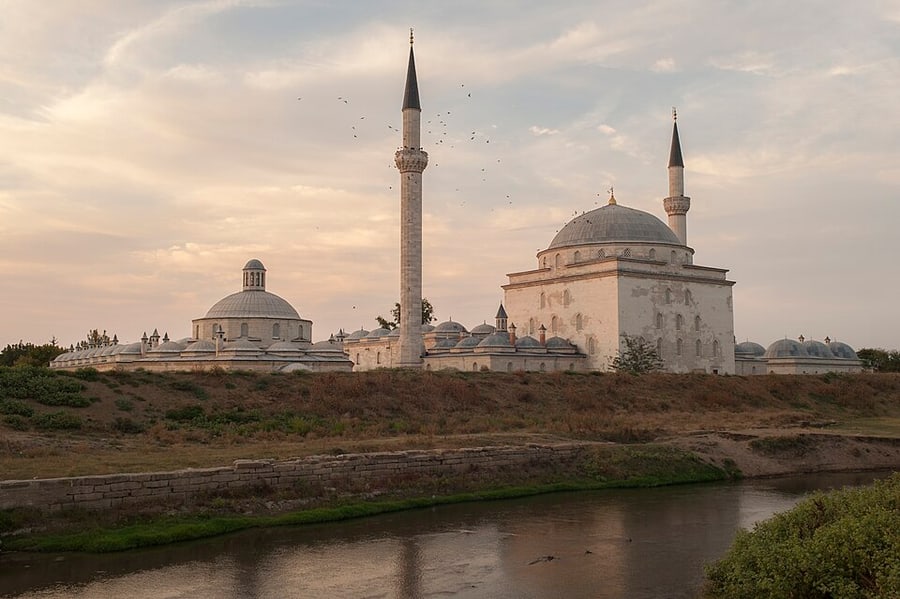

An endowment complex on the bank of the Tunca
Bayezid II's complex in Edirne was founded on the north bank of the Tunca river; it consists of a mosque with tabhanes on either side, a kitchen-imaret, a kitchen, a storehouse for provisions, a madrasa, a darüşşifa (hospital) and a bath, and the bridge connecting the area to the city also belongs to the complex. The sultan, who came to Edirne in May 1484 to set out on the campaign against Kilia and Akkerman, had the foundations laid during the days he was staying here, and according to the inscription the mosque was completed in 893 (1487–88). The text of the inscription above the main portal is by Zenbilli Ali Efendi and its calligraphy by Şeyh Hamdullah.
The revenues of the complex, three of whose endowment deeds are known, rose from 782,930 akçes at the end of the 15th century to 1,552,131 akçes in the second half of the 16th century. In the complex 147 staff drew salaries, and each of the eighteen students in the madrasa was given two akçes a day. There was also a small library of forty-two volumes, consisting of books on subjects such as Qur'anic exegesis, hadith, jurisprudence, theology and medicine.
Mosque and tabhanes
The square prayer hall of the mosque, entered from a courtyard surrounded by domed arcades, is covered by a single dome about 20 m in diameter, reaching an internal height of 31 m. The royal lodge in the left corner of the prayer hall is accepted as the first example in Ottoman art. The marble minbar is one of the finest of its kind; the wooden door leaves, whose lower parts rotted in the floods, have been moved to the Edirne museum for protection. Evliya Çelebi mentions four cypress trees in the courtyard planted by the sultan with his own hands; no trace of them remains today. The tabhanes adjoining both sides of the mosque follow a scheme of four iwans with four rooms at the corners; the article notes that the tradition of tabhanes adjoining the mosque found its most monumental expression here. The pair of minarets stands at the outer corners of the tabhanes, and their bases bear decoration rarely found in Turkish art.
The hospital that healed with music
According to the endowment deed, eighteen students lived in the eighteen-cell madrasa; Ibn Kemal also taught here. According to the author of the article, the claim that this was a medical madrasa has no sound basis. Of the darüşşifa, Evliya Çelebi writes that the mentally ill were treated with music and that concerts were given to the patients three days a week. With its third section, in which six iwans open onto a hexagonal hall, the darüşşifa is, according to the author of the article, a valuable work without parallel in Turkish hospital architecture.
Floods and rescue
Because of its position on the bank of the Tunca, the complex suffered much from floods in the 19th century; marks on the inner walls of the mosque show that the water rose to the height of a man. The darüşşifa functioned until the war of 1876, closed during the Balkan War and was left to fall into ruin. The double bath was demolished by the Directorate of Foundations in 1893–94 and its stones used to build an embankment. In recent years some sections have been repaired, an embankment built along the Tunca has stopped water flooding in every winter, and the darüşşifa has been restored and handed over to Trakya University. A survey drawing made by two Frenchmen in 1827 was published in an album presented to Tsar Nicholas I in 1830.
Related sultans
Cite as: Atlas of the Sultans, “Bayezid II Complex (Edirne) · Ottoman monuments”, https://padisahlaratlasi.com/en/monuments/bayezid-ii-complex-edirne/ (last updated 21 November 2026). Corrections · Image credits