TRENDEFRARAtlas of the Sultans · Ottoman monuments
Burmalı Mosque
Monument · Masjid, Istanbul, 1497
- Type
- Mosque
- Built
- 1497
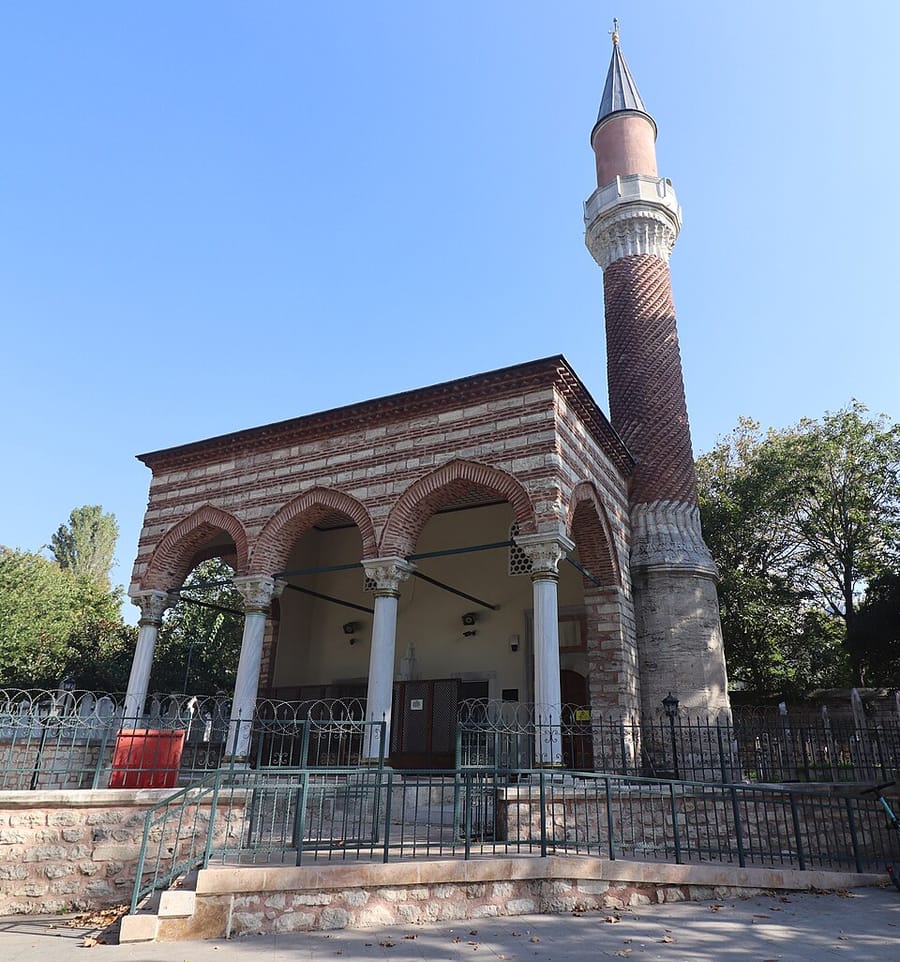

A small masjid with a spiral minaret
The masjid stands just beyond the outer courtyard wall of the Şehzade Mosque, on the Marmara side of the Aqueduct of Valens (Bozdoğan Kemeri). The inscription panel over its door is empty. According to Ayvansarayi, it was built by Emin Nureddin Osman Efendi, one of the judges of Egypt. Because its founder died in 1554 and was buried beside it, the building was long thought to date from the 16th century, and a plaque bearing the date 1540 was even placed by the door; yet a deed of endowment (vakfiye) dated April 1497 is known to exist. This shows that it stood long before Mimar Sinan's Şehzade Mosque.
The square prayer hall has a wooden roof, and the four marble columns of the portico are reused from older buildings. Its most notable feature is the minaret, whose round shaft is built in spiral ribs up to the balcony, using specially made bricks with half-round edges. It is a rare Istanbul example of the ribbed minarets of early Turkish architecture. Dropped from the list of staffed mosques in the Republican period, the building fell into ruin and was rented out for a time as a carpenter's workshop; in 1961 the Directorate of Foundations restored it under the architect Cahide Tamer, and it reopened for prayer.
Endowments and graveyard
The masjid is recorded as the Emin Nureddin Masjid in the Istanbul Endowments Survey Register drawn up in 1546. Many cells, shops and houses in Istanbul, baths in Zağra Eskihisarı and Gebze, and a mill in Hereke belonged to its endowment, and other benefactors also left endowments to it. Of these, properties given by Ayşe Hatun and by Ali Subaşı were expropriated by order of the sultan and with legal sanction in 1543–1548 for the building of the Şehzade Mosque.
The founder's grave, dated 1554, lies in the graveyard on the left; according to Eyice, Emin Nureddin Efendi must have built the masjid when he was twenty-five or thirty and died at an advanced age. The graveyard also holds the graves of Müezzinzade Halimi Mustafa Pasha, executed in Izmit in 1759–60, and of his nephew, the calligrapher Ibrahim Ağa (d. 1753–54). Mustafa Pasha's father Ali Efendi had served as muezzin of the masjid, and the pasha's mansion stood opposite it.
Fire, neglect and building materials
The masjid stood in a district where the mansions of leading statesmen were concentrated; in the 19th century the mansions of Rifat Pasha and Ahmed Muhtar Pasha stood on the land in front of it. In the 1911 Uzunçarşı-Mercan fire the surrounding area burned down, and although the masjid escaped serious damage, it was left without a congregation. In 1936 it was no more than four walls filled with rubble; a plan to route Atatürk Boulevard through the site and demolish the masjid was also considered and then abandoned.
The base and footing of the minaret and the walls of the main space are of cut küfeki stone, while the portico is built of alternating courses of stone and brick. The badly worn reused columns and capitals were replaced in the 1961–1962 restoration with other reused shafts and capitals collected from various parts of the city. Aydın Yüksel suggests that the masjid may originally have been domed, but no trace supporting this has been found. Similar minarets are found at the Burmalı Minare Mosque in Amasya and on one of the minarets of the Üç Şerefeli Mosque in Edirne. The primary school and fountains recorded in the endowment deed have disappeared over time.
Source: TDV Encyclopedia of Islam (TDV İslâm Ansiklopedisi), “BURMALI MESCİD” (Semavi Eyice)
Related sultans
Cite as: Atlas of the Sultans, “Burmalı Mosque · Ottoman monuments”, https://padisahlaratlasi.com/en/monuments/burmali-mosque/ (last updated 21 November 2026). Corrections · Image credits