TRENDEFRARAtlas of the Sultans · Ottoman monuments
Kara Davud Pasha Mosque
Monument · Mosque, Istanbul, 16th century
- Type
- Mosque
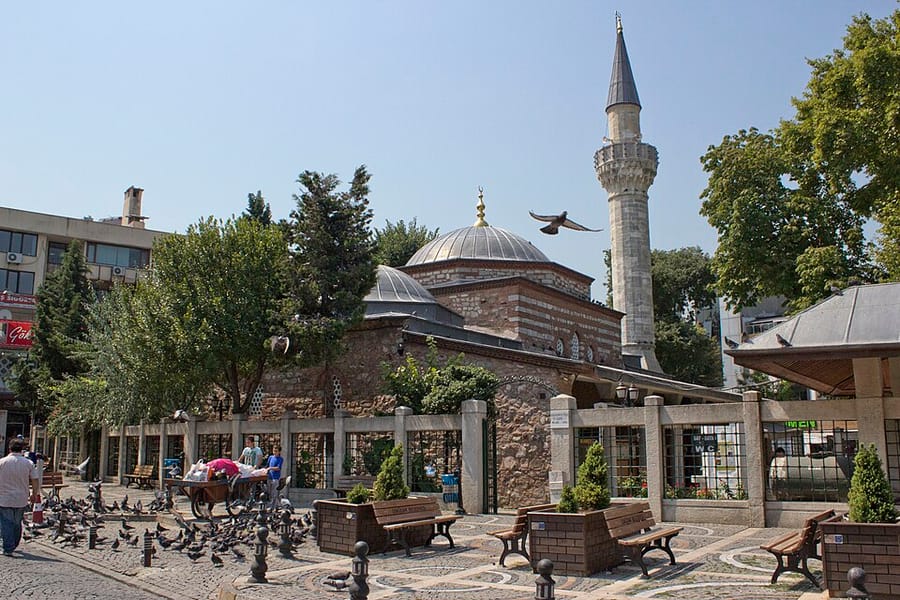

A mosque with an unusual plan
The mosque stands in Üsküdar beside Hakimiyet-i Milliye Avenue, which runs from the pier towards Kadıköy, a little beyond the Mimar Sinan Bazaar. It was built in the reign of Bayezid II by Davud Pasha, known by the nickname Kara Nişancı; according to Ayvansarayi, the pasha died at Gebze in 1505–1506. Although two Davud Pashas of the same period are confused in the sources, an endowment register of 1546 shows that the Nişancı and Küçük Davud Pasha were one and the same person.
The mosque was repaired twice, in 1817–18 and 1831–32, and again after a fire in 1867–68, although scholars have read the dates of these inscriptions differently. The transverse prayer hall has three sections; the domed side sections may originally have been guest rooms (tabhane), suggesting that the building was planned as a mosque with hospice rooms (zaviye). During the 1963–1966 restoration the wooden ceiling and tiled roof over the central space were replaced by a masonry dome, and the courtyard walls and a primary school endowed by Şehid Ali Pasha were demolished. As a result, the original form of its plan, rare in Ottoman religious architecture, can no longer be investigated.
The founder and his endowments
In his Vefeyat-ı Selatin, Ayvansarayi records that Kara Davud Pasha was first chief gatekeeper, became chancellor (nişancı) in 1497–98 and vizier in 1502, and never mentions him as admiral. The other Davud Pasha, known as Sani or Küçük (the Younger), was twice grand admiral, in 1483 and 1492–93, and died in 1506–1507. Yet the Istanbul endowment register of 1546 records the donor of endowments to the lodge and masjid of Şeyh Süleyman Halife as Davud Pasha son of Abdülhay, known as Küçük Davud Pasha, and refers also to his endowment in Üsküdar.
The Topkapı Palace Archives hold documents on the accounts of Kara Davud Pasha's endowments ranging from 1640 to 1779. Ayvansarayi writes that beside the courtyard gate opening onto the neighbourhood behind stood an upper-storey primary school endowed by Ali Pasha, who fell at the Battle of Petrovaradin in 1716.
Inscriptions and the present building
According to a six-couplet thuluth inscription, the first restoration was carried out by the trustee Hüseyin Agha, and according to a second inscription of five couplets, the second by another benefactor of the same name; a fire in between may have made this second repair necessary. A third inscription of three couplets, formerly over the courtyard gate, states that Hacı Aziz Agha had the mosque repaired in 1867–68 after a fire. Ibrahim Hakkı Konyalı, however, read the inscriptions as 1703–04, 1839 and 1857–58, so the first two in particular need to be re-examined by a specialist.
The mosque, 23.20 m wide, is built of rubble stone; the first restoration inscription is above the door arch of interlocking two-coloured marble. In the last restoration eight columns with lozenge capitals were erected to carry the roof of the portico, which is closed by walls at both ends. The sections of the prayer hall are divided by walls projecting 1.40 m. Ayvansarayi's remark that the mosque had two domes with a ceiling between them shows that the wooden ceiling existed at least in the second half of the 18th century. The grave of Alemdar Ahmed Baba, who died in September 1680, once in the courtyard, now lies at the edge of the pavement.
Source: TDV Encyclopedia of Islam (TDV İslâm Ansiklopedisi), “DÂVUD PAŞA CAMİİ” (Semavi Eyice)
Related sultans
Cite as: Atlas of the Sultans, “Kara Davud Pasha Mosque · Ottoman monuments”, https://padisahlaratlasi.com/en/monuments/kara-davud-pasha-mosque/ (last updated 21 November 2026). Corrections · Image credits