TRENDEFRARAtlas of the Sultans · Ottoman monuments
Atik Ali Pasha Mosque
Monument · Mosque, Istanbul, early 16th century
- Type
- Mosque
- Built
- 1510
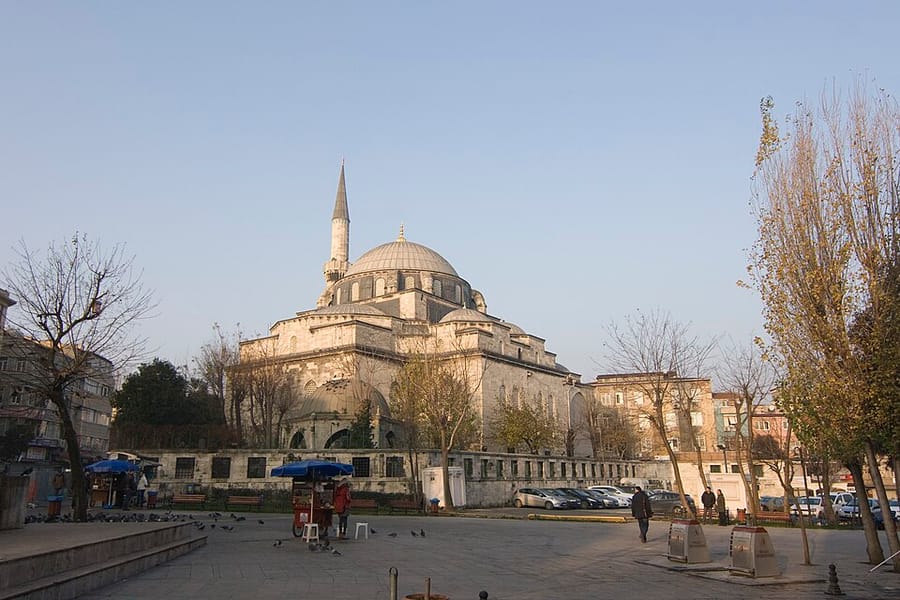

An early mosque in Çemberlitaş
Commissioned by Atik (Hadım) Ali Pasha, one of the grand viziers of Bayezid II, the mosque stands in Çemberlitaş on the site of the Forum of Constantine. It has no inscription. Ayvansarayi gives 1496–97 as its date of construction; however, since its endowment deed dates from 1509–10 and the pasha could only have built so large a work after becoming grand vizier, the mosque is thought to have been built not in 1496–97 but around 1509–10. It was accompanied by a madrasa, a caravanserai, a soup kitchen (imaret) and shops. Built entirely of cut stone, with a five-domed portico, a main space covered by a large dome and a half-dome, and lower domed sections on either side, it is compared to the first Fatih Mosque.
The mosque was probably badly damaged by the fires of 1587, 1633–34 and 1652 and by the earthquake of 1648; according to a document thought to relate to that earthquake, its central dome had collapsed completely and its minaret down to the balcony. After the earthquake of 1766 the columns separating the side sections from the central space were replaced by Baroque piers. Damaged again in the Hocapaşa fire of 1865 and the earthquake of 1894, it was repaired in 1896, when parts of the complex were lost, and restored once more in 1937–38. The madrasa across the street still stands, its front façade cut off.
Plan and line of development
The mosque was formerly also known as the Sedefçiler, Old Ali Pasha, Dikilitaş, Vezir Hanı and Sandıkçılar Mosque. Columns from the porticoes that once surrounded the Forum of Constantine were reused in the mosque and its dependencies. On either side of the main space, side areas each made up of two domed bays open onto the centre through wide arches; in the projecting mihrab section the transition is made by pendentives with very rich muqarnas. Because the side areas are not separated from the main space by a wall, the building is clearly not one of the zaviye-type mosques. In this respect the mosque is a link in a line of development running through the Üç Şerefeli Mosque in Edirne, the Sultan Mosque in Manisa, the Beyazıt Mosque in Amasya and the first Fatih and Beyazıt mosques in Istanbul. Of the reused columns of the portico, four are marble and two porphyry; the Quranic verse above the entrance was written by the calligrapher Sami Efendi in 1896. The candle cones hanging on either side of the mihrab are rare features.
The lost soup kitchen and the madrasa
A drawing made by Melchior Lorichs in 1553–1555 shows a multi-domed building with chimneys on the qibla side of the mosque; the last traces of this building, possibly a soup kitchen and guesthouse of lodge character, were cleared for Architect Kemaleddin's unfinished Sixth Vakıf Han. In the late 19th century the rites of the Kasım Çelebi Lodge of the Halveti order were held in the mosque. The Elçi Han, probably the caravanserai of the complex, was ruined in the fire of 1865 and pulled down around 1880. Of the sixteen cells of the symmetrically planned madrasa, twelve still stand; the four cells at the end were demolished when the street was widened.
Graveyard and fountain
On the qibla side of the mosque is an open tomb with a dome on six supports; it is not known to whom it belongs. According to Ayvansarayi, Ali Pasha fell in battle and his body was lost. The graveyard contains the tombs of statesmen such as Ali Efendi (d. 1752), keeper of the imperial land registers, and Küçük Hüseyin Efendi (d. 1742), who was sent to Italy as envoy in 1741. The baroque fountain adjoining the graveyard wall was built in 1754–55 by Grand Vizier Hekimoğlu Ali Pasha.
Source: TDV Encyclopedia of Islam (TDV İslâm Ansiklopedisi), “ATİK ALİ PAŞA CAMİİ” (Semavi Eyice)
Related sultans
Cite as: Atlas of the Sultans, “Atik Ali Pasha Mosque · Ottoman monuments”, https://padisahlaratlasi.com/en/monuments/atik-ali-pasha-mosque/ (last updated 21 November 2026). Corrections · Image credits