TRENDEFRARAtlas of the Sultans · 39 / 39 · sultan
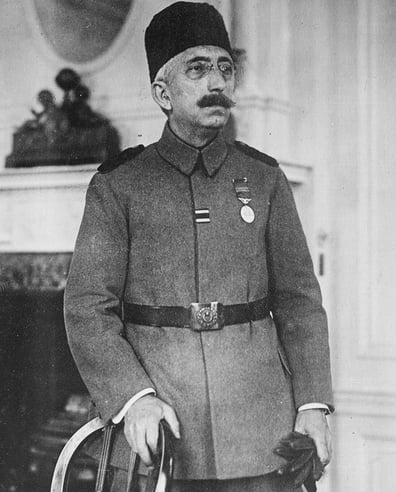
Photograph — Bain News Service · 1918
Mehmed VI
Vahideddin
The last sultan of a six-hundred-year dynasty. For four years he sat on a powerless throne in an occupied capital; when the sultanate was abolished on 1 November 1922 he left the country aboard a British warship and never returned.
Open the reign of Mehmed VI on the map▶ Watch the 1-minute video: YouTube · Instagram · TikTok
Interesting fact
He was the last Ottoman sultan. On 17 November 1922 he left Istanbul aboard the British warship Malaya, settled in San Remo in Italy and died there on 16 May 1926. He was devoted to literature, music and calligraphy; his compositions were performed at the palace while he was on the throne.
Source: TDV İslâm Ansiklopedisi (Turkish), article “MEHMED VI”
Life
Childhood and years as a prince
Mehmed Vahdeddin was born at Dolmabahçe Palace on 4 January 1861. His father was Sultan Abdulmejid I and his mother Gülistü Kadınefendi. He lost his father when he was six months old and his mother when he was four, and he was raised by his stepmother Şayeste Hanım. He was taught by private tutors and pursued literature, music and calligraphy at an advanced level. His compositions were performed at the palace during the years of his reign.
He witnessed the reigns of his elder brothers Murad V, Abdulhamid II and Mehmed V (Reşad). After the death of Yusuf Izzeddin Efendi in 1916 he became heir apparent; he represented the sultan at the funeral of the Austro-Hungarian emperor (1916) and at the invitation of the German emperor (1917).
Mudros and occupation
When his elder brother Mehmed V (Reşad) died on 3 July 1918, he came to the throne under the name Mehmed VI; he is more often known as Sultan Vahdeddin. The First World War was going badly: Palestine and Syria had been lost and Anatolia was under threat. In only the fourth month of his reign, on 30 October 1918, the delegation headed by Rauf Bey signed the Armistice of Mudros. On 13 November 1918 an Entente fleet of sixty ships arrived off Istanbul.
Believing that this extraordinary period could not be overcome through the parliamentary system, Vahdeddin used the authority given to him by the constitution to dissolve the Chamber of Deputies (Meclis-i Mebusan) on 21 December 1918. According to the TDV article, he believed that the state could be saved from its situation only by winning the support of Britain and France, and he adopted a policy of friendship with Britain; his greatest fear was the loss of Istanbul and the abolition of the caliphate and the sultanate. He appointed his brother-in-law Damad Ferid Pasha grand vizier several times.
Istanbul and Ankara
Among the officers sent to Anatolia to restore order was Mustafa Kemal Pasha; on 30 April 1919 he was appointed Inspector of the Ninth Army. The national resistance that began in Anatolia led to a widening rift between the Istanbul government and Ankara. During the government of Ali Rıza Pasha, talks held at Amasya (October 1919) produced an agreement on elections, and the last Ottoman Chamber of Deputies (Meclis-i Mebusan) opened in Istanbul on 12 January 1920.
On 16 March 1920 Istanbul was formally occupied; nationalist leaders were arrested and exiled to Malta, and the Chamber dispersed. On 23 April 1920 the Grand National Assembly convened in Ankara and declared itself the sole representative of the nation. The Istanbul government set up the Kuva-yi Inzibatiyye (Disciplinary Forces) against the Kuva-yi Milliye (National Forces). On 10 August 1920 the Treaty of Sèvres was signed; according to the TDV article, the sultan did not ratify the treaty despite all the pressure. In Ankara, meanwhile, Mustafa Kemal Pasha accused the sultan in harsh terms, and in a secret session of the Assembly it was argued that he could not be regarded as the legitimate caliph.
The abolition of the sultanate
After the Turkish War of Independence ended in victory, and following the sultan's refusal to recognize the Ankara government and the Istanbul government's decision to take part in the Lausanne Conference, the Grand National Assembly of Turkey abolished the sultanate on 1 November 1922. Thus the Ottoman sultanate, which had lasted since 1299, came to an end.
On 16 November 1922 Vahdeddin wrote a letter to the commander of the British occupation forces stating that his life was in danger and asking to be taken elsewhere, and he signed the letter “Mehmed Vahdeddin, caliph of the Muslims.” On the morning of 17 November 1922 he left Istanbul aboard the British warship Malaya. According to the TDV article, as he left he refused a suggestion that the sacred relics belonging to the caliphate be taken with him, saying that they were a gift of his ancestors to the Turkish nation. On 19 November 1922 the Assembly also removed him from the caliphate and elected Abdulmejid Efendi caliph.
Exile and death
Vahdeddin was first taken to Malta. At the invitation of Sharif Hussein he went to the Hejaz and stayed in Taif; from there he moved to Italy, reaching Genoa on 2 May 1923 and settling in San Remo. The lyrics of the songs he composed in Taif mostly express longing for his homeland.
He died in San Remo on 16 May 1926. According to the TDV article, he had left Istanbul with 20,000 British pounds, and when he died he owed a great deal to the shopkeepers of San Remo; the creditors did not allow the body to be buried until the debt was paid. The money could be raised only after a month, and the body, with permission obtained from France, was buried in the graveyard of the Süleymaniye Mosque in Damascus. He was the thirty-sixth and last sultan to ascend the Ottoman throne.
Source: TDV Encyclopedia of Islam (TDV İslâm Ansiklopedisi), “Mehmed VI” (Cevdet Küçük); Ali Fuad Türkgeldi's Görüp Işittiklerim, Mustafa Kemal Atatürk's Nutuk, the works of Rıza Tevfik and Murat Bardakçı, and Ottoman and British archival documents are the main sources of this article.
Meanwhile in the world
Contemporary rulers
- George VKing of the United Kingdom · 1910–1936First Windsor king; visited the front repeatedly during the war
- Victor Emmanuel IIIKing of Italy · 1900–1946King who asked Mussolini to form a government in 1922
- Vladimir LeninChairman of the Council of People's Commissars · 1917–1924Leader of the Bolshevik Revolution and founder of the Soviet state
- Woodrow WilsonPresident of the United States · 1913–1921President who announced the Fourteen Points and championed the League of Nations
- TaishōEmperor of Japan · 1912–1926Emperor for whom his son Hirohito served as regent from 1921
- Ahmad Shah QajarShah of Iran (Qajar dynasty) · 1909–1925Last Qajar shah, who lost power to Reza Khan after 1921
- Benedict XVPope · 1914–1922Pope who stayed neutral in World War I and attempted peace mediation
What was happening in the world?
- 1918The influenza pandemic spreads worldwide; about 500 million fall ill and at least 50 million die.
- 1920The League of Nations officially comes into existence on 10 January.
- 1920The Nineteenth Amendment is ratified in the United States, granting women the right to vote.
- 1922After the fascist march on Rome, the Italian king asks Mussolini to form a government as prime minister.
Sources: kids.britannica.com [1] · britannica.com [1] [2] [3] [4] [5] [6] [7] · archive.cdc.gov [1] · ungeneva.org [1] · archives.gov [1]
Family
| Father | Abdulmejid I |
|---|---|
| Mother | Gülüstü Hanım |
| Consorts | Nazikeda Kadın, Inşirah Hanım, Müveddet Hanım, Nevzad Hanım |
| Children | Fenire Sultan, Ulviye Sultan, Sabiha Sultan, Mehmed Ertuğrul |
Major achievements
- Signing of the Armistice of Mudros (1918) and the occupation of Istanbul
- Sent Mustafa Kemal to Anatolia as army inspector (1919)
- Dissolution of the Ottoman parliament (1920)
- Approved the signing of the Treaty of Sèvres
- Formation of the Caliphate Army against the National Movement
Treaties
- Armistice of Mudros (1918)
- Treaty of Sèvres (1920)
Grand viziers
| Name | From | To | Length |
|---|---|---|---|
| Talat Pasha | February 1917 | October 8, 1918 | 1-2 years |
| Ahmed Izzet Pasha | October 14, 1918 | November 8, 1918 | 25 days |
| Ahmed Tevfik Pasha (term 2) | November 11, 1918 | March 3, 1919 | 112 days |
| Damad Ferid Pasha | March 4, 1919 | September 30, 1919 | 210 days |
| Ali Rıza Pasha | October 2, 1919 | March 3, 1920 | 153 days |
| Salih Hulusi Pasha | March 8, 1920 | April 2, 1920 | 25 days |
| Damad Ferid Pasha (term 2) | April 5, 1920 | October 17, 1920 | 195 days |
| Ahmed Tevfik Pasha (term 3) | October 21, 1920 | November 4, 1922 | 2 years, 14 days |
Battles and treaties
| Year | Event | Result / parties |
|---|---|---|
| 1918 | Treaty: Armistice of Mudros | Ottoman Empire, Entente Powers |
| 1920 | Treaty: Treaty of Sèvres | Principal Allied Powers, British Empire, United Kingdom, Canada, Australia, New Zealand, South Africa, India, France, Italy, Japan, Allied Powers, Armenia, … |
Full infoboxes are in the site’s “Battles and Treaties” tab; source: TDV Encyclopedia of Islam.
Death
He died of a heart attack in exile in San Remo, Italy, in 1926, and was buried in the Sultan Selim Mosque in Damascus.
Territorial change
| Year | Region | Event | Source |
|---|---|---|---|
| 1918 | − Syria–Lebanon (Aleppo–Damascus) | Armistice of Mudros (1918) and Treaty of Sèvres (1920) — French mandate | TDV İA, “MEHMED VI” |
| 1918 | − Antep–Kilis | British, then French occupation after Mudros (1918–19) — Antep, Maraş, Urfa | TDV İA, “MEHMED VI” |
| 1918 | − Hatay (Sanjak of Alexandretta) | French occupation after the Armistice of Mudros (1918) | TDV İA, “MEHMED VI” |
| 1918 | − Palestine–Jordan (Jerusalem) | Armistice of Mudros (1918) — British mandate | TDV İA, “MEHMED VI” |
| 1918 | − Mosul–Shahrizor | British occupation after the Armistice of Mudros (November 1918) | TDV İA, “MEHMED VI” |
| 1918 | − Yemen–Asir | Armistice of Mudros (1918) — withdrawal of the garrisons | TDV İA, “MEHMED VI” |
| 1918 | − Kars–Ardahan–Artvin | Armistice of Mudros (1918) — withdrawal to the 1914 border | TDV İA, “KARS” |
| 1918 | − Batumi (Adjara) | Armistice of Mudros (1918) — withdrawal to the 1914 border | TDV İA, “BATUM” |
| 1918 | − Akhaltsikhe (Childir) | Armistice of Mudros (1918) — withdrawal to the 1914 border | TDV İA, “KARS” |
The lands that changed hands in this period, and the battles or treaties that brought the changes, can be seen on the map: map of the reign of Mehmed VI.
Cite as: Atlas of the Sultans, “Mehmed VI (Vahideddin): Reign Map, Wars and Conquests (1918–1922)”, https://padisahlaratlasi.com/en/sultans/vi-mehmed/ (last updated 21 November 2026). Corrections · Image credits
Grand viziers of this reign: Ahmed Tevfik Pasha · Talat Pasha · Damad Ferid Pasha
Capital in this reign: Istanbul
Myths and misconceptions: When did the Ottoman state end: 1922, 1923 or 1924?