TRENDEFRARAtlas of the Sultans · Grand viziers
Mahmud Şevket Pasha
Grand vizier, 1913
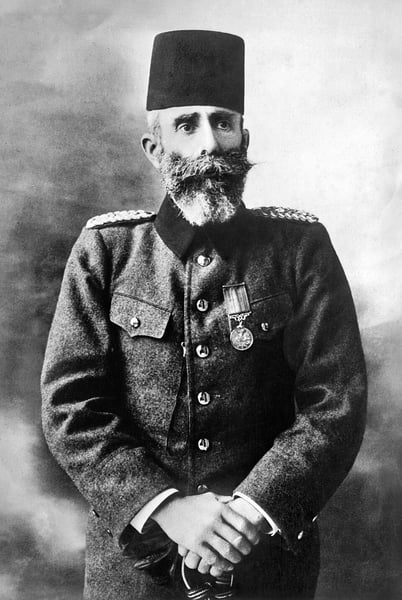

From Baghdad to the General Staff
He was born in 1856 in Baghdad and grew up there, which is why he was also called “Arap” (the Arab). His father was Kethüdazade Süleyman Bey, of Chechen origin. In 1870 he came to Istanbul for military education; after the Kuleli Military High School and the War College (Mekteb-i Harbiyye) he completed the General Staff (Erkân-ı Harbiyye) class as a captain in 1880. Besides Arabic he also knew German and French. He taught at the War College and served as assistant to von der Goltz Pasha; when, at the direction of the German military mission, it was decided to buy weapons from Germany, he worked on the purchasing commissions, played an important role in the choice of weapons and stayed in Germany for many years. In 1890 he became a colonel (miralay) and in 1895 a brigadier general (mirliva).
The Action Army
In 1901 he became a lieutenant general (ferik); his perceiving his assignment to the building of a telegraph line in the Hejaz as a kind of exile changed his feelings towards Abdulhamid II. In 1905, while governor of Kosovo, he established contact with the Committee of Union and Progress. In 1908 he became commander of the Third Army. After the 31 March Incident he entered Istanbul at the head of the Action Army (Hareket Ordusu), declared martial law, and was influential in the change that ended with the deposition of Abdulhamid II and the accession of Mehmed V. On 18 May 1909 he became inspector of the three armies; dominating the government and parliament, he maintained a harsh administration. The grand vizierate of Hüseyin Hilmi Pasha passed under his domination; in 1910 he became minister of war and would not agree to give up the post of inspector.
Criticism and grand vizierate
According to the author of the article, his harsh suppression of the Albanian revolt was one of the reasons for the disintegration in the Balkan War, and his withdrawal of troops from Tripoli in Libya for the Yemen revolts was also counted among the reasons for the weak resistance to the Italian attack. In 1912 he was forced to resign from the Ministry of War; after the Balkan War the press and the opposition named him among those responsible for the defeat.
After the Committee of Union and Progress forced Kıbrıslı Kamil Pasha to resign through the Raid on the Sublime Porte on 23 January 1913, it was he who formed the new cabinet. Although he did not believe the army could fight again, under the pressure of the Unionists a decision was taken to attack in order to save Edirne, and the city was recovered. Friction grew steadily between the grand vizier, who was unwilling to share his power, and the leaders of the Committee.
Assassination
On 11 June 1913, as he was going from the Ministry of War to the grand vizierate, he was killed in an armed attack near Çarşıkapı and was buried on the Hill of Eternal Liberty (Hürriyet-i Ebediyye). The author of the article, Zekeriya Türkmen, who states that the perpetrators were quickly caught and executed, writes that there is no doubt that the Committee of Union and Progress, which wanted to be rid of the pasha, had a role in the assassination, and that the event gave the Unionists an occasion to silence the opposition. He also states that the pasha paid little heed to the warnings of an assassination from Cemal Pasha, the guardian (muhafız) of Istanbul. He presents him as irritable, harsh and quick to act, yet overly cautious; he adds that, because of his entry into Istanbul with the Action Army, there were those who exalted him with titles such as Napoleon, and that his dictatorial conduct may reflect the influence of such rhetoric. His most important work is Osmanlı Teşkilat ve Kıyafet-i Askeriyyesi, which examines Ottoman military organization from the foundation to 1902.
Source: TDV Encyclopedia of Islam, “MAHMUD ŞEVKET PAŞA” (Zekeriya Türkmen)
Related sultans
City: Baghdad
Cite as: Atlas of the Sultans, “Mahmud Şevket Pasha · Grand viziers”, https://padisahlaratlasi.com/en/grand-viziers/mahmud-sevket-pasha/ (last updated 21 November 2026). Corrections · Image credits