TRENDEFRARAtlas of the Sultans · Ottoman monuments
Tomb of Mehmed V
Monument · Tomb, Istanbul, 1914
- Type
- Mausoleum (türbe)
- Built
- 1914
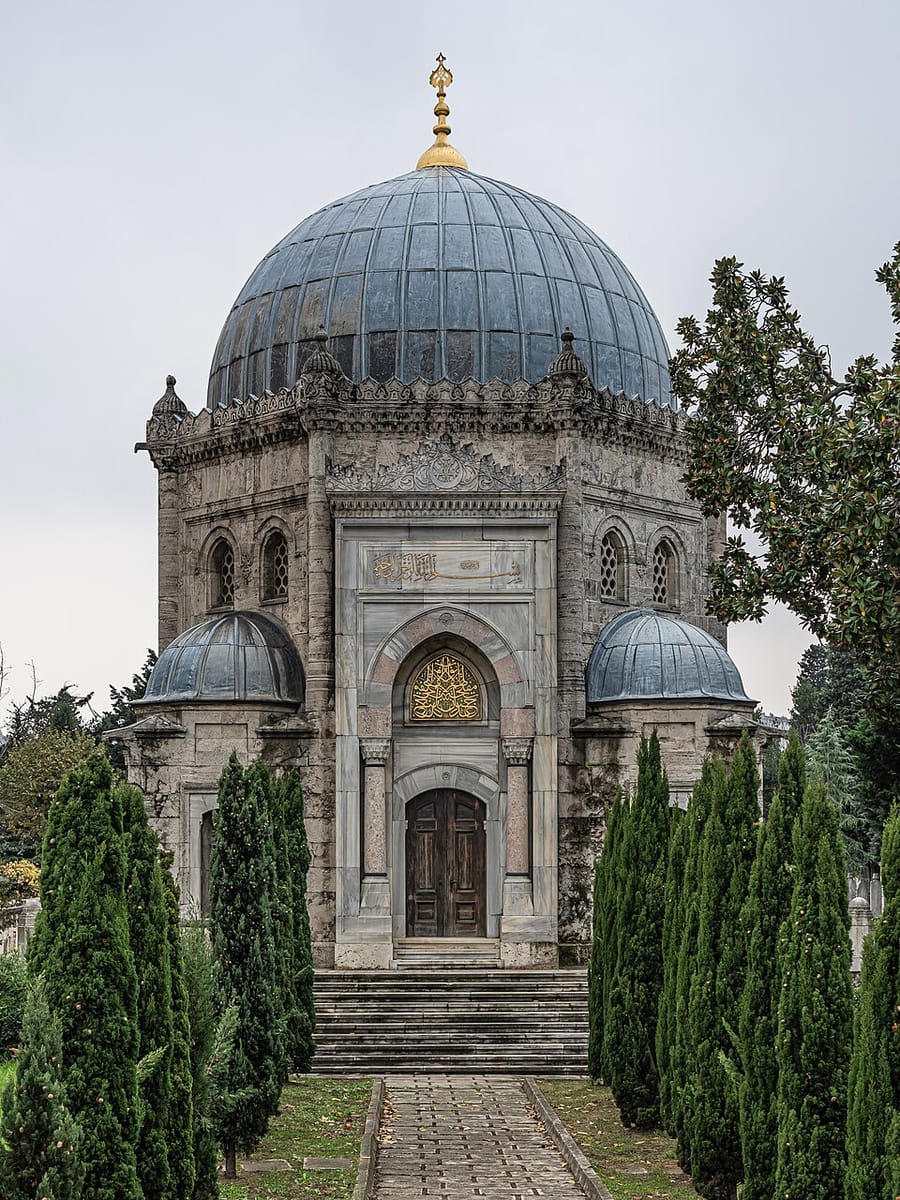

The last dynastic tomb
Sultan Mehmed V Reşad had his tomb built by the architect Mimar Kemaleddin on the shore of the Golden Horn in Eyüp, and when he died on 3 July 1918 he was buried there at his own wish. Some sources state that the tomb was completed in 1912, while the panel above the door bears the date 1914, which refers to its construction. It is the last dynastic tomb built in Istanbul and the only sultan's tomb outside the city walls. A primary school was also built beside it at the sultan's wish. Its inscription, written by the calligrapher Ömer Vasfi Efendi, was chiselled off under a Republican-era law requiring the removal of inscriptions and monograms (tughras) representing the dynasty.
The building is the most important example of the Ottoman neoclassical style in funerary architecture. Built of küfeki limestone on an octagonal plan, it rises on a base reached by ten steps and is covered by a lead-clad dome. The interior is lined with tiles copying 16th-century models, thought to have been made in the workshop of Hafız Mehmed Emin Efendi of Kütahya; the gilded painted decoration of the dome and the stained-glass windows are striking. The sultan is buried here together with his senior consort Kamures Kadın and his son Necmeddin Efendi.
School, masjid and exterior
The primary school beside the tomb seems to have taken the place of the schools and madrasas traditionally conceived together with funerary buildings; a small mosque attached to the north of the school, which was planned on Western educational models, shows that religious instruction still played an active role. The choice of site is said to reflect the sultan's wish to rest amid the sounds of water and children. The plan is essentially octagonal but, because of the triangular cells with squinches on either side of the entrance, becomes an irregular hexagon at ground level. The base forms a podium, an uncovered counterpart of the arcade surrounding the tomb of Suleiman the Magnificent.
The large pointed-arched windows framed by mouldings give the lower storey a massive appearance, while the upper storey, its corners softened by colonnettes, is livelier with paired windows. The window tympana with rumi arabesques, the muqarnas eaves frieze and the crested band are examples of stone carving. In the monumental portal, the shallow-arched entrance is set in a pointed-arched niche carried by two columns; verse 50 of Surah Sad is written in mirror script in the tympanum.
Interior decoration
Above the tile panels runs a Quranic band with the basmala and Surah al-Fajr in white thuluth script on a navy ground. On the inner faces of the door and window openings, the spaces left by the tiles are filled with painted decoration. The dome is painted with rumi motifs in red, green, white and blue on a gilded ground. The multicoloured stained glass in the plaster grilles of the upper windows depicts bunches of tulips rising from vases. The brass grille around the sultan's cenotaph bears the invocations Ya Latif and Ya Hafiz.
Source: TDV Encyclopedia of Islam (TDV İslâm Ansiklopedisi), “MEHMED REŞAD TÜRBESİ” (Ismail Orman)
Related sultans
Cite as: Atlas of the Sultans, “Tomb of Mehmed V · Ottoman monuments”, https://padisahlaratlasi.com/en/monuments/tomb-of-mehmed-v/ (last updated 21 November 2026). Corrections · Image credits