TRENDEFRARAtlas of the Sultans · Ottoman monuments
Monument of Liberty
Monument, Istanbul, 1909
- Type
- Monument
- Built
- 1909

A memorial tomb for the martyrs of the Constitution
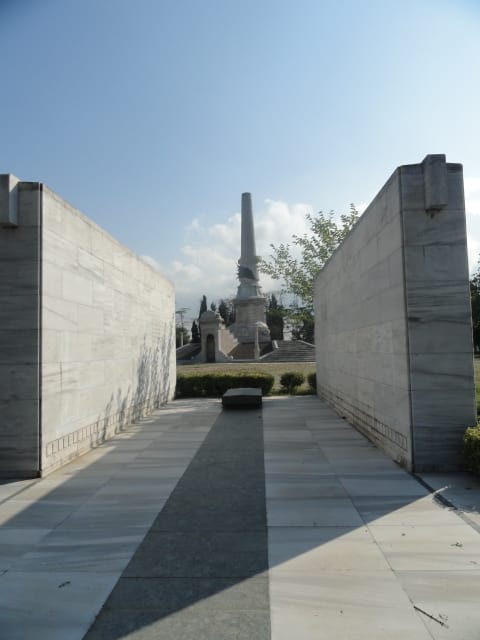
Standing on a hill above the Kağıthane valley in Şişli, the monument gave its site the name Hürriyet Tepesi (Liberty Hill). It was commissioned by the Committee of Union and Progress as a memorial tomb to keep alive the memory of those killed in the 31 March Incident and in the fighting that accompanied the restoration of the Second Constitutional Era. The architect Muzaffer Bey won the design competition opened in April 1909, and the monument was built under his supervision. An example of the neoclassical style of the last period of Ottoman art, it is one of the first commemorative monuments in Turkish history.
Built entirely of marble, it rests on a stepped platform with a hexagonal base: three faces bear the names of the dead and one the tughra of Sultan Mehmed Reşad. Above the base rises a shaft shaped like a cannon barrel, with bronze plaques at its foot symbolising the army and the navy. A bronze door on the east side leads down to a triangular tomb chamber with a mihrab. Mahmud Şevket Pasha, killed in 1913, was buried beside the monument in an open tomb built by the architect Kemaleddin Bey, and the remains of Talat Pasha, killed in Berlin in 1921, were brought to Istanbul in 1943 and interred here.
Inscriptions and medals
The site of the monument was first called Hürriyet-i Ebediyye (Eternal Liberty) and later simply Hürriyet Tepesi (Liberty Hill). On the faces of the hexagonal base not taken up by the names of the fallen and the tughra are carved the inscriptions “Date of the Restoration of Liberty, 10 July 1324” and “Symbol of the Constitution, 11 July 1325”. Gold and silver medals were struck to mark the building of the monument; one side bears Sultan Mehmed Reşad's tughra and a picture of the monument, the other the same two inscriptions.
The martyrs' tomb
Above the door to the tomb chamber is the inscription “Makbere-i Şüheda-yı Hürriyyet” (Tomb of the Martyrs of Liberty); according to Semavi Eyice, the space was conceived like the prayer area on the upper floors of old Turkish tombs. Inside, three thick piers form the foundation of the monument above; between them is a small dome, and in the left corner of the triangular plan is a mihrab. The Qur'anic verses carved in marble on the walls and piers are in the hand of Hasan Sabri Efendi, imam of the Imperial Band. The remains of Talat Pasha, murdered in Berlin, were brought from the Tempelhof Muslim Cemetery to Istanbul on 25 February 1943 and buried with great ceremony in a grave beside the monument.
Source: TDV Encyclopedia of Islam (TDV İslâm Ansiklopedisi), “ÂBİDE-i HÜRRİYET” (Semavi Eyice)
Related sultans
Cite as: Atlas of the Sultans, “Monument of Liberty · Ottoman monuments”, https://padisahlaratlasi.com/en/monuments/monument-of-liberty/ (last updated 21 November 2026). Corrections · Image credits