TRENDEFRARAtlas of the Sultans · Grand viziers
Talat Pasha
Grand vizier, 1917–1918
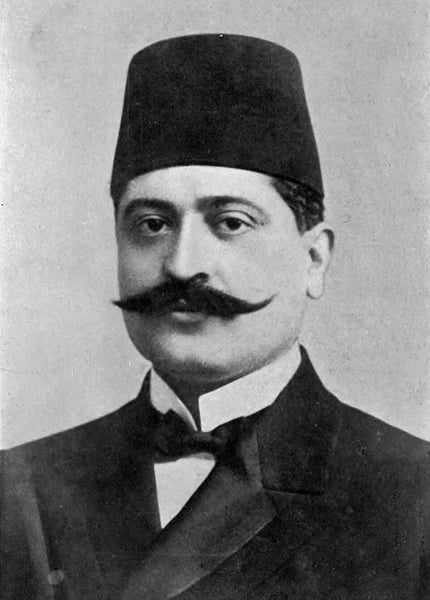

From Edirne to Salonica
He was born in Edirne on 1 September 1874; his father was Kadı Ahmed Vasıf Efendi and his mother Hürmüz Hanım. He completed the Edirne Military Middle School (Askerî Rüşdiye); after his father's death he began working at the Post and Telegraph Administration to support his family. At a young age he became acquainted with Young Turk ideas and joined an opposition organization in Edirne. In 1896 he was arrested and sentenced to three years' imprisonment; although he was pardoned in 1898, he was not allowed to stay in Edirne and was sent to Salonica (Selanik). There he worked as a clerk and chief clerk in the post and telegraph administration. In 1903 he joined the Macedonia Risorta Masonic lodge, where many opponents of the regime were to be found; some sources also claim that he belonged to the Bektaşi order.
Organizer of the Committee
He was among the founders and leaders of the Ottoman Freedom Society (Osmanlı Hürriyet Cemiyeti), founded in 1906; in 1907 the society merged with the Paris-based Ottoman Committee of Progress and Union (Osmanlı Terakki ve Ittihat Cemiyeti). Talat Bey, who used the pseudonym Sai, ran the correspondence as secretary of the new organization; together with Bahaeddin Şakir Bey he was one of the two people who supervised the organization's structure, and he played an important role in preparing the Revolution of 1908. He entered parliament as deputy for Edirne and in 1909 became minister of the interior. He was among those who organized and carried out the Raid on the Sublime Porte on 23 January 1913; he was influential in the decision to recover Edirne and headed the Ottoman delegation in the peace negotiations with the Bulgarians.
Ministry of the Interior and grand vizierate
After the assassination of Mahmud Şevket Pasha he again became minister of the interior on 12 June 1913 and became one of the most important shapers of state policy. In the debate over entering the First World War he gave indirect support to the pro-war group. The article states that, as one of the leaders of the Committee and as minister of the interior, he played an important role in the enactment and implementation of the provisional law of 27 May 1915, referred to in the literature as the Deportation Law (Tehcir Kanunu).
On 3 February 1917, upon the resignation of Said Halim Pasha, he became grand vizier with the rank of vizier, keeping the ministries of the interior and of finance as well; he thus became the first deputy (mebus) in Ottoman history to be appointed grand vizier. At the beginning of 1918 he headed the Ottoman delegation at the Brest-Litovsk negotiations. He was reappointed grand vizier by Mehmed VI on 8 July 1918; after the armistice initiatives he submitted his resignation on 8 October 1918.
Death in Berlin
After presiding over the last congress at which the Committee dissolved itself, on the night of 1-2 November 1918 he left the country on a German torpedo boat together with Enver Pasha and Cemal Pasha and went to Berlin. There, under the pseudonym Ali Sai, he directed the Committee's activities abroad, made contacts with the Bolsheviks and with the victorious powers, and also corresponded with Mustafa Kemal Pasha. The government of Damad Ferid Pasha referred him to the court martial (Divan-ı Harb-i Örfî), and his rank of vizier was withdrawn in 1919. On 15 March 1921 he was killed in Berlin by Soghomon Tehlirian, who was carrying out the decision of the Dashnaktsutyun to kill leading members of the Committee of Union and Progress; the court's jury acquitted the killer. His remains were brought to Istanbul in 1943 and buried on the Hill of Eternal Liberty. According to the author of the article, M. Şükrü Hanioğlu, whether the memoirs published after his death and some documents attributed to him really came from his pen is disputed.
Source: TDV Encyclopedia of Islam, “TALAT PAŞA” (M. Şükrü Hanioğlu)
Related sultans
City: Edirne (Adrianople)
Cite as: Atlas of the Sultans, “Talat Pasha · Grand viziers”, https://padisahlaratlasi.com/en/grand-viziers/talat-pasha/ (last updated 21 November 2026). Corrections · Image credits