TRENDEFRARAtlas of the Sultans · 29 / 39 · sultan
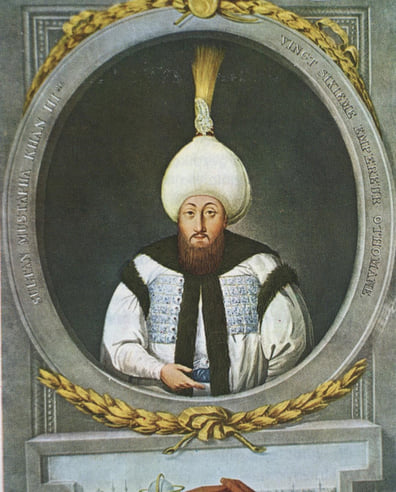
Imaginary portrait (made later) — artist and date unknown
Mustafa III
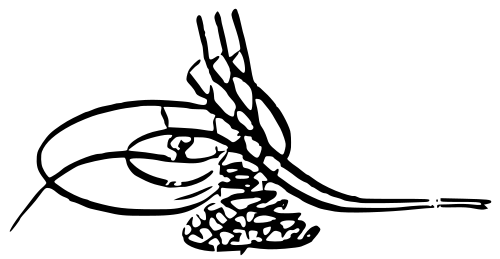
The sultan who seriously restarted military reform. But the war with Russia he entered in 1768 became the empire's heaviest defeat; he died before the peace was signed, and his brother paid the price.
Open the reign of Mustafa III on the map▶ Watch the 1-minute video: YouTube · Instagram · TikTok
Interesting fact
He set great store by the stars and astrologers; in 1763 he asked King Frederick II of Prussia to send him some of the astrologers he believed lay behind his victories. Frederick replied that his success came from knowledge of history, a trained army and a full treasury.
Source: TDV İslâm Ansiklopedisi (Turkish), article “MUSTAFA III”
Life
Years in the Cage
Mustafa was born in Edirne on 28 January 1717. His father was Ahmed III and his mother Mihrişah Emine Sultan. When his father was deposed in the Patrona Halil revolt of 1730, the thirteen-year-old Mustafa was sent with him to the palace's closed quarters, and he lived there for twenty-seven years, throughout the reigns of his cousins Mahmud I and Osman III.
The death in 1756 of his brother, who was a few days older than he was, opened the way to the throne for him. When Osman III died on 30 October 1757, he came to the throne at the age of forty.
Years of peace with Ragıb Pasha
In the first years of his reign the state was run by Grand Vizier Koca Ragıb Pasha, whom he had inherited from Osman III. Mustafa attached importance to economy at the palace: he abolished the Halberdier Corps (Baltacı Ocağı) of the Old Palace, which had been involved in corruption, and by abolishing the revenue grants (has) of the chief black eunuch and of the sword-bearer (silahtar) he achieved savings of more than a thousand purses. These measures exposed him to the charge of “stinginess”, but they increased the importance of the office of the defterdar (chief treasurer).
He followed the Seven Years' War in Europe closely. In Prussia's struggle against Austria and Russia he wanted an alliance with Prussia; Ragıb Pasha's cautious policy left this without result. After Ragıb Pasha's death on 8 April 1763 he sent Ahmed Resmî Efendi as envoy to Berlin. The long peace brought a revival of Mediterranean trade and an improvement in the finances. In the great Istanbul earthquake of 22 May 1766 many buildings collapsed, above all the Fatih Mosque; the sultan mobilized every resource for repairs and had the Fatih Mosque rebuilt, and buildings that had collapsed or been damaged, such as the Eyüp Sultan Mosque, the Grand Bazaar (Kapalıçarşı), the city walls, Tophane and the Maiden's Tower (Kız Kulesi), were also repaired. He built the Laleli Complex (1760–1764), which bears his name, and, for his mother and elder brother, the Ayazma Mosque in Üsküdar (1758–1761).
The Ottoman-Russian War of 1768–1774
In response to Russia's interventions in Poland, war was declared on Russia in 1768. Grand Vizier Muhsinzade Mehmed Pasha, who advised first strengthening the frontier fortresses and not entering a war without preparation, was not heeded; according to the TDV article, because the war was begun without serious preparation it went badly from the outset, and the army was entrusted to incompetent hands. The Russian fleet sailed around Europe into the Mediterranean and burned the Ottoman fleet at Chesme (Çeşme) on 6-7 July 1770. Russian forces overran Wallachia and Moldavia, and in July 1771 the Crimea as well; in 1773 they crossed the Danube.
On 6 July 1771 Mustafa concluded a treaty of alliance with Austria, which was uneasy about the Russian occupation of Wallachia and Moldavia; the treaty provided for cash payments and the cession of Lesser Wallachia, and according to the article its only results were that Austria carried off large sums of money and that the partition of Poland by Russia, Austria and Prussia in 1772 was made easier. At the negotiations of Focșani (Fokşan) and Bucharest in 1772, the opportunity to make peace with few losses was also missed.
Reform efforts and character
Mustafa could see that the army had fallen behind. With the technical assistance of the French officer Baron de Tott, he had the Tophane and the Artillery Corps (Topçu Ocağı) reformed, new cannon cast and the Corps of Rapid-Fire Artillery (Sürat Topçuları Ocağı) established. In October 1772 an Artillery School was opened; the foundations of the Imperial Naval Engineering School (Mühendishane-i Bahri-i Hümayun) were laid in his time, though it opened under his successor. He took his son, Prince Selim, along to the firing trials of the new cannon.
The sources describe him as a man who believed in fortune, who undertook nothing without waiting for an auspicious hour determined by astrology (ilm-i nücum), and who chose his viziers because he believed their stars were bright; he had even asked the king of Prussia for an astrologer. In the poems he wrote under the pen name “Cihangir” he lamented the inadequacy of the statesmen and the scarcity of well-trained men.
Death
According to the TDV article, his grief over the war led to his early death. Mustafa died on 21 January 1774, leaving behind a state that had suffered heavy devastation and was doomed to a disastrous peace, and he was buried in the tomb beside the Laleli Mosque that he had built. It is reported that on his deathbed, pointing to the weakness of his brother and heir Abdulhamid, he asked that his son Selim be placed on the throne; but it was his brother Abdulhamid I who succeeded him, and the war ended that same year with the Treaty of Küçük Kaynarca.
Source: TDV Encyclopedia of Islam (TDV İslâm Ansiklopedisi), “Mustafa III” (Kemal Beydilli); the main sources of this article are Şem'danizade, Vasıf, Mustafa Nuri Pasha, Ahmed Resmî Efendi's embassy report (sefaretname) and the memoirs of Baron de Tott.
Meanwhile in the world
Contemporary rulers
- Louis XVKing of France · 1715–1774Successor of Louis XIV; lost most colonies in the Seven Years' War
- Maria TheresaArchduchess of Austria, Queen of Hungary and Bohemia · 1740–1780Habsburg ruler known for wide-ranging administrative reforms
- Frederick II (the Great)King of Prussia · 1740–1786Seized Silesia and made Prussia a major European power
- Catherine II (the Great)Empress of Russia · 1762–1796Brought Russia fully into European political and cultural life
- George IIIKing of Great Britain and Ireland · 1760–1820British king during the American War of Independence
- Karim Khan ZandRuler of Iran (Zand dynasty) · 1750–1779Ruled as vakil (regent), never claiming the title of shah
- QianlongEmperor of China (Qing dynasty) · 1735–1796Fourth Qing emperor, who ruled for six decades
What was happening in the world?
- 1762Jean-Jacques Rousseau published The Social Contract, built around the idea of the general will.
- 1763The Treaty of Paris ended the Seven Years' War; France ceded mainland North America east of the Mississippi to Britain.
- 1768James Cook set out in HMS Endeavour on his first great voyage of exploration (1768–1771).
- 1769James Watt patented his steam engine with a separate condenser, greatly cutting fuel consumption.
- 1772In the First Partition of Poland, Russia, Prussia and Austria took almost a third of its territory.
- 1773At the Boston Tea Party, colonists protesting the Tea Act dumped 342 chests of tea into the harbour.
Sources: britannica.com [1] [2] [3] [4] [5] [6] [7] [8] [9] [10] [11] [12] [13]
Family
| Father | Ahmed III |
|---|---|
| Mother | Mihrişah Emine Sultan |
| Consorts | Mihrişah Sultan, Aynülhayat Kadın, Rifat Kadın, Adilşah Kadın |
| Children | Selim III, Şehzade Mehmed, Hatice Sultan, Beyhan Sultan, Hadice Sultan |
Major achievements
- Rapid-fire artillery corps and engineering school founded with Baron de Tott
- Fleet renewed and shipyard works
- Laleli Mosque and rebuilding after the 1766 earthquake
- First domestic borrowing through the esham bonds
- War with Russia begun in 1768 and the fleet burned at Çeşme (1770)
Treaties
None recorded.
Grand viziers
| Name | From | To | Length |
|---|---|---|---|
| Koca Ragıb Pasha | February 28, 1757 | April 8, 1763 | 6 years, 39 days |
| Hamza Hamid Pasha | April 8, 1763 | November 1, 1763 | 207 days |
| Köse Bahir Mustafa Pasha (term 3) | November 1, 1763 | March 28, 1765 | 1 year, 147 days |
| Muhsinzade Mehmed Pasha | March 30, 1765 | August 7, 1768 | 3 years, 130 days |
| Silahdar Hamza Pasha | August 7, 1768 | October 20, 1768 | 74 days |
| Yağlıkçızade Mehmed Emin Pasha | October 20, 1768 | August 12, 1769 | 296 days |
| Moldovancı Ali Pasha | August 12, 1769 | December 12, 1769 | 122 days |
| Ivazzade Halil Pasha | December 12, 1769 | December 20, 1770 | 1 year, 8 days |
| Silahdar Mehmed Pasha | December 20, 1770 | November 28, 1771 | 343 days |
| Muhsinzade Mehmed Pasha (term 2) | November 28, 1771 | August 4, 1774 | 2 years, 249 days |
Battles and treaties
| Year | Event | Result / parties |
|---|---|---|
| 1768 | Revolt: Revolt of Ali Bey al-Kabir | Defeated and wounded by Abu al-Dhahab Muhammad Bey at Salihiyya (8 May 1773); he died shortly afterwards |
| 1770 | Naval battle: Battle of Çeşme | The Ottoman fleet was burned in harbour; the Russian fleet blockaded the Dardanelles |
| 1770 | Revolt: Orlov Revolt (1770) | The uprisings were suppressed; Ottoman administration in the Morea was put back in order in 1779 |
| 1770 | Battle: Battle of Kagul (1770) | The Ottoman army was defeated, abandoned its camp and fell back across the Danube |
Full infoboxes are in the site’s “Battles and Treaties” tab; source: TDV Encyclopedia of Islam.
Death
He died of heart failure in Topkapı Palace in 1774 — four months before the signing of Küçük Kaynarca.
Territorial change
| Year | Region | Event | Source |
|---|---|---|---|
| 1771 | − Caffa (southern coast of Crimea and Kerch) | The Russian army occupied Crimea (1771); the Treaty of Küçük Kaynarca (1774) left Kerch and Yenikale to Russia, and Caffa to the khanate, now declared independent | TDV İA, “KEFE” |
The lands that changed hands in this period, and the battles or treaties that brought the changes, can be seen on the map: map of the reign of Mustafa III.
Cite as: Atlas of the Sultans, “Mustafa III: Reign Map, Wars and Conquests (1757–1774)”, https://padisahlaratlasi.com/en/sultans/iii-mustafa/ (last updated 21 November 2026). Corrections · Image credits
Terms on this page: Şehzade
Grand viziers of this reign: Koca Ragıb Pasha · Muhsinzade Mehmed Pasha
Monuments of this reign: Fatih Mosque Complex · Galata Mevlevi Lodge · Sultan Mustafa Mosque (Rhodes) · Ayazma Mosque · Laleli Mosque and Complex · Hala Sultan Tekke · Büyük Yeni Han · Zeynep Sultan Mosque