TRENDEFRARAtlas of the Sultans · Grand viziers
Muhsinzade Mehmed Pasha
Grand vizier, 1765–1768, 1771–1774
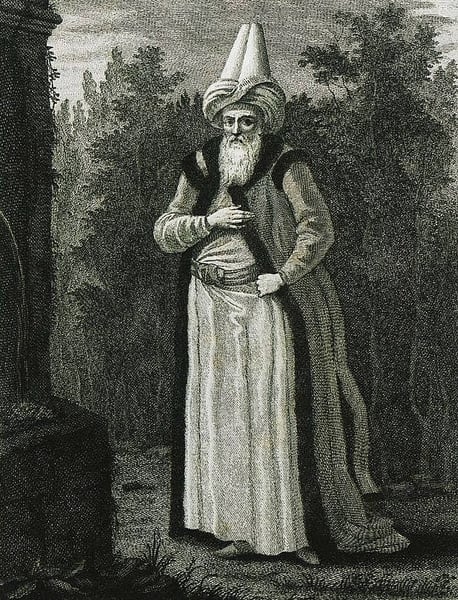 AI

Son of a grand vizier
He was born, probably in 1704, in the Molla Gürani quarter of Istanbul. He was the son of Muhsinzade Abdullah Pasha, who was ağa of the Janissaries when the Patrona Halil revolt was suppressed and later rose to the grand vizierate; the family's name comes from Muhsin Çelebi, a merchant from Aleppo. When his father became grand vizier he was made kethüda (lieutenant) of the gatekeepers in 1737, and the following year he was sent to the governorship of Maraş with the rank of vizier. He then served as governor and guardian in places such as Bender, Özü (Ochakiv), Khotyn, Lepanto, Negroponte and Nicopolis (Niğbolu), most of them in Rumelia; these posts are thought to have given him a good knowledge of the state of the Rumelian fortresses. In 1758 he married Esma Sultan, the daughter of Ahmed III; after the governorships of Bosnia and Rumelia he became grand vizier on 30 March 1765.
First grand vizierate: the ayan and the debate over war
The years 1765–1768, which fell within his grand vizierate, were generally calm. To calm the fierce rivalry among the ayan (provincial notables) who were rising in the provinces, he sent decrees announcing that the position of ayan in the districts would be granted by letter of the grand vizier; the author of the article interprets this stance as a policy that gave weight to centralization. When Russian influence in Poland strained relations, he asked for war to be avoided, since he knew that the Rumelian fortresses were not ready for defence. Because Mustafa III and some dignitaries of state were in favour of war, this opposition was regarded as weakness, and he was dismissed on 7 August 1768. Since he was held in respect, his property was not confiscated; he was sent to Rhodes.
The Morea revolt and the second grand vizierate
When war with Russia began, he was charged with guarding the fortress of Nauplia (Anabolu) in the Morea. He suppressed the Greek revolt that broke out on the peninsula by asking for help from the ayan of the northern districts; in the battle of 19 April 1770 the Greeks and the Russians who were helping them were routed. He then became governor of Bosnia and commander-in-chief (serasker) in Rumelia; after the defeat before Bucharest he was appointed grand vizier and commander-in-chief (serdar-ı ekrem) for the second time on 28 November 1771.
Knowing the army's inadequacy, he immediately sought peace and had a four-month armistice signed on 30 May 1772. Because of Russia's harsh terms and the objections of some statesmen in Istanbul who did not know the real state of the army, the negotiations were broken off; in 1773 fighting resumed, and the Russian army besieged the headquarters at Shumen (Şumnu). Seeing that no other option remained, Mehmed Pasha sent his steward of the grand vizierate (sadaret kethüdası), Ahmed Resmî Efendi, to Küçük Kaynarca, where peace was to be concluded.
Death and assessment
When his illness worsened, he died on 4 August 1774 near Karnobat (Karinabad) while returning to Istanbul; his body was buried first in Edirne and then, at Esma Sultan's request, in Eyüp. The article states that, although he was a good statesman, leaving him in office in his sick condition was a great mistake, and that this weakness had a significant share in the harsh treaty. Ahmed Resmî Efendi, who knew him closely, describes him as an experienced and cautious vizier who read a great deal about the European states. He belonged to the Cerrahi order; he wrote the first work on the life of the order's founder, Nureddin Cerrahi, and endowed a library to the lodge.
Source: TDV Encyclopedia of Islam, “MUHSİNZÂDE MEHMED PAŞA” (Yuzo Nagata)
Related sultans
Cite as: Atlas of the Sultans, “Muhsinzade Mehmed Pasha · Grand viziers”, https://padisahlaratlasi.com/en/grand-viziers/muhsinzade-mehmed-pasha/ (last updated 21 November 2026). Corrections · Image credits