TRENDEFRARAtlas of the Sultans · Ottoman monuments
Ishak Pasha Palace
Monument · Palace, Doğubayazıt, 1785
- Type
- Palace and pavilion
- Location
- Turkey
- Built
- 1785
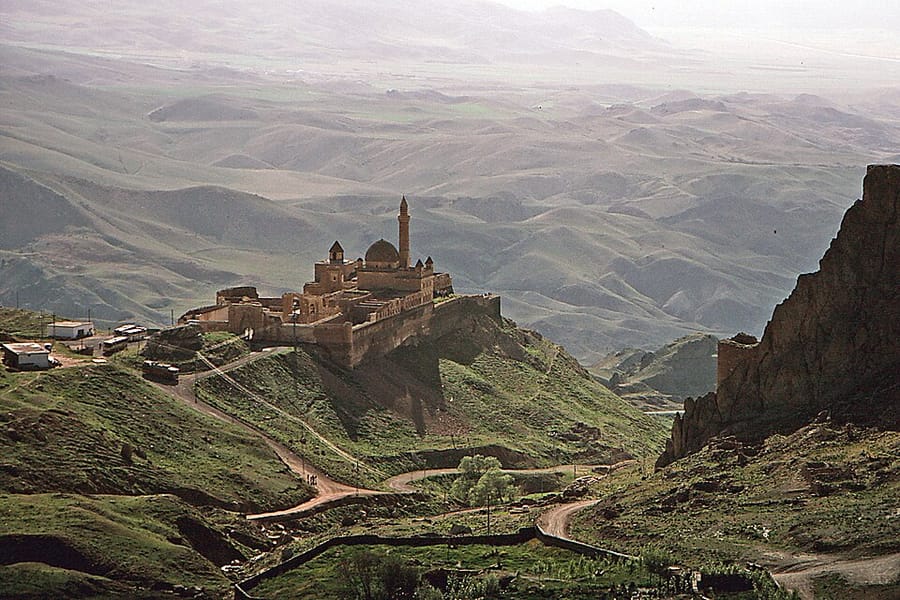

A pasha's palace at Doğubayazıt
This palace complex was built as a country residence on a hill overlooking Doğubayazıt in Ağrı province. According to the inscription over the gate of the harem, it was built in 1785 by Ishak Pasha. A son of Hasan Pasha of the Çıldır dynasty, Ishak Pasha had served with the rank of vizier as governor of Çıldır and Ahıska. The splendour of the palace, together with the exaggerated words spoken before the sultan by an Iranian envoy who had been a guest there, created the impression that the pasha was rivalling the Ottoman dynasty; Ishak Pasha fell from favour, was exiled to Hasankale and died there.
Covering a rectangular area of about 50 × 115 metres, the palace consists of three main groups aligned east to west: a first courtyard with guard cells, barracks and stables; a second courtyard with the selamlık (men's quarters), a mosque and a tomb; and the harem with its kitchen and bath. Its ornate main gate shows strong Seljuk influence together with traces of the European Empire style. After long neglect, the building was surveyed and drawn by Mahmut Akok in the 1960s and restoration followed; in the 1995 restoration its ruined sections were cleared and uncovered.
The later history of the palace
Little is known of the palace's history after Ishak Pasha; only the French Orientalist Pierre-Amédée Jaubert gives some information in his travel account. At the beginning of the 19th century a plague that broke out in the town spread to the palace, killing many in the harem as well as Mahmud Pasha, the bey of Doğubayazıt. The date of death later scratched on his gravestone in the cemetery of the inner courtyard was clarified by the account of Jaubert, whom Mahmud Pasha had imprisoned for a time, showing that the pasha died in 1805.
The region passed under Russian rule after the Russo-Ottoman War of 1877–1878 and returned to Turkish administration at the end of the First World War. The palace stands 7 kilometres from the old settlement and covers about 7,600 square metres. From the 1950s it became known for its picturesque appearance, and in 1982 Yüksel Bingöl wrote a doctoral thesis on it in Germany.
Courtyards, selamlık and mosque
In the first courtyard, to the right of the gate, is a pointed-arched fountain set against the wall; on the right are six guard cells with basements, and behind them rooms whose basement was a dungeon and whose upper floor served as barracks. The inner facade opposite rises with a tall, slender portal flanked by large reliefs of cypress trees. The selamlık apartment is entered through a door with a muqarnas hood set within a pointed-arched iwan.
The mosque is two storeys of the palace high; the roof of its portico is a terrace with towers capped by pyramidal roofs at the corners. The five-sided mihrab niche is pointed-arched with a muqarnas hood. The tomb outside the qibla wall is rectangular below ground and octagonal above; covered by a broken pyramidal roof, its facades are filled with raised floral ornament, and there is no cenotaph inside.
The harem apartment
The splendid arched gate of the harem is bordered by a large torus moulding and framed by intricate floral compositions with a pair of facing lions at the bottom. The engravings of Charles Texier and Flandin clearly show windows of an upper floor on the facade. Whether the section in the middle of the harem, with three pointed-arched openings carried on two columns, was a reception hall or an inner courtyard is debated.
The roof of the kitchen, of almost 100 square metres, is a striking structure formed by four large arches set against one another. One room of the domed, two-part bath was for undressing and the other for bathing. The harem rooms on the ground floor number twelve; remains on the north wall show that a similar arrangement existed on the upper floor.
Source: TDV Encyclopedia of Islam (TDV İslâm Ansiklopedisi), “İSHAK PAŞA SARAYI” (Semavi Eyice)
Related sultans
Cite as: Atlas of the Sultans, “Ishak Pasha Palace · Ottoman monuments”, https://padisahlaratlasi.com/en/monuments/ishak-pasha-palace/ (last updated 21 November 2026). Corrections · Image credits