TRENDEFRARAtlas of the Sultans · Ottoman monuments
Molla Çelebi Mosque
Monument · Mosque, Istanbul, 1561–1562
- Type
- Mosque
- Built
- 1561–1562
A work of Mimar Sinan
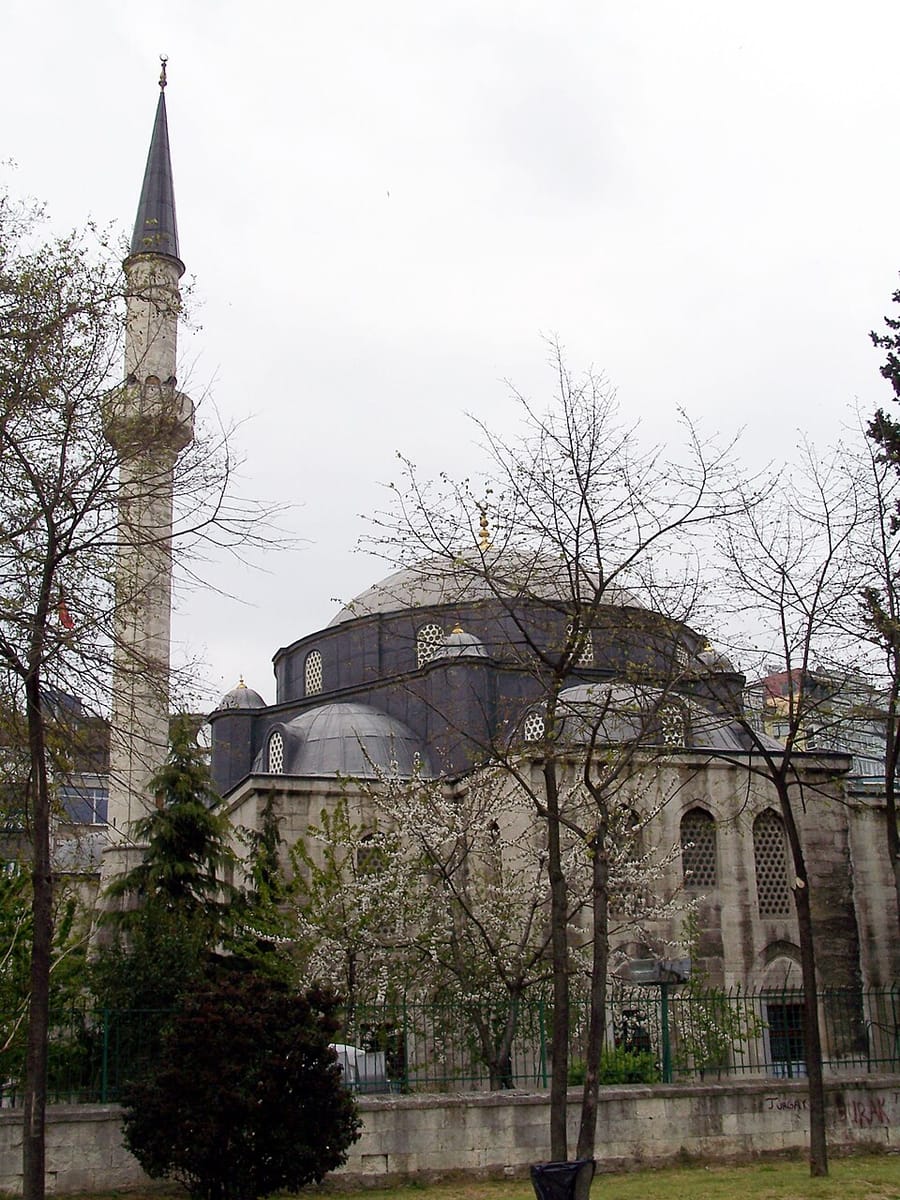

A six-support mosque at Fındıklı
Also known as the Fındıklı Mosque, this is the only surviving building of the complex founded by Mehmed Vüsuli Efendi, Chief Judge (kazasker) of Anatolia, who was known as Molla Çelebi and, after his mother-in-law, the poet Hubbi Hatun, as Hubbi Mollası. The complex's endowment deed of 1584 and the lists of Sinan's works show that the mosque and the bathhouse were built by Mimar Sinan. The bathhouse inscription gives the date 1561–62, and the mosque must have been completed then or shortly afterwards. The bathhouse was demolished in 1957 during road widening.
Belonging to the group of six-support mosques, the building has a main dome 11.80 m in diameter, extended on every side except the north by five semi-domes; a deeper semi-dome in front of the mihrab makes the mihrab section project outward. The mosque was damaged in fires in 1723, 1724, 1823 and 1843, and Abdulhamid I had the mosque, bathhouse and fountain repaired in 1789. After the 1843 fire a wooden porch had been built in front; in the 1958 restoration the General Directorate of Foundations removed it and built a five-domed portico on six marble columns.
Supports, dome and interior
Of the six piers carrying the dome, the two on the south are set at the corners of the mihrab niche; those on the east and west are half-octagonal, while the two on the north are octagonal in section and free-standing. Apart from the northern pair, the piers end outside in weight towers capped with small domes. The dome, hexagonal on the outside, has ten round-arched windows around its base. The space between the free-standing northern piers and the north wall is covered by a wider pointed arch and two half-vaults, and two tiers of wooden galleries were placed there.
The transition to the half-dome over the mihrab is made with muqarnas; the rather plain plaster mihrab has a muqarnas hood. The painted decoration of blue, red, yellow and white floral motifs inside was renewed in recent years. The wooden minbar dates from the 19th century, its raised floral ornament gilded. The main door, with a depressed arch of alternating two-coloured stone and a marble frame, reflects the simplicity of Sinan's age. The cylindrical minaret at the north-west corner was rebuilt at a later date, and its balcony took on a Baroque form.
Sebil, library, graveyard and bath
The sebil that Grand Vizier Koca Yusuf Pasha built in front of the portico in 1786–87 was dismantled in 1957 and moved in front of the Kabataş pier. The State Yearbook of 1879 shows that a library of 144 volumes was formed inside the mosque from donated books; these were later transferred from the library in the Kılıç Ali Pasha Madrasa to the Süleymaniye Library. The graveyard west of the mosque is enclosed by a railed wall built in 1720 by Hüseyin Paşazade Hacı Mehmed Bey; the oldest of its nineteen surviving graves, dated 1709, belongs to the Shaykh al-Islam Sadreddinzade Sadık Mehmed Efendi.
Once one of Istanbul's busiest double baths, the building had a plan similar to that of the Haseki Bath opposite Hagia Sophia; shortly before its demolition it had been converted into a single bath and lost its classical character. The right-hand fragment of its inscription is in the courtyard of the Merzifonlu Kara Mustafa Pasha Madrasa at Çarşıkapı, and three of its marble basins are in the hall of honour of Istanbul University's Faculty of Letters. A hadith school was later planned as an addition to the complex, but it was never built.
Source: TDV Encyclopedia of Islam (TDV İslâm Ansiklopedisi), “MOLLA ÇELEBİ KÜLLİYESİ” (Arzu Iyianlar)
Related sultans
Cite as: Atlas of the Sultans, “Molla Çelebi Mosque · Ottoman monuments”, https://padisahlaratlasi.com/en/monuments/molla-celebi-mosque/ (last updated 21 November 2026). Corrections · Image credits