TRENDEFRARAtlas of the Sultans · Ottoman monuments
Jezzar Pasha Mosque
Monument · Mosque, Acre, 1781–1782
- Type
- Mosque
- Location
- Acre, Palestine and Israel
- Built
- 1781–1782
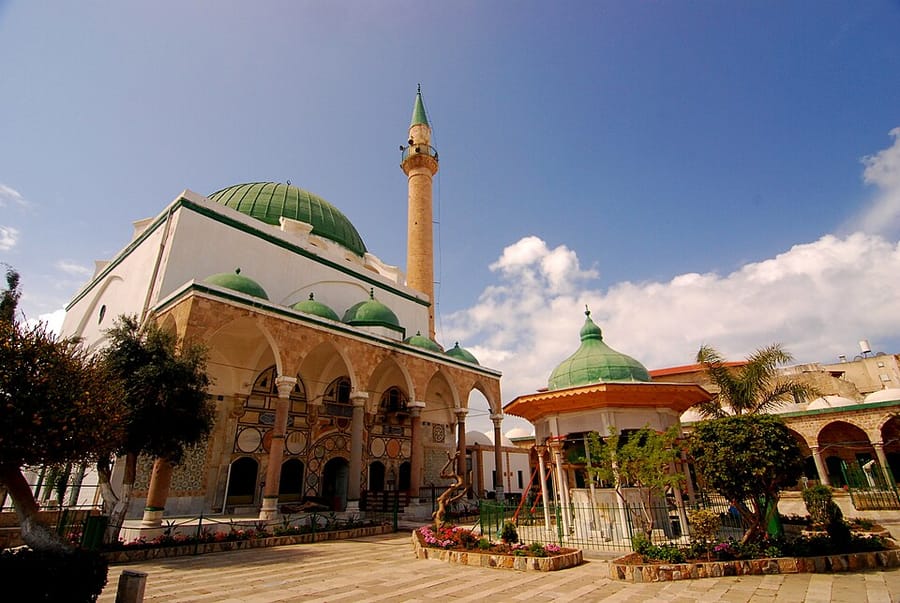

The largest mosque in Acre
The mosque stands inside the citadel at the end of the Suq al-Abyad in Acre, a former Ottoman provincial seat now within the borders of Israel. It was built in 1781–82 by the governor Cezzar (Jezzar) Ahmed Pasha (d. 1804) while he was endowing the city with works such as a madrasa, a bath, fountains and a sebil. Extensively repaired in 1897, it is still the largest mosque in Acre. Together with its madrasa, library, ablution fountain and tomb, it is laid out as a complex (külliye).
The square prayer hall of this single-domed, centrally planned mosque is entered through a portico of six columns and five domes. On the cut-stone façades the pointed arches carrying the dome are expressed as large niches, and the lead-covered dome sits on a windowed drum. The interior decoration is largely Baroque in character, and the slender, tall minaret is simple in appearance. The domes of the arcades around the courtyard rest on marble and granite columns brought from Tyre and Caesarea. In one corner of the courtyard is the madrasa-library known as the Ahmediye, important for its manuscripts, and a room in the north-west corner serves as the tomb of Cezzar Ahmed Pasha.
Facade and minaret
Of the five domes covering the five pointed-arched bays of the portico, the central one is large and the others small. On the exterior, the great niches formed by the arches carrying the dome hold two rows of windows below and one row above. At the top the walls end in a moulding that runs around the building, and the drum of the dome is supported by small buttresses. The interior decoration appears to have undergone some changes during restoration. The minaret, rising at the right corner against the portico, has a lead-covered cap and a balcony with an iron railing.
Courtyard, shops and ablution fountain
The courtyard in which the mosque stands is rectangular and surrounded by porticoes on three sides. Behind the porticoes is a row of rooms that look single-storeyed from inside and two-storeyed from outside; the ground floors of the outer rooms are used as shops. The courtyard is reached by a circular staircase. Between the northern main gate and the portico, on the right, stands an elegant ablution fountain with an onion dome.
Source: TDV Encyclopedia of Islam (TDV İslâm Ansiklopedisi), “CEZZÂR AHMED PAŞA CAMİİ” (Özkan Ertuğrul)
Related sultans
Cite as: Atlas of the Sultans, “Jezzar Pasha Mosque · Ottoman monuments”, https://padisahlaratlasi.com/en/monuments/jezzar-pasha-mosque/ (last updated 21 November 2026). Corrections · Image credits