TRENDEFRARAtlas of the Sultans · 3 / 39 · sultan
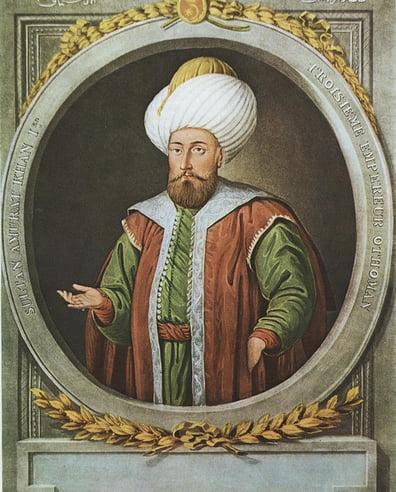
Imaginary portrait (made later) — artist and date unknown
Murad I
Hüdavendigar (“the Sovereign”)
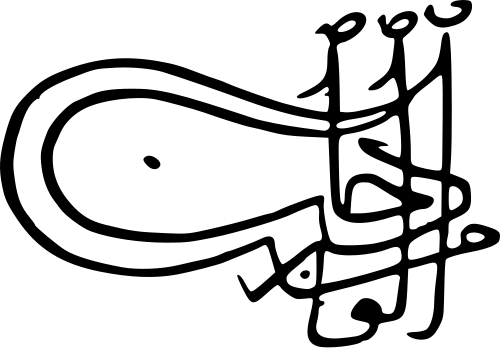
He turned the principality into a state firmly rooted in the Balkans and founded most of the classic Ottoman military and administrative institutions. He was the first sultan to expand by purchase and marriage as well as by conquest.
Open the reign of Murad I on the map▶ Watch the 1-minute video: YouTube · Instagram · TikTok
Interesting fact
After the victory at Kosovo in 1389, while walking among the dead on the battlefield, he was stabbed by Miloš Obilić, who had hidden among the bodies, and died. His inner organs were buried on the spot (the Meşhed of Hudavendigar); his body was taken to his tomb at Çekirge in Bursa.
Source: TDV İslâm Ansiklopedisi (Turkish), article “MURAD I”
Life
Princehood and first years in Rumelia
Murad was born in 1326, the year Bursa was taken. His father was Orhan Bey and his mother Nilüfer Hatun, the daughter of the tekfur (local Byzantine lord) of Yarhisar; he was born of the same mother as his elder brother Süleyman Pasha, who opened up Rumelia. At the age of twelve he was sent to the sanjak of Bursa together with Şahin, who had been his tutor (lala) since childhood; after the conquest of Izmit he moved to Sultanöyüğü (Eskişehir).
After the death of Süleyman Pasha he was sent to Rumelia in 1357 with a strong force, together with his tutor Şahin, and until 1362 he made conquests there as a prince. The Ottoman chronicles placed these years after his accession; Halil Inalcık stresses that this error misled modern historians as well. With him, besides Lala Şahin, were frontier beys such as Evrenos and Hacı Ilbey; in 1359 it was they who thwarted the attempt of the Crusader fleet of the Papacy and Byzantium to land at Lapseki (Lampsacus) and in the Gulf of Saros.
Murad went about taking Edirne (Adrianople) methodically: first he sent his raiders (akıncı) right up to Constantinople to cut off any help reaching the city, and he took Çorlu, Lüleburgaz and Babaeski on the Constantinople-Edirne road, Keşan to the south, and Dimetoka (Didymoteicho), the second largest city of Thrace. According to the TDV article, the people of Edirne surrendered the city on 5 May 1361 and Murad entered it through the Kum Kalesi gate. (Because the sources disagree, the atlas shows the capture of Edirne as a disputed date: 1361 or 1369.)
Accession to the throne
While Murad was on campaign towards Filibe (Plovdiv), he received the news of his father's death from the kadi of Bursa, Çandarlı Kara Halil (March 1362). Meanwhile the men of his brothers Ibrahim and Halil, in Nicaea (Iznik) and Eskişehir, tried to seize the throne in Bursa with the support of Karamanid and Eretna forces. Murad left Lala Şahin in Rumelia as beylerbeyi (governor-general) at the head of the frontier beys and returned to Bursa; Çandarlı had brought the situation under control by the time he arrived.
In the sources and inscriptions he is referred to by titles such as “bey, han, hüdâvendigâr, padişah, sultânü's-selâtîn”; in Ottoman histories he appears most often as Gazi Hünkâr and Hüdavendigar. Serbian and Bulgarian sources call him “tsar”. In his time the principality (beylik) became a sultanate in its titles as well.
Expansion in the Balkans
Murad's greatest victory in the Balkans was the Battle of Çirmen on 26 September 1371. In this battle, which Ottoman tradition also calls the “Sırp Sındığı” (the Serbian Rout), the vanguard of Hacı Ilbey made a night attack on the Serbian army camped on the banks of the Maritsa (Meriç); in the confusion the Serbian army broke up. This victory opened the gates of Macedonia; the Serbian lords and the Bulgarian Tsar Shishman agreed one after another to pay tribute and to send soldiers to the sultan's army.
The Byzantine emperor too became a tributary vassal of the Ottomans and in that capacity joined the sultan's army on campaign. Ottoman forces besieged Thessaloniki for the first time in 1372. With the death of King Louis the Great of Hungary in 1382, Murad was rid of his strongest rival in the Balkans; in 1383 he sent his vizier Çandarlı Hayreddin Pasha against Serres and Thessaloniki, and conquests in the direction of Niš, Epirus and Albania gathered pace.
The conquests also changed the military organization of the state. Çandarlı Hayreddin created the Janissary corps from prisoners of war (mid-1360s). The Yörük groups sent to the frontiers formed the core of the akıncı forces. Those who came from Islamic lands and entered the sultan's service were enrolled in the palace's sipahi oğlanları cavalry units; with the timars distributed in Rumelia, the number of timar-holding sipahis grew. A rule was introduced whereby the timar of a deceased timar holder was divided among his sons instead of being given to someone else; the TDV article regards this as an important reform of the period. Thus the classical Ottoman army had taken shape in its main branches in the reign of Murad I.
Anatolian policy: a wedding, a dowry and a purchase
In Anatolia Murad expanded more by diplomacy than by the sword. In 1381 he held a great wedding in Bursa and invited the Anatolian beys. His son Bayezid married the daughter of Süleyman of Germiyan; Kütahya, Simav, Emet and Tavşanlı on the Karaman border, together with the rich alum mines of Gediz, were given to Bayezid as dowry. The land of Hamid passed to the Ottomans through a purchase made in accordance with Islamic law. The wedding became a diplomatic arena in which Murad made the Anatolian beys acknowledge his superiority.
This expansion made conflict with the Karamanids inevitable. In the battle at a place called Frenkyazısı, the regular Ottoman army defeated Karaman's tribal forces; Halil Inalcık regards this battle as a turning point showing that traditional tribal armies could no longer stand up to a regular army.
Murad also faced a great trial within his own family: his son Savcı Bey rebelled together with Andronikos, the son of the Byzantine emperor. Ottoman tradition dates the revolt to 1385, but Byzantine and Western sources show that it took place in the 1370s.
Kosovo and death
The last campaign of his life was against the Serbian Prince (Knez) Lazar. The efforts of the new Hungarian king, Sigismund, to establish influence on the far side of the Danube had set him against Lazar and the king of Bosnia; this situation worked to Murad's advantage. The Ottomans won the battle fought on the plain of Kosovo in June 1389. According to Ahmedi's Gazaname, as Murad walked among the corpses with a few of his guards (haseki) after the battle, he was stabbed with a dagger by a Serbian nobleman who had hidden among the dead, and he died shortly afterwards. Serbian epic tradition remembers this man as Miloš Obilić.
Murad's internal organs were buried where he fell as a martyr; a tomb later known as the Hüdavendigar Meşhedi was built on the spot. His body was taken to Bursa together with that of his son Yakub Çelebi, whom Bayezid had put to death on taking the throne, and buried in his tomb at Çekirge. He is the only Ottoman sultan to have lost his life on the battlefield. According to his endowment deed dated 1385, he built the Hüdavendigar Complex at Çekirge in Bursa, comprising a mosque, madrasa, soup kitchen (imaret) and guesthouse, the Hisar Mosque in the citadel of Bursa, and a mosque each in Bilecik and Yenişehir; in 1388 he founded an imaret in Nicaea in the name of his mother, Nilüfer Hatun.
Kosovo became the subject of a national epic for the Serbs; the first reports to reach the West were confused enough to claim that the Turks had been routed. In reality the battle consolidated Ottoman supremacy in the Balkans. In his twenty-seven-year reign Murad had turned the Marmara state he inherited from his father into a power reaching to the Danube, Albania and Central Anatolia.
Source: TDV Encyclopedia of Islam (TDV İslâm Ansiklopedisi), “Murad I” (Halil Inalcık); Ahmedi's Gazaname, Neşri, Oruç Bey and Idris-i Bitlisi, together with Byzantine and Western sources, are the main foundations of this article.
Meanwhile in the world
Contemporary rulers
- Charles V (the Wise)King of France · 1364–1380Reorganized the army and navy, recovering land from the English
- Richard IIKing of England · 1377–1399Became king as a child; deposed in 1399
- Hongwu EmperorMing Emperor (China) · 1368–1398Founder of the Ming dynasty, born to a poor peasant family
- TimurFounder of the Timurid state · 1370–1405Built a vast Central Asian state centered on Samarkand
- Louis I (the Great)King of Hungary · 1342–1382Also became King of Poland from 1370
- Dmitry DonskoyPrince of Moscow · 1359–1389His victory at Kulikovo accelerated Moscow's rise
What was happening in the world?
- 1368Zhu Yuanzhang drove the Mongols from Beijing and founded the Ming dynasty in China.
- 1378The election of two rival popes began the Western Schism in the Catholic Church.
- 1380At the Battle of Kulikovo, Russian forces under Dmitry Donskoy defeated the Golden Horde.
- 1381In England, the Peasants' Revolt led by Wat Tyler broke out against the poll tax.
- 1385In the Union of Krewo, Grand Duke Jogaila of Lithuania agreed to take the Polish throne and accept Catholicism.
Family
| Father | Orhan |
|---|---|
| Mother | Nilüfer Hatun |
| Consorts | Gülçiçek Hatun, Maria Thamar Hatun (Bulgarian princess), Paşa Melek Hatun |
| Children | Bayezid I, Yakub Çelebi, Savcı Bey, Nefise Sultan |
Major achievements
- Capture of Adrianople (1361 or 1369; the date is disputed), made the capital
- Founding of the Janissary corps and the cadet corps, the devşirme system
- The Pençik law regulating the recruitment of prisoners of war
- Creation of the Beylerbeylik of Rumelia
- Victories on the Maritsa (Chernomen, 1371) and in the First Battle of Kosovo (1389); the historicity of the Sırpsındığı (1364) account is disputed
- Hamid and Germiyan lands acquired by purchase and dowry — expansion without war
- The title Hüdavendigar; the title 'sultan' becomes established
Treaties
- Vassalage and tribute agreements with Eastern Roman (Byzantine), Serbian and Bulgarian lords
Viziers
| Name | From | To | Length |
|---|---|---|---|
| Sinaneddin Fakih Yusuf Pasha | 1349 | 1364 | |
| Çandarlı Kara Halil Hayreddin Pasha | 1364 | 1387 | |
| Çandarlı Ali Pasha | 1387 | 1406 |
These names and years come from traditional vizier lists compiled later and are approximate.
Battles and treaties
| Year | Event | Result / parties |
|---|---|---|
| Treaty: Vassalage and tribute agreements with Eastern Roman (Byzantine), Serbian and Bulgarian lords | ||
| 1364 | Battle: Sırpsındığı | Same event as the Battle of Chernomen (1371) |
| 1369 | Siege: Capture of Adrianople | The governor was defeated and fled; the city surrendered |
| 1371 | Battle: Maritsa | The Serbian army was routed; the way into Macedonia lay open |
| 1386 | Battle: Battle of Frenkyazısı | Karamanid defeat; by the peace Beyşehir was ceded to the Ottomans |
| 1387 | Siege: First Ottoman capture of Thessalonica | The city surrendered to the Ottomans after a long blockade |
| 1388 | Battle: Battle of Bileća | Rout of the Ottoman raiding force |
Full infoboxes are in the site’s “Battles and Treaties” tab; source: TDV Encyclopedia of Islam.
Death
He was stabbed to death on the battlefield right after the First Battle of Kosovo (1389) by a Serbian nobleman, whom later Serbian epic tradition names Miloš Obilić. He is the only Ottoman sultan to have died on the field of battle.
Territorial change
| Year | Region | Event | Source |
|---|---|---|---|
| 1364 | + Eastern Rumelia (Plovdiv–Sliven) | Plovdiv (Filibe) surrendered after a long siege (1364); Stara Zagora was also taken under a pledge of safety, and Yambol followed in 1369. Ottoman chroniclers give 1361 for Plovdiv | TDV İA, “MURAD I” (disputed date: TDV I. Murad: Filibe 765'te (büyük ihtimalle 1364) teslim oldu; TDV Filibe Osmanlı rivayetindeki 1361'i tartışmalı sayar) |
| 1371 | + Western Thrace (Komotini–Kavala) | Raids into western Thrace and Komotini after Edirne | TDV İA, “MURAD I” |
| 1371 | + Rhodopes (Kardzhali–Smolyan) | The Rhodopes (Kardzhali–Smolyan): with the conquest of the Maritsa valley, together with Bulgaria and Western Thrace (1371) | Inalcık, The Ottoman Empire: The Classical Age, p. 12; Imber, The Ottoman Empire, 1300–1650, p. 93; Ágoston – Masters, Encyclopedia of the Ottoman Empire, p. 397; Iorga, Geschichte des osmanischen Reiches, I, 241 |
| 1381 | + Germiyan (Kütahya–Afyon–Uşak) | Kütahya and its surroundings received as dowry (1381) | TDV İA, “MURAD I” |
| 1383 | + Macedonia (Skopje–Bitola) | The capture of Serres (1383) began direct Ottoman rule in Macedonia; Bitola, Prilep and Štip were also taken in these years. After Chernomen (1371) the Serbian lords of Macedonia had been tributary vassals | TDV İA, “SEREZ” |
| 1387 | + Thessaloniki–Chalkidiki–Mount Athos | Capture of Thessaloniki (1387) | TDV İA, “SELÂNİK” |
| 1388 | + Northern Dobruja (Constanța–Tulcea) | Ivanko, ruler of Dobruja, recognises Ottoman suzerainty (c. 1388) | TDV İA, “DOBRUCA” (disputed date: TDV: the date of entry is uncertain; Ivanko became a vassal under Murad I) |
| 1388 | + Southern Dobruja (Dobrich–Silistra) | Ivanko, ruler of Dobruja, recognises Ottoman suzerainty (c. 1388) | TDV İA, “DOBRUCA” (disputed date: TDV: the date of entry is uncertain; Ivanko became a vassal under Murad I) |
The lands that changed hands in this period, and the battles or treaties that brought the changes, can be seen on the map: map of the reign of Murad I.
Cite as: Atlas of the Sultans, “Murad I (Hüdavendigar (“the Sovereign”)): Reign Map, Wars and Conquests (1362–1389)”, https://padisahlaratlasi.com/en/sultans/i-murad/ (last updated 21 November 2026). Corrections · Image credits
Monuments of this reign: Dzhumaya Mosque · Hüdavendigar Complex · Green Mosque of Iznik · Tomb of Sultan Murad
Women of the dynasty in this reign: Nilüfer Hatun
Capital in this reign: Bursa · Edirne
State organisation: The Grand Vizierate and the Sublime Porte · The Learned Hierarchy and the Judgeship · The Province and Sandjak System · The devshirme system · The Kapıkulu corps
Myths and misconceptions: Was Istanbul always the Ottoman capital? · Did fratricide begin with Mehmed the Conqueror's law code? · Was the tughra the sultan's own handwritten signature?