TRENDEFRARAtlas of the Sultans · 4 / 39 · sultan
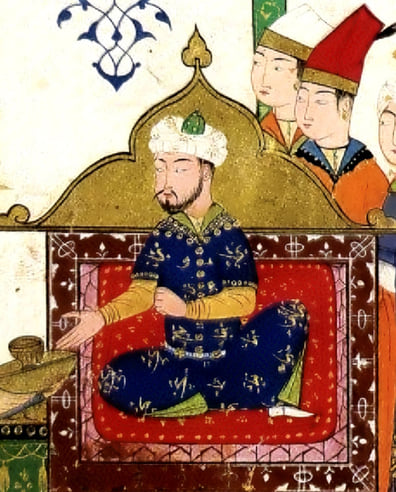
Imaginary portrait (made later) — mid-15th c.
Bayezid I
Yıldırım (“the Thunderbolt”)

In thirteen years he carried the state to its height and lost it in a single battle. The Battle of Ankara broke the unity of Anatolia, restored the principalities and began the eleven-year Interregnum — the sharpest break in Ottoman history.
Open the reign of Bayezid I on the map▶ Watch the 1-minute video: YouTube · Instagram · TikTok
Interesting fact
Defeated by Timur at the Battle of Ankara in 1402, he was taken prisoner and died in captivity at Akşehir on 8 March 1403. The defeat broke up the state he had expanded so quickly.
Source: TDV İslâm Ansiklopedisi (Turkish), article “BAYEZİD I”
Life
Princehood and the epithet “the Thunderbolt”
Bayezid was born in 1354. He was the eldest son of Murad I; his mother was Gülçiçek Hatun. Around 1381 he married Sultan Hatun, the daughter of Süleyman Çelebi of Germiyan; he became sanjak governor (sancak beyi) of the lands ceded to the Ottomans as his wife's dowry and, settling in Kütahya, was charged with guarding the eastern frontier of the state.
In 1386 he took part in his father's campaign against Alaeddin Bey of Karaman. The courage and dash he showed at the Battle of Frenkyazısı earned him the epithet “Yıldırım” (the Thunderbolt). He also played an important part in winning the Battle of Kosovo on 15 June 1389.
Accession at Kosovo
Murad I, gravely wounded at Kosovo, asked in his last wishes that Bayezid succeed him, as he was his eldest son and he judged him capable; when his father died, Bayezid was enthroned on the battlefield. On the advice of the leading men of the state, and to avoid a civil war, he had his only surviving brother, Yakub Çelebi, put to death. The Serbian Prince (Knez) Lazar, who had been taken prisoner, was also executed on the battlefield.
The new sultan returned at once to Bursa, because at the news of Murad's death the vassal beys in Anatolia had begun to stir. Before crossing to Anatolia he came to terms with Lazar's son Stefan Lazarević: he married Stefan's sister Olivera (Maria Despina) and secured the right to draw auxiliary troops from the Serbs. From then on, because of Hungarian pressure, Stefan remained loyal to Bayezid and fought at his side on his campaigns.
Uniting the Anatolian principalities
In the winter of 1389–1390 Bayezid took Alaşehir and brought the principalities (beyliks) of Aydın, Saruhan, Menteşe, Hamid and Germiyan in western Anatolia under Ottoman rule. On this campaign Süleyman Bey of the Candarids and Manuel II Palaiologos, son of the Byzantine emperor, were also with the Ottoman army with their forces; Byzantium was now a vassal supplying troops to the sultan's army.
He then marched against the Karamanids, took Beyşehir and besieged Konya. In the east he entered into a long struggle with Kadı Burhaneddin, ruler of Sivas; the emir of Amasya surrendered his city to the Ottomans in 1392. After the victory at Nicopolis he defeated Alaeddin Bey of Karaman at the Battle of Akçay; in the autumn of 1397 the lands of the Candarids, and in 1398 the Canik region and the lands Kadı Burhaneddin had ruled, were annexed to the Ottoman state. In this way Bayezid brought most of the Turkmen principalities of Anatolia under a single rule within a short time.
The Balkans, Constantinople and Nicopolis
In the Balkans Bayezid took the Bulgarian capital Tarnovo (Tırnova) on 17 June 1393; the Bulgarian Tsar Shishman was forced to withdraw to Nicopolis as an Ottoman vassal. In the winter of 1393–1394 he gathered the Balkan princes and the Byzantine dynasty at Serres. In 1394 he recaptured Thessaloniki, which had been taken in 1387 and lost in 1389, and conquered Thessaly. In the spring of the same year he placed Constantinople, which he had kept under blockade for seven years, under close siege. In 1395 he attacked the fortresses on the Hungarian frontier; on 17 May 1395, in a battle near the Argeș river in Wallachia, he defeated Mircea, the prince of Wallachia, and installed Vlad in his place, then reached Nicopolis and did away with the Bulgarian Tsar Shishman. He sent Evrenos Bey to the Morea, and southern Albania too was brought under direct Ottoman rule.
This rapid expansion united the Hungarians and the Venetians in a new Crusade. In 1396, while Bayezid was striving to take Constantinople, the Crusader army under King Sigismund of Hungary besieged Nicopolis. Bayezid lifted the siege of Constantinople, marched swiftly to the Danube and inflicted a crushing defeat on the Crusaders on 25 September 1396. He then took Vidin from Stratsimir, the last independent Bulgarian prince. The Byzantine Emperor Manuel was forced to accept the establishment of a Turkish quarter in Constantinople, the building of a mosque and the installation of a kadi. To keep Constantinople under pressure, Bayezid had the fortress of Güzelcehisar (Anadoluhisarı) built on the Anatolian shore (1396–1397).
Timur, Ankara and captivity
Bayezid's capture in the east of Elbistan, Malatya, Behisni, Kahta and Divriği, which belonged to the Mamluks, closed the way to an understanding with the Mamluks in the face of the threat from Timur. Timur welcomed the Anatolian beys who fled from Bayezid and took refuge with him; Bayezid in turn gave protection to Timur's enemies Sultan Ahmed Jalayir and Kara Yusuf. In August 1400 Timur besieged and took the Ottoman city of Sivas and subjected it to a bloody sack.
The two rulers met on 28 July 1402 on the plain of Çubuk near Ankara. Bayezid was defeated and taken prisoner. He died in captivity at Akşehir on 8 March 1403. The defeat at Ankara brought down the state Bayezid had expanded so rapidly: the Anatolian beys took back their lands, and his surviving sons, the princes Süleyman, Isa, Musa and Mehmed Çelebi, went to war with one another for the throne. The problems of this period, known as the Interregnum, could only be fully resolved in the time of Mehmed II.
The TDV article presents Bayezid as an extremely brave, energetic, capable and just ruler, though harsh in temperament. In Bursa he built a dervish lodge (zaviye), a madrasa, a soup kitchen (imaret), a caravanserai, a bridge and a hospital; the Great Mosque of Bursa (Ulucami, 1399–1400) is his work. He sought to eliminate the vassal dynasties in Anatolia and Rumelia and to build a centralized state; this aim was left unfinished in his time, but after his sons it became the main line of Ottoman policy.
Source: TDV Encyclopedia of Islam (TDV İslâm Ansiklopedisi), “Bayezid I” (Halil Inalcık); Sharaf al-Din Ali Yazdi's Zafername, Ibn Arabshah, Ahmedi and the memoirs of the Bavarian captive Johann Schiltberger are among the sources of this article.
Meanwhile in the world
Contemporary rulers
- TimurFounder of the Timurid state · 1370–1405Central Asian conqueror who made Samarkand his capital
- Charles VIKing of France · 1380–1422His mental illness plunged the kingdom into factional strife
- SigismundKing of Hungary · 1387–1437Of the Luxembourg dynasty; later German king and emperor
- Manuel II PalaiologosByzantine Emperor · 1391–1425Toured Italy, France and England seeking military aid
- Władysław II JagiełłoKing of Poland · 1386–1434Grand duke of Lithuania; founder of the Jagiellonian dynasty
- BarquqMamluk Sultan · 1382–1399First sultan of the Circassian (Burji) Mamluk line
What was happening in the world?
- 1392Yi Seong-gye ended the Goryeo dynasty and founded the Joseon dynasty in Korea.
- 1397The Kalmar Union joined Denmark, Norway and Sweden under one ruler, led by Queen Margaret I.
- 1398Timur captured and sacked Delhi; the Delhi Sultanate never regained its former strength.
- 1399In England, Richard II was deposed and Henry IV took the throne.
- 1400Geoffrey Chaucer, author of The Canterbury Tales, died and was buried in Westminster Abbey.
Sources: britannica.com [1] [2] [3] [4] [5] [6] [7] [8] [9] [10] [11]
Family
| Father | Murad I |
|---|---|
| Mother | Gülçiçek Hatun |
| Consorts | Devlet Hatun or Devletşah Hatun (Germiyanid; whether the two names refer to the same person is disputed), Despina (Olivera) Hatun (Serbian princess), Hafsa Hatun (Aydınid) |
| Children | Süleyman Çelebi, Isa Çelebi, Musa Çelebi, Mustafa Çelebi, Mehmed I (Çelebi), Kasım, Fatma Hatun, Hundi Hatun |
Major achievements
- Anatolian principalities united under one rule (Aydın, Saruhan, Menteşe, Karaman, Candar, Rum)
- Victory at Nicopolis (1396) — rout of a great crusader army
- First serious siege of Constantinople and construction of Anadoluhisarı
- He is said to have received a diploma as 'Sultan of the Lands of Rum' from the Abbasid caliph in Cairo
- Construction of the Great Mosque of Bursa
- Earned the name ‘Thunderbolt’ for his speed of movement
Treaties
None recorded.
Viziers
| Name | From | To | Length |
|---|---|---|---|
| Çandarlı Ali Pasha Vizier since 1387; after the Battle of Ankara he remained in office under Emir Süleyman until 1406. | 1387 | 1406 |
These names and years come from traditional vizier lists compiled later and are approximate.
Battles and treaties
| Year | Event | Result / parties |
|---|---|---|
| 1389 | Battle: First Battle of Kosovo | Ottoman victory; Murad I killed, Lazar executed, Serbia became an Ottoman vassal |
| 1392 | Battle: Battle of Kırkdilim | The Ottoman army was defeated and withdrew |
| 1393 | Siege: Ottoman capture of Tarnovo | End of the Tsardom of Tarnovo; the city stayed Ottoman until 1878 |
| 1394 | Siege: Siege of Constantinople (1394–1402) | The city was not taken; the siege ended after the battle of Ankara |
| 1395 | Battle: Rovine | Ottoman victory; Mircea had to leave his throne and Vlad was installed |
| 1396 | Battle: Nicopolis | Decisive Ottoman victory; the crusading army was routed and leading French nobles taken prisoner |
| 1402 | Battle: Battle of Ankara | Victory for Timur; Bayezid I captured, the Anatolian principalities restored, the Interregnum began |
Full infoboxes are in the site’s “Battles and Treaties” tab; source: TDV Encyclopedia of Islam.
Death
Captured by Timur at the Battle of Ankara (1402), he fell ill and died in captivity at Akşehir in March 1403. Stories that he was carried in a cage or took his own life are later traditions.
Territorial change
| Year | Region | Event | Source |
|---|---|---|---|
| 1390 | + Aydın–Saruhan–Menteşe | Campaign against the western Anatolian principalities (1390): Aydın, Saruhan, Menteşe · returned after the Battle of Ankara (1402) | TDV İA, “BAYEZİD I” |
| 1390 | + Teke–Hamid (Antalya–Isparta–Burdur) | Annexation of Teke and Hamid (1390–1391) · passed to the Karamanids after the Battle of Ankara (1402) | TDV İA, “TEKEOĞULLARI” (disputed date: TDV: the 1390 campaign reached the border of Antalya; whether the city was taken that year is unknown) |
| 1392 | + Kastamonu–Sinop (Candar) | Kastamonu campaign (1392) · lost after the Battle of Ankara (1402) | TDV İA, “BAYEZİD I” |
| 1393 | + Thessaly (Larissa–Trikala–Arta) | Thessaly campaign (1393) and submission of the Greek despotates | TDV İA, “BAYEZİD I” (one-year difference: TDV: around 1394) |
| 1393 | + Danubian Bulgaria | Tarnovo was taken after a long siege (17 June 1393) and the Bulgarian tsardom came to an end; since Chernomen (1371) Tsar Shishman had been a tributary vassal | TDV İA, “TIRNOVA” |
| 1394 | + Southern and Central Albania (Vlorë–Berat–Elbasan) | Raids into Albania (1385–1394) | TDV İA, “BAYEZİD I” |
| 1397 | + Karaman–Konya–Kayseri | Battle of Akçay (1397), capture of Konya · lost after the Battle of Ankara (1402) | TDV İA, “BAYEZİD I” |
| 1398 | + Sivas–Amasya–Tokat (Rum) | Capture of Sivas, Tokat and Amasya (1398) — after the Battle of Ankara it remained Mehmed Çelebi's base | TDV İA, “AMASYA” |
| 1398 | + Canik (Samsun–Ordu) | Capture of Samsun (1398) · after the Battle of Ankara (1402) Kubadoğlu Cüneyd restored his principality | TDV İA, “SAMSUN” |
| 1402 | − Aydın–Saruhan–Menteşe | Campaign against the western Anatolian principalities (1390): Aydın, Saruhan, Menteşe · returned after the Battle of Ankara (1402) | TDV İA, “BAYEZİD I” |
| 1402 | − Germiyan (Kütahya–Afyon–Uşak) | Battle of Ankara (1402) — the Germiyan principality was restored | TDV İA, “BAYEZİD I” |
| 1402 | − Teke–Hamid (Antalya–Isparta–Burdur) | Annexation of Teke and Hamid (1390–1391) · passed to the Karamanids after the Battle of Ankara (1402) | TDV İA, “TEKEOĞULLARI” |
| 1402 | − Kastamonu–Sinop (Candar) | Kastamonu campaign (1392) · lost after the Battle of Ankara (1402) | TDV İA, “BAYEZİD I” |
| 1402 | − Karaman–Konya–Kayseri | Battle of Akçay (1397), capture of Konya · lost after the Battle of Ankara (1402) | TDV İA, “BAYEZİD I” |
| 1402 | − Canik (Samsun–Ordu) | Capture of Samsun (1398) · after the Battle of Ankara (1402) Kubadoğlu Cüneyd restored his principality | TDV İA, “SAMSUN” |
| 1402 | − Northern Dobruja (Constanța–Tulcea) | After the Battle of Ankara (1402) Mircea of Wallachia re-entered Dobruja | TDV İA, “DOBRUCA” |
| 1402 | − Thessaloniki–Chalkidiki–Mount Athos | Returned to the Eastern Roman Empire (Byzantium) by Süleyman Çelebi's Treaty of Gallipoli (1403) after the Battle of Ankara | TDV İA, “SELÂNİK” (one-year difference: TDV: Gelibolu Antlaşması 1403) |
| 1402 | − Southern Dobruja (Dobrich–Silistra) | After the Battle of Ankara (1402) Mircea of Wallachia re-entered Dobruja | TDV İA, “DOBRUCA” |
The lands that changed hands in this period, and the battles or treaties that brought the changes, can be seen on the map: map of the reign of Bayezid I.
Cite as: Atlas of the Sultans, “Bayezid I (Yıldırım (“the Thunderbolt”)): Reign Map, Wars and Conquests (1389–1402)”, https://padisahlaratlasi.com/en/sultans/i-bayezid/ (last updated 21 November 2026). Corrections · Image credits
Monuments of this reign: Green Mosque of Iznik · Grand Mosque of Bursa (Ulucami) · Timurtaş Pasha Complex · Anadolu Hisarı · Yıldırım Mosque (Bursa) · Yıldırım Mosque (Edirne)
Capital in this reign: Bursa
Myths and misconceptions: Did fratricide begin with Mehmed the Conqueror's law code?