TRENDEFRARAtlas of the Sultans · 27 / 39 · sultan
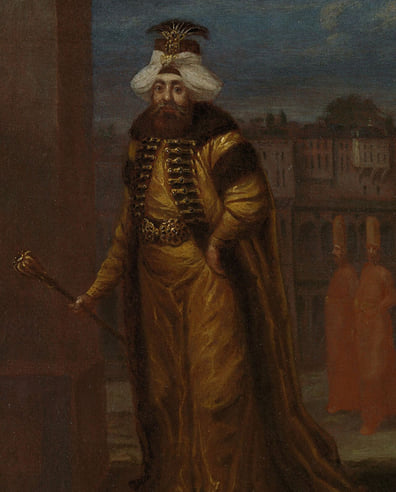
Portrait made in his lifetime — Jean-Baptiste Vanmour · c. 1730–37
Mahmud I
The empire's last great territorial gain was made in his reign. As the first sultan to introduce European-style military training, he began the line of reform that ran until the Tanzimat.
Open the reign of Mahmud I on the map▶ Watch the 1-minute video: YouTube · Instagram · TikTok
Interesting fact
He wrote poetry as “Sebkati” and composed music, some of which survives. He founded libraries at the Hagia Sophia, Fatih and Süleymaniye mosques and placed there valuable manuscripts that had lain unused in the palace.
Source: TDV İslâm Ansiklopedisi (Turkish), article “MAHMUD I”
Life
Twenty-seven years in the Cage
Mahmud was born in Edirne on 2 August 1696. He was the eldest son of Mustafa II; his mother was Saliha Sultan. He spent his childhood in Edirne; his tutor was Ibrahim Efendi, the son of Şeyhülislam Feyzullah Efendi. When his father was deposed in 1703 he was brought to Istanbul together with his brothers; in 1705 he was circumcised along with them.
For the next twenty-seven years he lived in the closed princes' quarters known as the “kafes” (the Cage), spending his time mostly on goldsmith's work.
After the Patrona revolt
When his uncle Ahmed III stepped down from the throne during the Patrona Halil revolt of 1730, Mahmud became sultan on 2 October 1730; the first to swear allegiance to him was his uncle. In the first months of his reign power was effectively in the hands of the rebels. Taking affairs of state into his own hands, Mahmud soon did away with the rebel ringleaders; new attempts at revolt in 1731 were also thwarted with the support of the city's people. The Janissaries, as well as the Bosnians and Albanians, who had taken part in the events were removed from Istanbul, and strict control was established in the city.
Mahmud also took a close interest in social order: he introduced regulations on matters such as the supervision of the tradesmen and the fixing of prices (narh).
Iran and Nadir Shah
In the east the struggle with Iran continued. On 15 September 1731 the governor of Baghdad, Ahmed Pasha, defeated the Iranians. But Nadir, whose power was growing in Iran, soon began to retake the places the Ottomans had captured. After long negotiations, in 1736 an agreement was reached on condition that Nadir be recognized as shah and that Sunnism be officially proclaimed in Iran; Nadir's demand that Jafarism (Caferilik) be recognized as a “fifth school” of law was, however, rejected. After the Peace of Belgrade, war with Nadir Shah broke out again; finally, on 4 September 1746, a peace (the Treaty of Kerden) was concluded on the basis of the Treaty of Kasr-ı Şirin, providing for the safety of pilgrims and travelers and the return of prisoners.
Russia, Austria and the Treaty of Belgrade
In 1736 Russia attacked the Crimea; in June 1737 Austria too invaded Ottoman territory in three columns. The Russians took Ochakov (Özi), while the Austrians took Niš, entered Wallachia and seized Bucharest. After these losses Mahmud went over to the counteroffensive; Niš was recovered. In the spring of 1739 the army under Grand Vizier Ivaz Mehmed Pasha marched on Belgrade, defeated the Austrians at Grocka (Hisarcık) and laid siege to Belgrade.
With the Treaty of Belgrade, signed through French mediation in September 1739, Belgrade, northern Serbia and Little Wallachia returned to the Ottomans. This was the greatest diplomatic success the Ottomans achieved against Europe in the 18th century, and it opened a long period of peace for the state.
Reforms, buildings and death
Military reforms were also carried out under Mahmud. Humbaracı Ahmed Pasha (Comte de Bonneval), a man of French origin, founded a salaried Corps of Bombardiers (Humbaracı Ocağı) and in 1734 opened a barracks and school in Üsküdar called the Hendesehane (Humbarahane); according to the TDV article, this was the first forerunner of the engineering schools that would be founded under Mustafa III and Selim III. The Artillery Corps (Topçu Ocağı) was reorganized and new cannon were cast. After Ibrahim Müteferrika's death in 1747, efforts were made to reopen the printing press, which had closed.
Mahmud founded libraries in the Hagia Sophia, Fatih and Süleymaniye mosques and in the Galata Palace; to provide income for these libraries he endowed villages in Vidin and Smederevo (Semendire); the Cağaloğlu Bath, which he built as an endowment for the Hagia Sophia Library, still operates today. To solve the water problem of Galata and Beyoğlu he had dams built; the water they collected was distributed to more than 100 fountains, foremost among them the square fountain at Tophane, which he had completed. Today's Taksim district takes its name from the water distribution building (maksem, or taksim) that he had built. The Nuruosmaniye Mosque, a pioneering work of the Baroque style, was begun in his time and finished under his successor, Osman III.
The sources describe him as a pious, intelligent, learned, gentle, peace-loving and just sultan. He wrote poems under the pen name “Sebkati”, occupied himself with music and composed works, some of which have survived to the present day. The TDV article describes him as the sultan “who gave the Ottoman state its last brilliant era”. On 13 December 1754, returning from Friday prayers, he died at the Demirkapı entrance of Topkapı Palace. He was buried not in the tomb he had had prepared beside the Nuruosmaniye but, at the wish of Osman III, in the tomb of Turhan Sultan beside the Yeni Cami.
Source: TDV Encyclopedia of Islam (TDV İslâm Ansiklopedisi), “Mahmud I” (Abdülkadir Özcan); the main sources of this article are Silahdar Fındıklılı Mehmed Ağa, Subhi, Izzi, Şem'danizade and Ahmed Vasıf.
Meanwhile in the world
Contemporary rulers
- Louis XVKing of France · 1715–1774Successor of Louis XIV; lost most colonies in the Seven Years' War
- Maria TheresaArchduchess of Austria, Queen of Hungary and Bohemia · 1740–1780Habsburg ruler known for wide-ranging administrative reforms
- Frederick II (the Great)King of Prussia · 1740–1786Seized Silesia and made Prussia a major European power
- Elizabeth (Yelizaveta Petrovna)Empress of Russia · 1741–1762Daughter of Peter the Great; took power in a 1741 coup
- George IIKing of Great Britain · 1727–1760Second Hanoverian king of Great Britain, also elector of Hanover
- Nader ShahShah of Iran (Afsharid dynasty) · 1736–1747Founder of the Afsharid dynasty and a formidable military commander
- QianlongEmperor of China (Qing dynasty) · 1735–1796Fourth Qing emperor, who ruled for six decades
What was happening in the world?
- 1735Carl Linnaeus published Systema Naturae, introducing a hierarchical system for classifying living things.
- 1739Nader Shah defeated the Mughals at Karnal and sacked Delhi, carrying off the Peacock Throne to Iran.
- 1740Frederick II's invasion of Silesia began the War of the Austrian Succession.
- 1748Montesquieu published The Spirit of Laws, setting out the separation of powers.
- 1751The first volume of the Encyclopédie, edited by Diderot and d'Alembert, was published.
- 1752Benjamin Franklin's kite experiment showed that lightning is electricity.
Sources: britannica.com [1] [2] [3] [4] [5] [6] [7] [8] [9] [10] [11] [12] [13]
Family
| Father | Mustafa II |
|---|---|
| Mother | Saliha Sultan |
| Consorts | Ayşe Kadın, Verd-i Hoş Kadın, Hatem Kadın |
| Children | He had no children |
Major achievements
- The artillery and bombardier corps reorganised on European lines with Humbaracı Ahmed Pasha (Comte de Bonneval) — the first serious military reform
- The first engineering instruction in the Hendese Odası
- Serbia and Belgrade retaken by the Treaty of Belgrade (1739) — the empire's last major territorial gain
- Nuruosmaniye Mosque begun; libraries and pious foundations
- The border with Persia settled at Kerden
Treaties
- Treaties of Belgrade (1739, Austria and Russia)
- Treaty of Kerden (1746, Persia)
Grand viziers
| Name | From | To | Length |
|---|---|---|---|
| Silahdar Damad Mehmed Pasha | October 1, 1730? | January 22, 1731 | |
| Kabakulak Ibrahim Pasha | January 22, 1731 | September 1731 | |
| Topal Osman Pasha | September 10, 1731 | March 12, 1732 | 184 days |
| Hekimoğlu Ali Pasha | March 12, 1732 | July 15, 1735 | 3 years, 125 days |
| Gürcü Ismail Pasha | July 1735 | December 1735? | |
| Silahdar Seyyid Mehmed Pasha | January 1736? | August 1737 | 1-2 years |
| Muhsinzade Abdullah Pasha | August 5, 1737 | December 19, 1737 | 136 days |
| Yeğen Mehmed Pasha | December 19, 1737 | March 22, 1739 | 1 year, 93 days |
| Hacı Ivaz Mehmed Pasha | March 23, 1739 | June 22, 1740 | 1 year, 91 days |
| Şehla Ahmed Pasha | June 22, 1740 | April 1742 | 1-2 years |
| Hekimoğlu Ali Pasha (term 2) | April 21, 1742 | September 23, 1743 | 1 year, 155 days |
| Seyyid Hasan Pasha | September 23, 1743 | August 9, 1746 | 2 years, 320 days |
| Tiryaki Hacı Mehmed Pasha | August 1746 | August 24, 1747 | 1-2 years |
| Seyyid Abdullah Pasha | August 24, 1747 | January 3, 1750 | 2 years, 132 days |
| Devatdar Mehmed Emin Pasha | January 3, 1750 | July 1, 1752 | 2 years, 180 days |
| Köse Bahir Mustafa Pasha | July 1, 1752 | February 16, 1755 | 2 years, 230 days |
Battles and treaties
| Year | Event | Result / parties |
|---|---|---|
| 1732 | Treaty: Treaty of Ahmed Pasha (1732) | Ottoman Empire, Safavid Empire |
| 1733 | Siege: Siege of Baghdad (1733) | Baghdad held for seven months; Topal Osman Pasha defeated Nadir and lifted the siege |
| 1737 | Battle: Battle of Banja Luka (1737) | The Austrian attack was repulsed; Banja Luka was relieved |
| 1739 | Treaty: Treaty of Belgrade | Habsburg Monarchy, Ottoman Empire |
| 1746 | Treaty: Treaty of Kerden | Opponent: Persia (Afsharid dynasty, Nader Shah) |
Full infoboxes are in the site’s “Battles and Treaties” tab; source: TDV Encyclopedia of Islam.
Death
He died of a heart attack in the saddle in 1754, on his way back from Friday prayers.
Territorial change
| Year | Region | Event | Source |
|---|---|---|---|
| 1735 | − Azerbaijan–Shirvan–Yerevan | Nader's offensive — Ganja, Tbilisi and Yerevan were retaken (1735); treaties of Constantinople (1736) and Kerden (1746) | TDV İA, “MAHMUD I” |
| 1736 | − Azov (Don mouth) | Russian forces took Azov in 1736; by the Treaty of Belgrade (1739) it was ceded to Russia on condition that its fortifications be demolished (TDV, Azak) | TDV İA, “AZAK” |
| 1739 | + Smederevo–Šumadija | Austro-Turkish War of 1736–1739 and the Treaty of Belgrade (1739) — Serbia and Belgrade recovered | TDV İA, “MAHMUD I” |
| 1739 | + Belgrade–Šabac | Austro-Turkish War of 1736–1739 and the Treaty of Belgrade (1739) — Serbia and Belgrade recovered | TDV İA, “MAHMUD I” |
The lands that changed hands in this period, and the battles or treaties that brought the changes, can be seen on the map: map of the reign of Mahmud I.
Cite as: Atlas of the Sultans, “Mahmud I: Reign Map, Wars and Conquests (1730–1754)”, https://padisahlaratlasi.com/en/sultans/i-mahmud/ (last updated 21 November 2026). Corrections · Image credits
Terms on this page: Tanzimat
Grand viziers of this reign: Hekimoğlu Ali Pasha
Monuments of this reign: Old Mosque (Edirne) · Muradiye Mosque (Edirne) · Hagia Sophia · Basketmakers' Kiosk · Hekimoğlu Ali Pasha Mosque · Cağaloğlu Hamam · Ayrılık Fountain · Tombul Mosque · Nuruosmaniye Complex · Madrasa Slimania
Myths and misconceptions: Did the Ottoman state collapse right after the 1683 defeat at Vienna?