TRENDEFRARAtlas of the Sultans · Ottoman monuments
Nuruosmaniye Complex
Monument · Mosque and complex, 1749–1755
- Type
- Complex (külliye)
- Built
- 1749–1755

A complex of two sultans
The foundations of the complex, right beside the Grand Bazaar in the middle of the city's commercial district, were laid by Mahmud I on 19 January 1749. When the sultan died before construction was finished, his brother Osman III completed the work, and the complex was opened on 5 December 1755. Osman III gave the mosque the name Nur-ı Osmani (“Light of Osman”); according to the author of the article, this name ostensibly kept alive the dynasty's name but in reality the sultan's own. The inscription likewise names Osman III as the founder. The Fatma Hanım Mescid had previously stood on the site of the buildings.
Construction was carried out by Simeon (Simon) Kalfa under the direction of the building commissioner Ahmed Efendi; Ahmed Efendi also wrote a treatise describing the building of the mosque. R. Walsh, in his book on Istanbul, claimed that the sultan first sent an architect to Europe to study cathedrals, but the truth of this claim has not been established.
An imperial mosque in the Baroque style
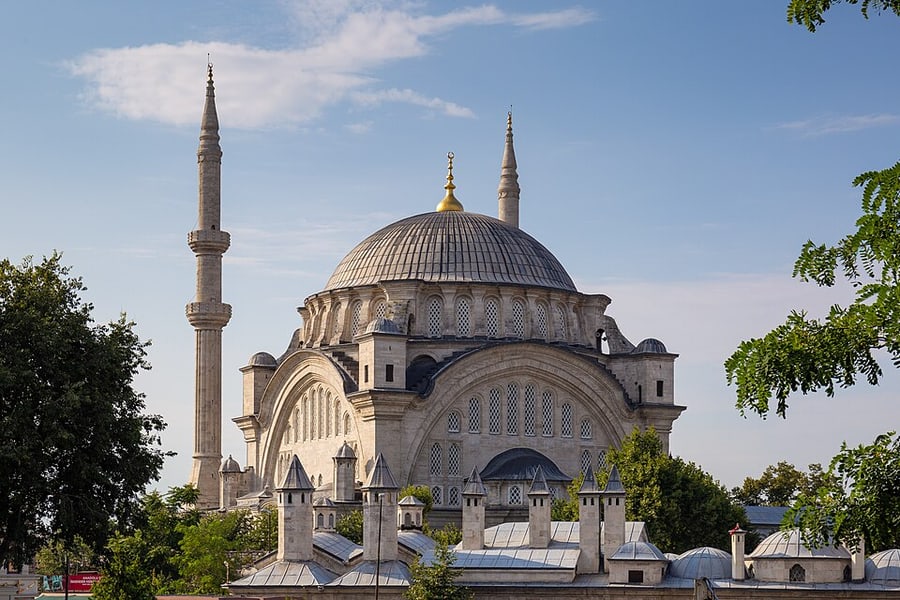
The layout of the complex was designed very differently from the imperial complexes of the classical period. Because the mosque was built on sloping ground, a basement, perhaps intended as a market, was left beneath the terrace on which the courtyard and the mosque stand. The arcaded courtyard, reached by stairs from the outer courtyard, was built for the first time in Turkish art in a semicircular shape; since there is no ablution fountain in its centre, the ablution taps were placed in the outer courtyard. The square prayer hall is covered by a single dome 25.50 metres in diameter, whose weight is distributed over four great arches. There are two cut-stone minarets with fluted shafts and two balconies each.
According to the author of the article, the European Baroque style that entered Turkish art in the 18th century shows itself very strongly in this mosque: apart from the shape of the space, the form of the courtyard, the profiles of the arches, the door niches, the plaster windows, the mihrab and the minbar were made in the Baroque manner. The only element that continues tradition is the inscriptions written by the best calligraphers of the period. The author regards the Nuruosmaniye as an example of an entirely new architectural approach that left its mark on the city.
The other buildings of the complex
The complex consists of the mosque, a royal pavilion, a madrasa, a library, a tomb, a sebil, a fountain, a kitchen-imaret and shops. The royal pavilion is reached by a great ramp on the east side. The madrasa and the imaret, built in 1755 according to their inscriptions, are on the qibla side; the madrasa has twelve student rooms and a classroom. In the madrasa, whose endowment deed required the teaching of writing, the calligraphers Abdullah Zühdi Efendi and Arif Efendi of Filibe (Plovdiv) taught calligraphy for years. The library, with its original plan, was arranged in keeping with the Baroque approach, with a columned reading hall.
In the square-plan tomb lies Şehsuvar Valide Sultan, the mother of Osman III; between the tomb and the royal pavilion are buried Hibetullah Sultan and a daughter and nine sons of Mahmud II who died between 1809 and 1824. The complex's water was supplied by the Nuruosmaniye water channel, bringing water from the Halkalı springs.
The present state
As the author of the article reports, the basement beneath the terrace has never been used to this day. The lead caps of the minarets were replaced at the end of the 19th century with the present stone caps. The sebil and the fountain outside the gate opening onto the Grand Bazaar are elegant examples of Turkish Baroque art; however, since the eaves of the sebil were removed years ago its beauty cannot be fully seen, and the fountain, whose stones are worn, is in a very ruined state.
Source: TDV Encyclopedia of Islam (TDV İslâm Ansiklopedisi), “NURUOSMANİYE KÜLLİYESİ” (Semavi Eyice)
Related sultans
Cite as: Atlas of the Sultans, “Nuruosmaniye Complex · Ottoman monuments”, https://padisahlaratlasi.com/en/monuments/nuruosmaniye-complex/ (last updated 21 November 2026). Corrections · Image credits