TRENDEFRARAtlas of the Sultans · Ottoman monuments
Cağaloğlu Hamam
Monument · Bathhouse, Istanbul, 1741–1742
- Type
- Bathhouse (hammam)
- Built
- 1741–1742
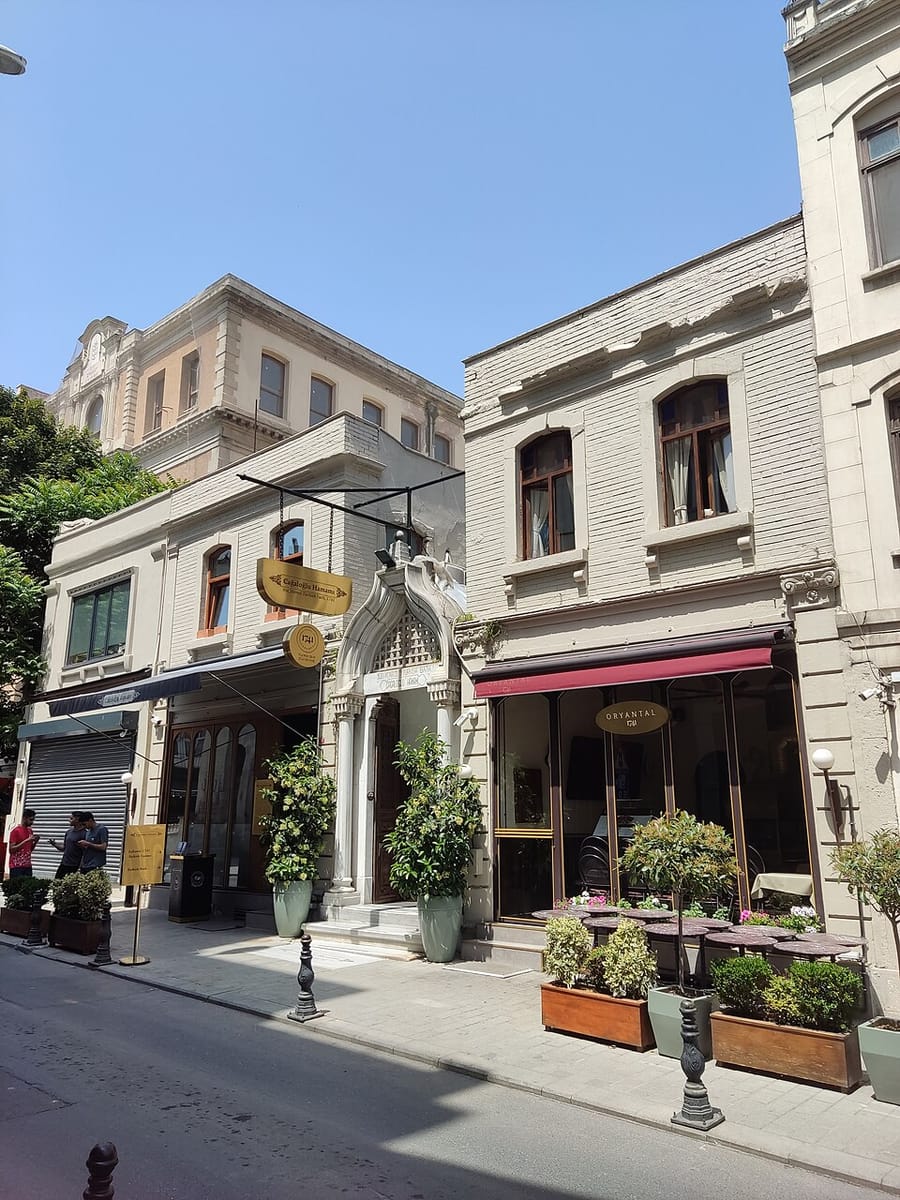

A bath endowed for the Hagia Sophia library
Standing on Yerebatan Street, which runs from Hagia Sophia Square to Cağaloğlu, this bathhouse (hamam) was built by Sultan Mahmud I to provide income for the library he had founded inside the Hagia Sophia Mosque. Both the neighbourhood and the bath take their name from Cağaloğlu Sinan Pasha, whose mansion stood nearby. Imperial orders of 1740 show marble being brought from the island of Marmara for the works, while the verse inscription above the door states that Mahmud I built it in 1741–42. H. Glück, who studied the bath in 1916–17, cautiously reports the operator's claim that it was the work of an architect named Hüsrev.
It is a double bath with separate men's and women's sections. The men's dressing hall, 14 × 14 metres, is covered by a large dome and has a Baroque marble fountain basin at its centre. The hot room has a layout found in no other Turkish bath: an octagon formed by eight columns, extended on three sides by domed iwans, with four private cubicles in the corners. Its Baroque details mark the beginning of foreign artistic currents in Turkish art. After Mustafa III banned the building of new baths in the city in 1768, it remained the last of Istanbul's great public baths. The hamam is still in operation today.
Building records
Archival documents published by Ahmed Refik show how construction proceeded. An order of June 1740 instructed the deputy judge of Marmara Island to bring down columns and other marble from the quarry, because the marble already brought to the landing was not enough. Another order of the same year asked that part of the water brought from the Great Dam (Büyük Bent) be allotted to the bath from the Hagia Sophia distribution tank, and a renewed request for marble towards the end of the year shows that the work was not yet finished. A rumour that the engraving by Thomas Allom in R. Walsh's book, published in 1838, depicts this bath suggests that foreigners were already visiting it at that time.
The men's and women's sections
Because the street level has risen, the men's section is reached by descending steps; in front of the entrance is an outer door with an oddly shaped marble arch that fits no period of Turkish architecture. The transition to the dome of the changing hall is made by scalloped squinches, and a lantern opens at the centre of the dome. In the warm room four columns create nine bays, wide in the middle and narrow at the sides; the column capitals have volutes at their upper corners, oval medallions in the middle and a baroque four-leaf ornament. The hot room, a square space of 12.50 metres a side, is entered only through a door 0.70 metres wide. The women's section is entered from a side street; the corner cubicles of its hot room are not separated by screen walls. A water tank runs the full length outside both sections.
Its place in bath architecture
Semavi Eyice regards the Cağaloğlu Bath as a highly distinctive and innovative example of the variant of the four-iwan, four-cubicle type represented by the baths of the Süleymaniye, Çemberlitaş and the Yeni Hamam in Iznik. He finds it regrettable that a building known clearly to be a sultan's endowment has not received the care it deserves in private ownership, and considers it a serious gap that no better survey has yet replaced the very incomplete plan Glück was able to draw in 1917 because of various difficulties.
Source: TDV Encyclopedia of Islam (TDV İslâm Ansiklopedisi), “CAĞALOĞLU HAMAMI” (Semavi Eyice)
Related sultans
Cite as: Atlas of the Sultans, “Cağaloğlu Hamam · Ottoman monuments”, https://padisahlaratlasi.com/en/monuments/cagaloglu-hamam/ (last updated 21 November 2026). Corrections · Image credits