TRENDEFRARAtlas of the Sultans · Ottoman monuments
Old Mosque (Edirne)
Monument · Mosque, Edirne, 1402–1413
- Type
- Mosque
- Built
- 1402–1413
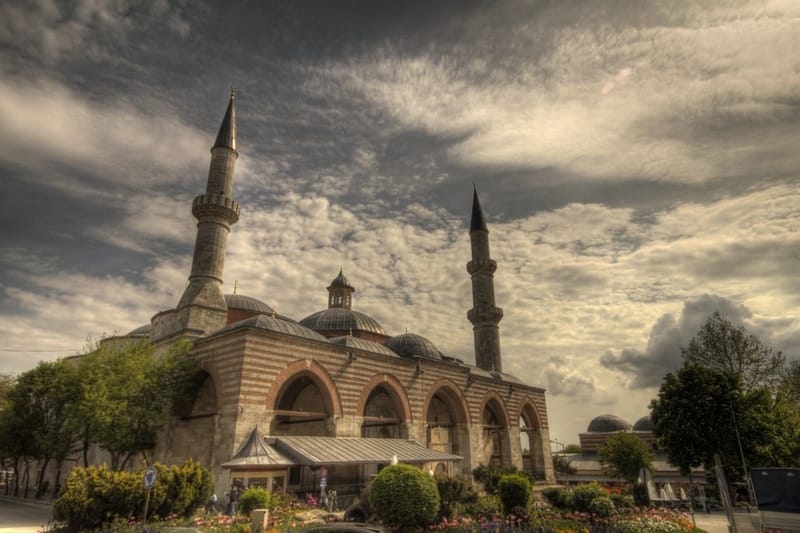

Edirne's nine-domed mosque
Construction of the Old Mosque (Cami-i Atik), also popularly called the Great Mosque (Ulucami), was begun in 1402–03 by Emir Süleyman Çelebi and completed in 1413 by Sultan Mehmed I (Çelebi Mehmed). An Arabic inscription over the main portal gives Mehmed's name and the date of construction, while an inscription over the west door names the architect Hacı Alaeddin of Konya and his foreman Ömer b. Ibrahim. With its covered market (bedesten), madrasa, timekeeper's house and sebil, the mosque formed a small complex, and it belongs to the group of multi-unit great mosques.
The square mosque of dressed stone is covered by nine domes carried on four massive piers; as in the Great Mosque of Bursa, the domes of the central row are higher. Inside are a wooden gallery dated 1611, rich painted decoration and calligraphy, a stone said to have been brought from the Kaaba, and a preaching chair that belonged to Hacı Bayram-ı Veli. Damaged by a fire in 1748 and an earthquake in 1752, the mosque was repaired by Mahmud I in 1753 and again in 1865 under Sultan Abdulaziz. The old minaret, damaged in the 1953 earthquake, was rebuilt in 1965.
Domes and interior
The mosque has no courtyard and is entered through three doors. The domes on octagonal drums along the mihrab axis are carried by prismatic triangles and squinches, while the other domes on round drums rest on pendentives. The eight-segmented dome at the entrance is topped by a lantern. The wooden gallery of 1611 was commissioned by Ramazan Agha of Plovdiv and bears Edirne-style lacquer decoration. The geometric ornament on the sides and steps of the marble minbar is remarkable.
The stone popularly called the Kaaba stone is visited especially on holy nights. The preaching chair of Hacı Bayram-ı Veli was never used again out of respect for his memory and has become a kind of shrine in the eyes of the people. The five-bay portico along the north front has a dome in the centre and cloister vaults at the sides; built of alternating stone and brick courses, it has windows with geometric and floral ornament. A special installation is known to have once provided the congregation with hot water for ablutions in winter.
The two minarets
The mosque's original minaret stands at the right corner of the portico; it has a single balcony, and its base is reached by a stair inside the wall. The two-balcony minaret, thought to have been added later by Murad II, stands detached on the north-west; a fountain is set into its square base, whose corners carry cylindrical projections with muqarnas brackets and conical caps. The upper parts of the minaret shafts took their present form after 1752. The sword-girding ceremony of Ahmed II, who never went to Istanbul during his reign, was held in this mosque.
Other units of the complex
After the Üç Şerefeli Mosque was built, this mosque came to be called Cami-i Atik, the Old Mosque. The bedesten that Mehmed I built in 1418 as an endowment for the mosque is among the largest of its kind: the rectangular building of alternating stone and brick has four doors and is covered by fourteen domes in two rows; it was repaired in 1897–98 and in 1965.
On the outer face of the three-sided sebil north-east of the mosque is a Qur'anic inscription of 1781 in large thuluth by Nakkaşzade Mehmed; the sebil is now used as a bookshop. The timekeeper's room built in 1826 disappeared because of road construction. The madrasa, also called Medrese-i Atika, has not survived, so its architecture is unknown.
Source: TDV Encyclopedia of Islam (TDV İslâm Ansiklopedisi), “ULUCAMİ” (Nesrin Çiçek Akçıl)
Related sultans
Cite as: Atlas of the Sultans, “Old Mosque (Edirne) · Ottoman monuments”, https://padisahlaratlasi.com/en/monuments/old-mosque-edirne/ (last updated 21 November 2026). Corrections · Image credits