TRENDEFRARAtlas of the Sultans · Ottoman monuments
Basketmakers' Kiosk
Monument · Pavilion, Istanbul, 1643
- Type
- Palace and pavilion
- Built
- 1643
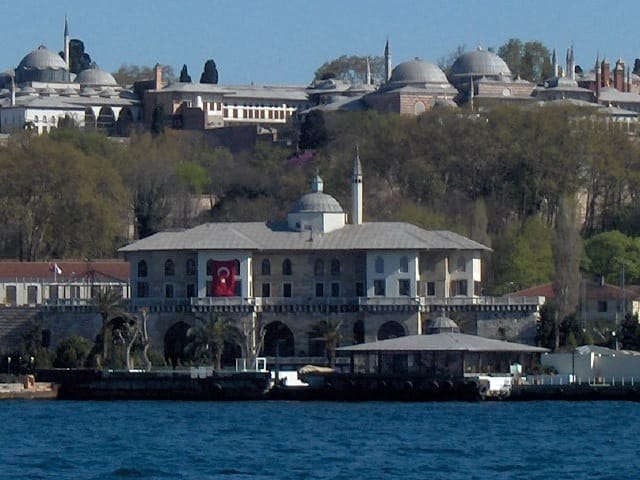

A shore pavilion at Seraglio Point
Standing on the sea walls of Seraglio Point (Sarayburnu) facing the Golden Horn, in the outer gardens of Topkapı Palace, this pavilion (kasır) was built in 1643 at the order of Sultan Ibrahim, during the tenure of Kasım Ağa as chief court architect. A smaller kiosk is known to have stood on the site earlier. It probably takes its name from the basketmakers who worked in the area; according to tradition, their guild shared the building costs out of gratitude to Sultan Ibrahim, who was known for his interest in basketry. Its boathouse held the imperial barges, and it is thought to have been built so that the dynasty and the women of the harem could watch naval ceremonies.
Raised on bases added to the city wall above a substructure of arches and vaults, the pavilion contains a domed square audience hall with bay projections on three sides, an entrance section and a room with a single projection. It was repaired many times between the 17th and 19th centuries; in the 1739 repair a private prayer enclosure was added for Mahmud I, while the open, colonnaded hall was closed in by the mid-19th century. Once used as a pharmacy store of the Gülhane Military Medical School, it was restored in the 1960s; since the 1980 repair its lower floor has served as a restaurant and its upper floor as the International Press Centre.
The earlier pavilion and its rooms
Together with the Yalı Köşkü on the same shore, which has not survived, the pavilion was one of the two shore pavilions at Sarayburnu. Late 16th-century expense registers of the Yalı Köşkü show that another shore pavilion stood on the site of the present building. The historian Naima also writes that the small pavilion here was rebuilt on a larger scale as a kiosk in the manner of an imperial tent. The sultans set out to sea from this shore, and musical gatherings were held in the divanhane (main hall).
Documents from the 1739 repair list the pavilion's units one by one: a maksure (screened enclosure), a large domed room, sofas facing the sea, the garden and the middle, an imperial throne facing the sea, an ablution room with a small room beside it, an ağa's room, a lavatory and a room for the chief eunuch (Darüssaade ağası). Despite many repairs, the building kept these units until the mid-19th century.
The divanhane and the façades
The main walls of the divanhane are of masonry, while its projecting bays are timber with brick infill. The sea-side bays do not appear in James Robertson's photograph from the mid-19th century, so they are thought to have been renewed later, perhaps added in the 1739 repair. The lower windows are rectangular with marble frames, the upper ones pointed-arched. The section in front of the domed room is entered through a flat-arched door of green marble bearing a six-line building inscription. In the earliest known engraving, by Josephus Grelot, the dome is drawn large with a tall lantern. The marble-columned arcade of the open divanhane is clearly visible in John Frederick Lewis's engraving of 1835.
The exterior, now quite plain, has no decoration apart from an hourglass carved in marble at the corner of the door. It has been suggested that the façades were originally faced with marble slabs and tiles or decorated with painted ornament; decoration on the outer face of the closed divanhane can be made out in a panorama of 1794 in the Franz Babinger collection.
Painted decoration and furnishings
At the centre of the divanhane dome is an eight-pointed star, surrounded by gilded medallions decorated with flowers in vases and by floral motifs. The corners of the dome, once coffered, now show landscape paintings in gilded medallions. 18th-century expense registers also record the richness of the interior: curtains of Chios cloth at windows with mother-of-pearl inlaid shutters, velvet cushions with gold thread, red broadcloth mattresses and crystal lamp shades.
Source: TDV Encyclopedia of Islam (TDV İslâm Ansiklopedisi), “SEPETÇİLER KASRI” (Tuğba Erzincan)
Related sultans
Cite as: Atlas of the Sultans, “Basketmakers' Kiosk · Ottoman monuments”, https://padisahlaratlasi.com/en/monuments/basketmakers-kiosk/ (last updated 21 November 2026). Corrections · Image credits