TRENDEFRARAtlas of the Sultans · 28 / 39 · sultan
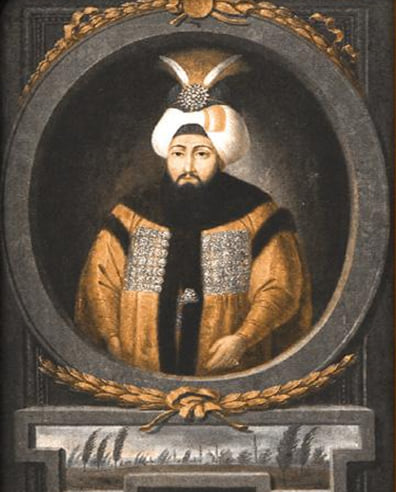
Imaginary portrait (made later) — Konstantin Kapıdağlı · c. 1804–06
Osman III
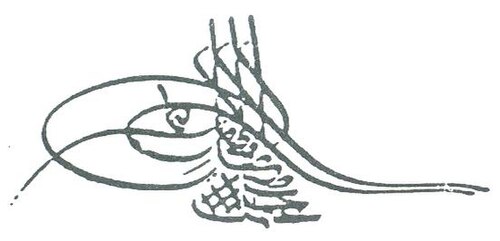
In his three-year reign there were no campaigns and the borders did not change. Fifty-one years in the ‘cage’ left their mark on his style of rule; he is remembered for frequent changes of grand vizier.
Open the reign of Osman III on the map▶ Watch the 1-minute video: YouTube · Instagram · TikTok
Interesting fact
He spent longer than any other prince in Ottoman history in the Şimşirlik apartments (the “cage”) and came to the throne in 1754 at the age of fifty-eight. During those years he made small portable writing desks called piştahta.
Source: TDV İslâm Ansiklopedisi (Turkish), article “OSMAN III”
Life
Fifty years in the Cage
Osman was born in the Edirne Palace on 3 January 1699. His father was Mustafa II and his mother Şehsuvar Valide Sultan. When his father was deposed in the Edirne Incident of 1703, he was sent, at the age of four, to the Şimşirlik quarters of Topkapı Palace, and he remained there for about fifty years, including the reign of his elder brother Mahmud I.
Little is known about this long confined life beyond the fact that he made small portable writing desks called “piştahta” and small chests (çekmece). According to the TDV article, he was the prince who spent the longest time in the Şimşirlik in Ottoman history.
Sultan at fifty-eight
When his elder brother Mahmud I died on 13 December 1754, he came to the throne at the age of fifty-eight. His first task was to choose the officials he would work with; but throughout his three-year reign he made very frequent changes in the senior posts, above all the grand vizierate. These changes can be seen as an attempt to reduce the weight of the grand viziers. Hekimoğlu Ali Pasha was dismissed after fifty-three days, at the same time as the Ayvansaray fire, and was spared execution through the intercession of the valide sultan; another grand vizier was executed. The last grand vizier of the reign was Koca Ragıb Pasha, who took office in 1757.
Harsh measures were taken in the provinces as well: steps were taken against the bandits around Erzurum and Sivas, and the famous ayan (provincial notable) Karaosmanoğlu Hacı Mustafa Ağa was captured and executed.
A strict order
Osman sought to regulate social life with strict rules. The prohibitions concerning women's dress and their going out in public continued; young women in particular were required not to walk about in “fashionable” clothes, to wear loose cloaks (ferace) and to go out only on necessary business. The old rules on the dress and mounts of non-Muslims were reiterated. The court chronicler Hâkim Mehmed Efendi writes that on the tours the sultan made in disguise, he had some people who broke these rules hanged.
His short reign was marked by great fires. In 1755 four great fires broke out in Istanbul; of these, the Hocapaşa and Cibali fires were a disaster for the walled city. The sultan was present at the scene of all four. He also visited the Arsenal (Tersane) and, for the casting of cannon, the Tophane.
The Nuruosmaniye and his death
Despite his short reign, Osman commissioned many charitable works. He had the unfinished parts of the Nuruosmaniye Mosque and Complex, whose foundations had been laid by his elder brother Mahmud I, completed, and opened it with a grand ceremony on 5 December 1755; the mosque was named after him. Regarded as the first great work of the Ottoman Baroque, this building opened a new chapter in the architectural appearance of Istanbul.
Because of a stomach ailment, in his last weeks he could attend the Friday procession (cuma selamlığı) only with difficulty. He died on 30 October 1757; some Western sources write that he died after an operation to remove a tumor on his thigh. Instead of in his own tomb at the Nuruosmaniye, he was buried in the tomb of Turhan Valide Sultan at the Yeni Cami. He was succeeded by his cousin Mustafa III, the son of Ahmed III.
Source: TDV Encyclopedia of Islam (TDV İslâm Ansiklopedisi), “Osman III” (Fikret Sarıcaoğlu); the main sources of this article are the court chronicler (vak'anüvis) Hâkim Mehmed Efendi, Şem'danizade, the Ruzmerre records and documents in the Prime Ministry Ottoman Archives (Başbakanlık Osmanlı Arşivi).
Meanwhile in the world
Contemporary rulers
- Louis XVKing of France · 1715–1774Successor of Louis XIV; lost most colonies in the Seven Years' War
- Maria TheresaArchduchess of Austria, Queen of Hungary and Bohemia · 1740–1780Habsburg ruler known for wide-ranging administrative reforms
- Frederick II (the Great)King of Prussia · 1740–1786Seized Silesia and made Prussia a major European power
- Elizabeth (Yelizaveta Petrovna)Empress of Russia · 1741–1762Daughter of Peter the Great; took power in a 1741 coup
- George IIKing of Great Britain · 1727–1760Second Hanoverian king of Great Britain, also elector of Hanover
- Ahmad Shah DurraniRuler of the Afghans (Durrani dynasty) · 1747–1772Regarded as the founder of the modern Afghan state
- QianlongEmperor of China (Qing dynasty) · 1735–1796Fourth Qing emperor, who ruled for six decades
What was happening in the world?
- 1754The French and Indian War between Britain and France began in North America (1754–1763).
- 1755Samuel Johnson's two-volume Dictionary of the English Language was published in London.
- 1755On 1 November an earthquake and tsunami destroyed about two-thirds of Lisbon, killing tens of thousands.
- 1756After France and Austria became allies, Frederick II invaded Saxony and the Seven Years' War began.
- 1757Robert Clive defeated the Nawab of Bengal at Plassey, often seen as the start of British supremacy in India.
Sources: britannica.com [1] [2] [3] [4] [5] [6] [7] [8] [9] [10] [11] [12]
Family
| Father | Mustafa II |
|---|---|
| Mother | Şehsuvar Sultan |
| Consorts | Ferhunde Kadın, Leyla Kadın |
| Children | He had no children |
Major achievements
- Enthroned after fifty-one years in the ‘cage’ — the longest wait in the dynasty's history
- Nuruosmaniye Mosque completed (1755)
- Rebuilding after the great fires of Istanbul
Treaties
None recorded.
Grand viziers
| Name | From | To | Length |
|---|---|---|---|
| Köse Bahir Mustafa Pasha | July 1, 1752 | February 16, 1755 | 2 years, 230 days |
| Hekimoğlu Ali Pasha (term 3) | February 15, 1755 | May 18, 1755 | 92 days |
| Naili Abdullah Pasha | May 18, 1755 | August 24, 1755 | 98 days |
| Bıyıklı Ali Pasha | August 24, 1755 | October 25, 1755 | 62 days |
| Yirmisekizçelebizade Mehmed Said Pasha | October 25, 1755 | April 1, 1756 | 159 days |
| Köse Bahir Mustafa Pasha (term 2) | April 1, 1756 | January 12, 1757 | 286 days |
| Koca Ragıb Pasha | February 28, 1757 | April 8, 1763 | 6 years, 39 days |
Death
He died of a stroke in Topkapı Palace in 1757.
Territorial change
The lands that changed hands in this period, and the battles or treaties that brought the changes, can be seen on the map: map of the reign of Osman III.
Cite as: Atlas of the Sultans, “Osman III: Reign Map, Wars and Conquests (1754–1757)”, https://padisahlaratlasi.com/en/sultans/iii-osman/ (last updated 21 November 2026). Corrections · Image credits
Terms on this page: Grand vizier · Vizier
Grand viziers of this reign: Hekimoğlu Ali Pasha · Koca Ragıb Pasha
Monuments of this reign: Mahmut Pasha Mosque · Nuruosmaniye Complex · Madrasa Slimania