TRENDEFRARAtlas of the Sultans · Ottoman monuments
Sultan Mustafa Mosque (Rhodes)
Monument · Mosque, Rhodes, 1765
- Type
- Mosque
- Built
- 1765
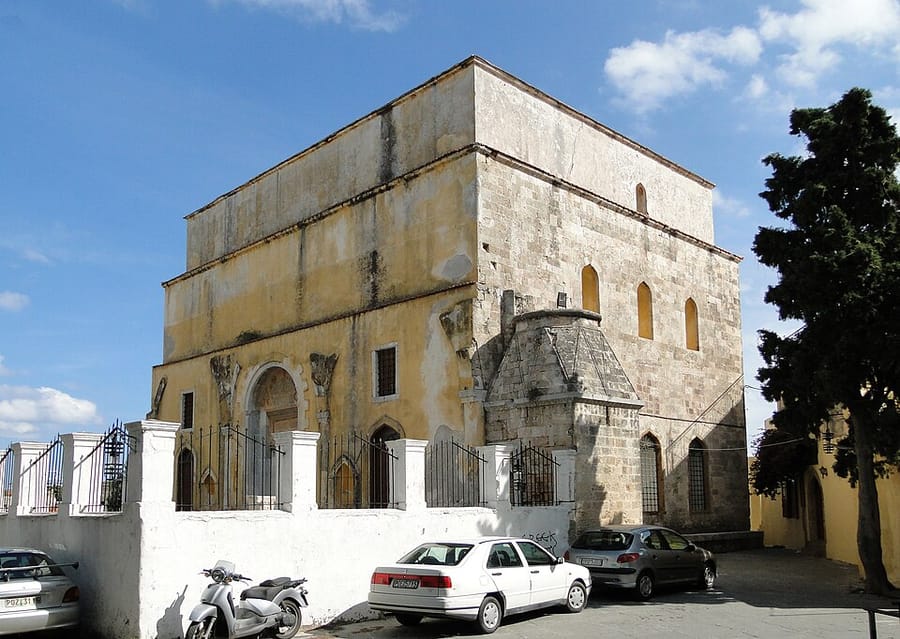

A sultan's mosque inside Rhodes castle
Construction of this mosque, on a square within the walled town of Rhodes, was begun by Ebubekir Pasha in 1610–1620, but the building was left unfinished. Later, Sultan Mustafa III ordered its completion and the construction of a bathhouse to provide it with income; according to the inscription over the main door, the mosque dates from 1765. Its almost square prayer hall is covered by a tall dome, resting on two free-standing columns to the north and on the mihrab wall, and by vaults on three sides. The mihrab framed by Ionic columns and the painted decoration with C-scrolls are features of the late Ottoman period.
Badly damaged in the earthquakes of 1856 and 1863, the mosque was repaired at various times. The minaret, destroyed in 1863 and rebuilt, was pulled down in 1973; only its base survives, and the porticoes in front have also been lost. After the island passed to Greece, the mosque was closed to worship for lack of a congregation; for some time it has been used for the wedding ceremonies of the Turks of Rhodes. The nearby Sultan Mustafa Bath, also known as the Yeni Hamam or Süleymaniye Hamam, is one of the largest surviving bathhouses in Greece.
Portal and porticoes
The mosque's courtyard, enclosed by iron railings, is reached by a few steps. The portico on the north façade, now lost, rested on four columns and had pointed arches and three domes; it was surrounded on three sides by a second, U-shaped portico under a sloping roof, carried at the front on small wooden posts. Above the two-couplet date inscription over the main portal, the word mashallah in the centre is flanked by reliefs of flowers in vases; the wooden door leaves are notable for their fine workmanship. The side panels of the marble minbar bear rose motifs, and the lunettes of the lower windows a crescent motif.
Minaret and fountain
According to the sources, at the beginning of the 20th century the minaret had a single balcony and a conical cap; in the 1930s it was 30 metres high, with a cylindrical shaft and a ringed spire. The ablution fountain in the square outside the courtyard was once covered by a dome carried on eight columns with volute capitals. Each face of its twelve-sided marble water tank is carved with a cypress on either side of the tap and vases decorated with roses, tulips and carnations above them; only this tank survives, in a ruined state.
The Sultan Mustafa Bath
One of the three Turkish baths in Rhodes that survive today, the building was built as a single bath; a section was later added in place of its water tank and assigned to women. The 13 × 13-metre changing hall of the men's section is covered by a dome nearly 13 metres in diameter; its shell-decorated squinches and borders with chain, flower and leaf motifs are noteworthy. The three-iwan warm room contains a water-filled pit known as the Jewish pool, found in baths in places with large Jewish communities. Damaged in the 1863 earthquake, the bath had its plan largely altered by the repairs of 1873 and 1893.
Related sultans
Cite as: Atlas of the Sultans, “Sultan Mustafa Mosque (Rhodes) · Ottoman monuments”, https://padisahlaratlasi.com/en/monuments/sultan-mustafa-mosque-rhodes/ (last updated 21 November 2026). Corrections · Image credits