TRENDEFRARAtlas of the Sultans · Ottoman monuments
Büyük Yeni Han
Monument · Inn (han), Istanbul, 1761–1763
- Type
- Inn and caravanserai
- Built
- 1761–1763
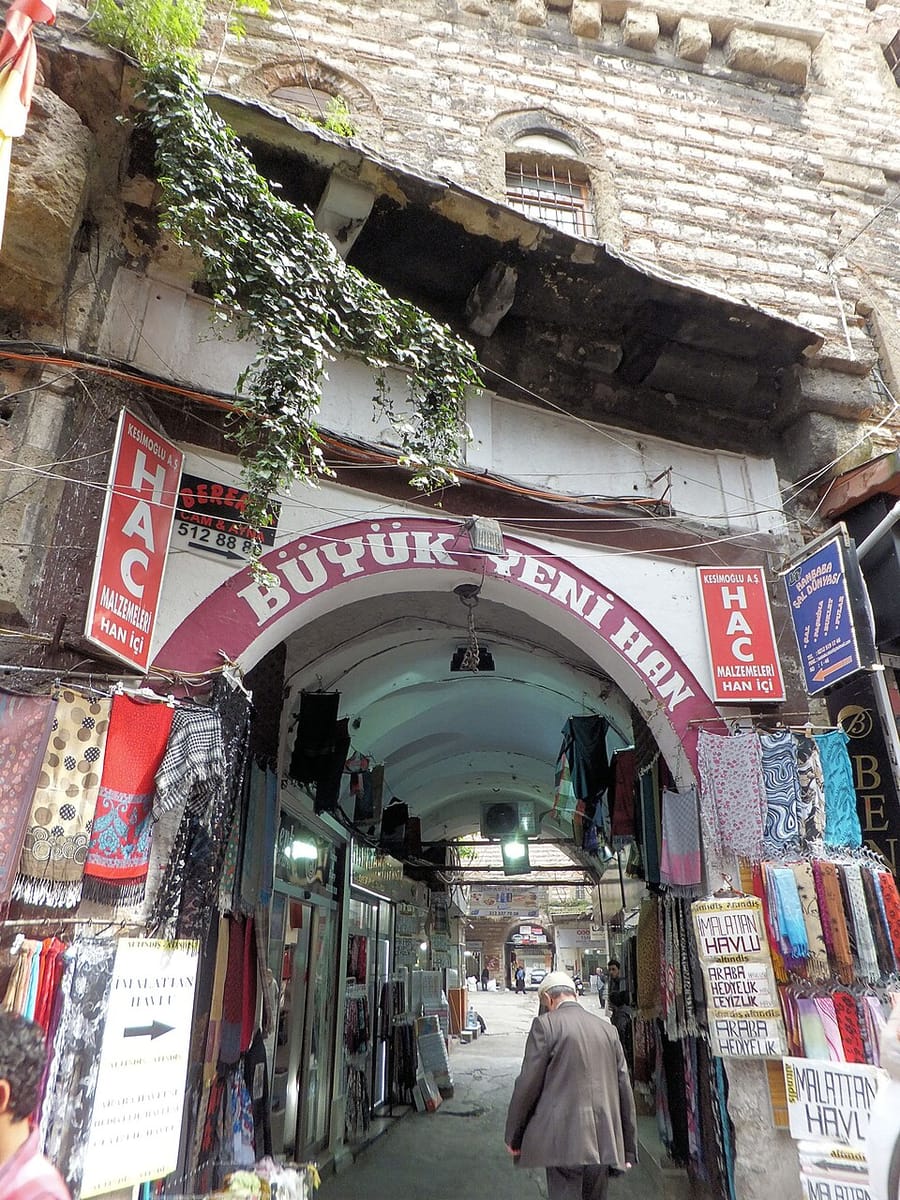

A three-storey commercial han
Standing on Çakmakçılar Yokuşu opposite the Büyük Valide Han, the Büyük Yeni Han was built by Sultan Mustafa III to provide income for his foundations. Its exact date is uncertain: a yearbook printed in 1817 gives 1761, while the date 1763–64 appears beneath the birdhouse on a corner of the building; work may therefore have begun in 1761 and been completed in 1763. Its neighbour, the Küçük Yeni Han, was built at the same time. The han was long used by money-changers, and the Emniyet Sandığı (a public savings and loan bank), opened in 1868, occupied rooms on its upper floor until 1927.
Built of cut stone and brick in a mixed technique, the han is arranged around two rectangular courtyards on a narrow, steeply sloping site, and unusually it has three storeys. On the façade facing the slope, the top-floor rooms project on stone corbels, following the curve of the street. At the corner of Sandalyeciler Street, high up, is a stone birdhouse flanked by the inscription 'maşallah'. In the 20th century its rooms were taken over by small workshops and weaving shops that damaged the building.
Plan and building technique
Only the lowest floor of the han is entirely of stone. The main entrance is on Çakmakçılar Yokuşu, from which the building extends backwards. Of the two courtyards, the first is 42 m and the second 25 m long, both 15-12 m wide, separated by a connecting wing. The rooms are ranged behind brick round-arched corridors resting on square stone piers and are covered with trough vaults; barrel vaults are used on the upper floor. External shops line the Sandalyeciler street façade. Because of the slope, the rear entrance on Tarakçılar street opens only onto the third floor. The iron-plated wooden gate leaves of the entrance are still in place.
Façade and birdhouse
The upper-floor projections on the façade facing the slope taper to nothing at one corner to follow the curve of the street, and the stone consoles carrying them are carved in gradually diminishing sizes. A similar façade is found at the Hasan Pasha Hanı, built around 1740. At the corner of Sandalyeciler street, the stone birdhouse about one metre wide at the very top was described by Malik Aksel, who mistakenly called the building the Yeni Valide Hanı, as resembling a fairy-tale house, with its coloured but faded ornament and the large 'mashallah' inscriptions on either side; the cells for the birds have lost their shape over time.
Decorated rooms and early depictions
According to C. Bildik, writing in 1948, some rooms were decorated in keeping with the wealth of the merchants and money-changers who worked here: stucco relief ornament, painted Edirne-style decoration and finely made built-in shelves and cupboards; the vault decoration of room no. 34 was especially showy. An engraving by the English artist Bartlett, who saw the han seventy or eighty years after it was built, drawn for Miss J. Pardoe's book, shows the first courtyard lively with merchants and their goods. C. Gurlitt's single-floor plan, published in 1908–1912, is the only drawing of the han.
Source: TDV Encyclopedia of Islam (TDV İslâm Ansiklopedisi), “BÜYÜK YENİ HAN” (Semavi Eyice)
Related sultans
Cite as: Atlas of the Sultans, “Büyük Yeni Han · Ottoman monuments”, https://padisahlaratlasi.com/en/monuments/buyuk-yeni-han/ (last updated 21 November 2026). Corrections · Image credits