TRENDEFRARAtlas of the Sultans · Ottoman monuments
Yavuz Sultan Selim Mosque
Monument · Mosque and complex, Istanbul, 1522
- Type
- Mosque
- Built
- 1522
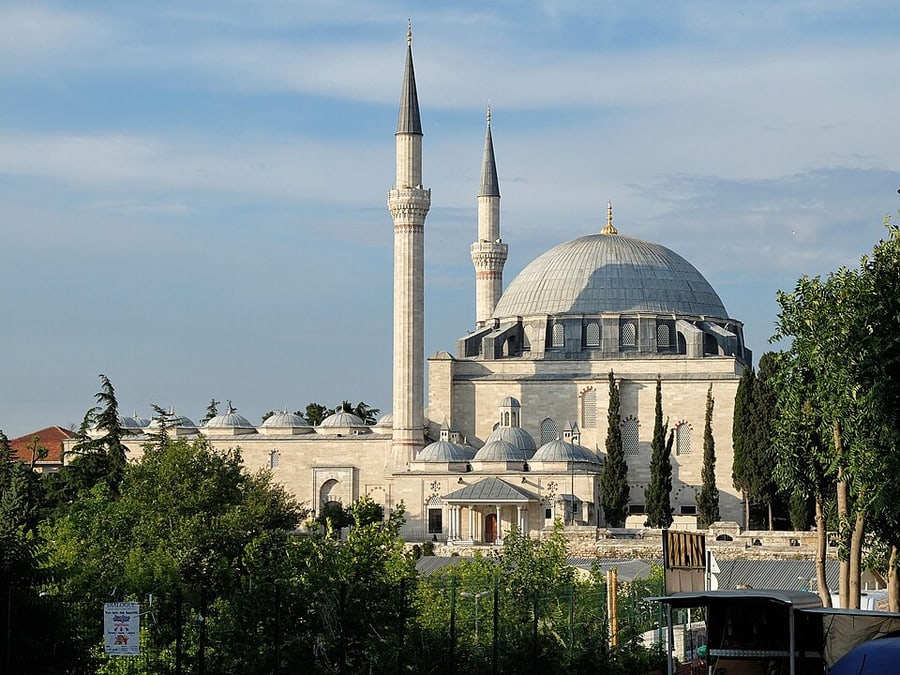

In the name of Kanuni's father
The complex stands on the steep slopes above the Golden Horn, next to the Byzantine open-air reservoir called Çukurbostan. It consists of the mosque, two tabhanes, the tombs of Selim I (Yavuz) and Hafsa Sultan, a tomb of princes, a school and an imaret; a double bath further away is also counted as part of the complex. The inscription above the main portal states that the mosque was built in Muharram 929 (December 1522) by order of Sultan Selim; the tomb inscription records that the tomb was built at the same date by Suleiman the Magnificent (Kanuni). Since Selim died in 1520, the article thinks that he ordered or intended the complex, and that Kanuni completed it out of respect for his father without inscribing his own name.
The mosque, the tabhane, the tomb and the school are thought to have been built by Acem Ali, then chief architect, and the bath and the caravanserai by Mimar Sinan. According to the article, the view that the mosque is Sinan's work is wrong; what Sinan built is the second Sultan Selim complex, at Yenibahçe.
The last of the mosques with tabhanes
Built of cut küfeki limestone, the mosque, with its great dome and two minarets with one balcony each, presents an impressive sight from the Golden Horn, and it is the last example of the mosques with tabhanes. In plan it resembles the Beyazıt (Bayezid II) Mosque in Edirne; its square prayer hall, measuring 24.35 × 24.30 m, is covered by a single dome resting on four great arches concealed in the walls. In the lunettes of the windows of the courtyard and the portico are tile panels in the cuerda seca (coloured glaze) technique, dominated by yellow and green. The door leaves in the kündekari technique and the marble mihrab and minbar are notable for their careful workmanship. The royal lodge in the far left corner stands on seven columns with muqarnas capitals; a small courtyard with two gates was set aside outside for the sultan's private entrance. Of the four gates of the complex, Evliya Çelebi calls the one on the Golden Horn side the Forty Steps (Kırk Merdiven) because of its long, steep stairway.
The tombs
After Selim's death in the village of Sırt, his body was brought to Istanbul; the funeral prayer was led by Zenbilli Ali Efendi in the Fatih Mosque, and he was buried here. In the octagonal tomb of cut stone stands only his sarcophagus; in accordance with his will, the muddy kaftan of Kemalpaşazade was laid over it. The tile panels on either side of the door state that the tomb was built by order of Kanuni in December 1522. Beside it are the ruined tomb of Kanuni's mother Hafsa Sultan, the tomb of princes in which Kanuni's sons and Yavuz's daughters lie, and the tomb of Sultan Abdulmejid, who died in 1861.
Later periods
The imaret of the complex, whose endowment deed is dated 1557, no longer exists; it is said to have collapsed in the earthquake of 1884. In its place a two-storey madrasa was built by the architect Kemaleddin Bey in 1917; in the Republican period the building became the Cumhuriyet Girls' High School in 1924 and, from 1950, the Yavuzselim Girls' Vocational High School. The school was ruined after the fire of 1918 and was repaired in the 1960s and turned into a library. The gilded decoration on the ceiling of the royal lodge was uncovered from beneath oil paint during the restoration around 1937.
Related sultans
Cite as: Atlas of the Sultans, “Yavuz Sultan Selim Mosque · Ottoman monuments”, https://padisahlaratlasi.com/en/monuments/yavuz-sultan-selim-mosque/ (last updated 21 November 2026). Corrections · Image credits